
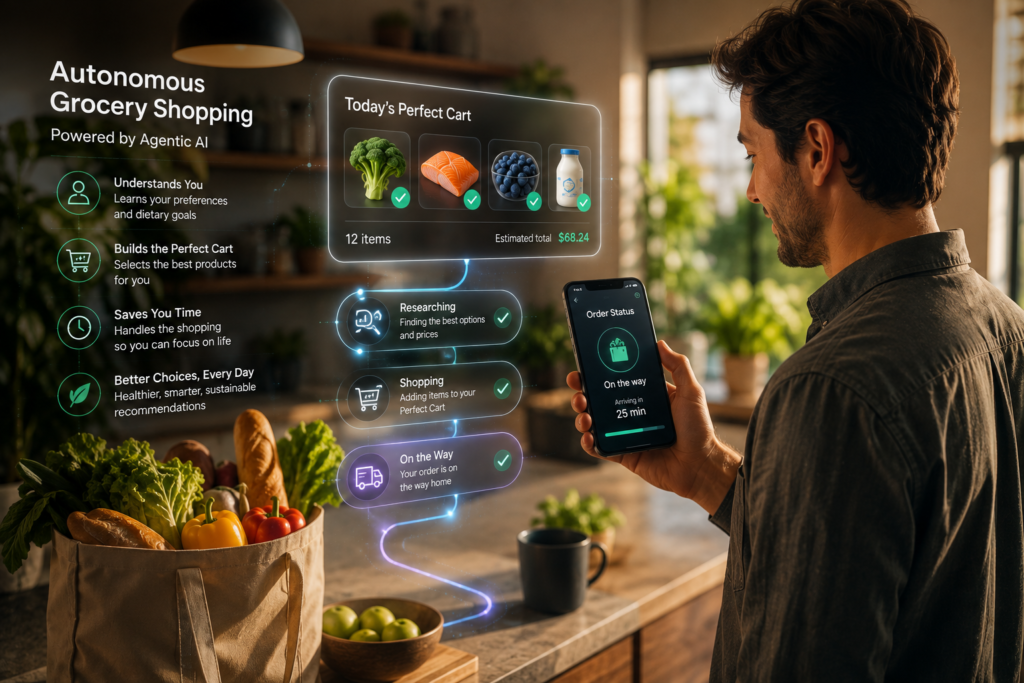
How AI agents, household memory, and the Perfect
Autonomous Grocery Shopping
For more than two decades, digital grocery has made it easier to access a store without fundamentally changing the shopper’s job. Consumers still decide what to cook, remember what is running low, compare products, manage dietary needs, find promotions, choose substitutions, and build the cart one item at a time.
Autonomous Grocery Shopping changes the division of labor. Instead of asking the shopper to operate a digital catalog, an AI agent can understand the household’s goal, create a plan, assemble an appropriate basket, optimize the result, and prepare the order for approval. The shopper remains in control, but no longer performs every repetitive decision manually.
This future is closer than it sounds because many of the required capabilities already exist: conversational interfaces, agentic planning, retailer APIs, real-time inventory, Food Intelligence, Shopper Intelligence, pantry awareness, cart optimization, and digital checkout. The near-term opportunity is not uncontrolled purchasing. It is progressive autonomy: AI does more of the work while retailers and shoppers define permissions, policies, and guardrails.
Definition |
What Is Autonomous Grocery Shopping?
Autonomous Grocery Shopping applies agentic AI to the recurring work of feeding a household. Agentic systems can pursue a goal with limited supervision, use tools and data, make a plan, take actions, evaluate results, and adapt when conditions change.
In grocery, autonomy begins before payment. An AI system is already acting autonomously when it converts a broad goal such as “feed my family this week for under $175” into meals, quantities, products, substitutions, promotions, and a ready-to-review cart. It has moved beyond offering advice and has started completing the mission.
Autonomy is therefore a spectrum, not a binary condition. A shopper might allow an agent to prepare a cart but require approval before checkout. The same shopper may authorize automatic replenishment of routine staples, while requiring explicit review for substitutions, health-related products, expensive items, or sponsored recommendations.
The most useful definition is practical: the AI handles repetitive complexity, the retailer defines the rules, and the shopper controls the outcome.
Level | What the AI Does | Shopper Role | Grocery Example |
1. Assist | Answers questions and recommends options | Makes every decision and builds the cart | Suggests three dinner ideas |
2. Prepare | Creates a plan, list, or draft cart | Reviews and edits the proposed solution | Builds a weekly cart for approval |
3. Act with Approval | Completes approved steps across retailer systems | Approves important actions or exceptions | Applies offers and confirms substitutions |
4. Act Within Guardrails | Executes routine missions within budgets and policies | Monitors and adjusts preferences | Replenishes approved household staples |
5. Delegated Autonomy | Coordinates the full mission, including purchase and fulfillment | Sets goals, permissions, and oversight | Plans meals and submits the order on schedule |
The Evolution from Search to Automation
The history of grocery eCommerce can be understood as a gradual transfer of work from the shopper to the system.
Traditional eCommerce digitized the store. Search and category navigation helped shoppers find products online, but the customer still had to know what to look for and assemble the order manually.
Recommendation engines improved discovery. They predicted products a shopper might like based on purchase history, similarity, popularity, or basket context. Recommendations reduced some friction, but they still presented choices rather than completing the job.
Conversational commerce made the interface easier. Shoppers could express a need in natural language, ask for ideas, or request help. Yet many conversational tools stopped at an answer, leaving the shopper to translate the answer into products and actions.
Agentic Commerce for Grocery adds planning, decision-making, orchestration, and execution. The agent can interpret the goal, connect to retailer systems, evaluate alternatives, and take bounded actions on the shopper’s behalf.
Autonomous shopping is the next step. McKinsey’s analysis of agentic commerce describes an emerging environment in which AI agents increasingly influence discovery, evaluation, cart creation, and transactions. Grocery is especially suited to this shift because so much of the work is frequent, repeatable, and governed by household patterns.
The shift |
Why Grocery Shopping Still Creates So Much Work
Grocery shopping looks like a transaction, but it is really a recurring planning and decision-making process. The purchase is only the final step. Most of the cognitive work happens before checkout.
1. Shoppers Must Translate Outcomes into Products
Consumers usually begin with an outcome: dinners for the week, school lunches, a holiday gathering, healthier breakfasts, pantry replenishment, or a lower grocery bill. Traditional eCommerce forces them to translate that outcome into dozens of product searches and selections.
2. The Decisions Are Interdependent
A grocery basket is a connected system. Choosing a recipe affects ingredients. Choosing a package size affects waste and value. Selecting a substitution can disrupt a meal. Spending more in one category reduces the budget available elsewhere. Optimizing one item at a time can easily produce a poor overall cart.
3. The Household Has Competing Needs
One account may serve adults, children, athletes, seniors, guests, pets, allergies, dietary restrictions, different tastes, and different schedules. The shopper is frequently acting as the planner and purchasing agent for several people at once.
4. The Same Work Repeats Every Week
Many decisions are predictable: staples need replenishment, preferred brands recur, quantities follow household consumption, and familiar meals return. Yet most digital experiences make the shopper reconstruct the order from memory every time.
5. Context Changes the Correct Answer
Inventory, promotions, prices, delivery windows, pantry contents, schedules, weather, and shopper intent can all change. A good cart must adapt in real time rather than repeat last week’s basket without understanding why it worked.
6. Shoppers Need Confidence, Not More Choices
More search results do not reduce uncertainty. Shoppers want confidence that the cart is complete, affordable, compatible with the household, and ready for the meals or occasions they are planning. Autonomous systems create value when they reduce decision burden without removing visibility or control.
How AI-Generated Grocery Carts Work
The most visible expression of Autonomous Grocery Shopping is the AI-generated cart. Instead of beginning with an empty basket, the experience begins with a goal and produces a complete proposed solution.
At Delectable AI, this outcome is called the Perfect Cart: a dynamically generated basket optimized for the household, the shopping mission, and the current retail context.
Step 1: Understand the Mission
The agent identifies what the shopper is trying to accomplish and asks only the clarifying questions required to proceed. The request may include meals, budget, nutrition goals, number of people, preparation time, preferred cuisines, event timing, or a recurring replenishment mission.
Step 2: Retrieve Household Context
The system retrieves durable preferences and current context, including household composition, accepted brands, dietary restrictions, disliked foods, budget sensitivity, pantry inventory, purchase cadence, saved recipes, and recent intent signals.
Step 3: Understand Food and Products
Autonomous cart building requires more than product names and categories. Nutrition and ingredient knowledge can be grounded in sources such as USDA FoodData Central, while retailer catalogs must connect those food attributes to the products actually available for sale.
Foundational identifiers and structured attributes also matter. GS1 standards help the retail ecosystem consistently identify and exchange product information. Grocery agents then need additional intelligence about ingredients, allergens, dietary compatibility, recipes, substitutions, meal occasions, and household suitability.
Step 4: Create the Plan
The agent decomposes the mission into connected tasks. It may select meals, calculate servings, identify required ingredients, estimate pantry gaps, schedule replenishment, and decide where a product choice affects another part of the basket.
Step 5: Assemble and Optimize the Cart
The agent maps the plan to available SKUs and balances multiple objectives, including preference, budget, nutrition, convenience, promotions, inventory, private-label opportunities, package size, expected waste, and basket completeness.
Step 6: Explain, Confirm, and Execute
The proposed cart should make important decisions visible. The shopper can see why substitutions were made, where savings were found, which items remain uncertain, and what requires approval. Depending on the permission level, the agent can save the cart, schedule the order, apply offers, select fulfillment, or complete the purchase.
Step 7: Learn from the Outcome
Edits are valuable signals. Removing an item, rejecting a substitute, choosing a different brand, changing a meal, or approving a higher price teaches the system how to improve the next mission. Household intelligence compounds when these signals are captured with consent and used responsibly.
Intelligence Input | Agent Action | Cart Outcome |
Household goal | Defines the mission, constraints, and required approvals | The cart is built around an outcome, not a product query |
Pantry and purchase cadence | Estimates what is available and what is likely running low | Fewer duplicates and more accurate replenishment |
Food and recipe relationships | Connects meals, ingredients, substitutions, and quantities | Complete meal solutions rather than isolated products |
Catalog, price, and inventory | Maps needs to available SKUs and current conditions | A cart that can actually be fulfilled |
Promotions and loyalty | Applies eligible savings and evaluates alternatives | Better value without forcing the shopper to hunt for deals |
Policies and permissions | Determines which actions can proceed and which require approval | Useful autonomy with retailer and shopper control |
Household Memory Is the Foundation of Autonomy
An autonomous grocery agent cannot be useful if every session begins as a conversation with a stranger. Grocery decisions become easier when the system remembers what the household has already taught it.
Shopper Intelligence converts transactions, preferences, behavior, explicit goals, and real-time intent into a living understanding of the shopper and household. This is different from a static segment or a simple record of past purchases.
What Household Memory Should Understand
- Who lives in the household and who the current shopping mission is serving
- Foods, brands, cuisines, recipes, and flavors the household prefers or avoids
- Allergies, dietary restrictions, health and wellness goals, and relevant retailer policies
- Budget ranges, price sensitivity, promotion preferences, and private-label acceptance
- Pantry inventory, consumption cycles, staple replenishment patterns, and package-size needs
- Meals that were accepted, recipes that were saved, and items that repeatedly went unused
- Substitutions the household accepted, rejected, or tolerated only under certain conditions
- The immediate mission, including schedule, occasion, urgency, and available cooking time
Memory Must Be Dynamic
A household is not a permanent persona. Preferences change, children grow, budgets tighten, schedules shift, and health priorities evolve. The agent must distinguish durable preferences from temporary context and allow shoppers to correct or remove assumptions easily.
Memory Must Be Permissioned
Retailers should be transparent about what is remembered, why it improves the experience, and how it is used. Shoppers need controls to review preferences, correct errors, manage sensitive information, and decide which missions may be automated.
Household memory principle |
Real-World Autonomous Grocery Shopping Use Cases
1. The Weekly Family Cart
A shopper asks the retailer app to plan five dinners, include school lunches, replenish staples, and keep the total order under a defined budget. The agent reviews household preferences and pantry context, selects meals that share ingredients, builds the cart, applies promotions, and flags two substitutions for review.
2. Pantry-Aware Meal Planning
The shopper wants to use what is already at home. The agent identifies meals that fit the pantry, adds only missing ingredients, recommends ways to use perishable items first, and prepares the remaining grocery order.
3. Routine Replenishment
The system estimates that milk, coffee, pet food, paper products, and several staples are likely running low. It prepares a replenishment cart based on purchase cadence and asks the shopper to approve it. Over time, low-risk items can be authorized for automatic ordering within a weekly or monthly budget.
4. Budget Recovery
The initial basket exceeds the household’s target. The agent identifies lower-cost brands, on-sale alternatives, recipes that share ingredients, package-size changes, and nonessential items that can be deferred. It presents the tradeoffs instead of forcing the shopper to manually rebuild the order.
5. Intelligent Out-of-Stock Resolution
An ingredient becomes unavailable after the cart is built. The agent evaluates the intended recipe, allergen requirements, flavor, nutrition, price, preferred brands, and accepted substitution patterns. It chooses the best replacement or proposes a modified meal if no suitable product exists.
6. Event and Occasion Planning
A shopper is hosting ten people for a game-day gathering. The agent creates a menu, calculates quantities, checks pantry inventory, balances dietary needs, adds beverages and serving supplies, applies promotions, and builds a complete order for the scheduled date.
7. Health-Aligned Shopping with Guardrails
A shopper may ask for higher-protein breakfasts, lower-sodium options, allergen-free snacks, or products aligned with a dietary lifestyle. The system can use verified attributes and clearly explain why products were included. Sensitive decisions should follow retailer policies, confidence thresholds, and appropriate human or shopper review rather than being treated as medical advice.
Food Intelligence is essential across these use cases because the system must understand the relationships among products, ingredients, recipes, nutrition, allergens, flavors, meal occasions, and substitutions rather than merely match keywords.
Autonomous Does Not Mean Uncontrolled
The phrase “autonomous shopping” can suggest a system that buys products without visibility or permission. That is neither the most realistic near-term model nor the most desirable one.
Retailers should design autonomy around risk, reversibility, and shopper preference. Adding an approved staple to a draft cart is low risk. Replacing an allergen-sensitive item, exceeding a budget, using a sponsored recommendation, or submitting a large order has a different impact and should require stronger controls.
A practical autonomous system should provide:
- Clear permission levels by mission, product category, price, and action
- Budget caps, quantity limits, approved brands, and prohibited substitutions
- Explanations for meaningful product choices and tradeoffs
- Disclosure when sponsored products or retailer priorities influence the cart
- Confidence thresholds and escalation when product data is incomplete or conflicting
- Audit trails for automated actions, approvals, edits, and exceptions
- Easy review, correction, undo, and opt-out controls for the shopper
The NIST AI Risk Management Framework offers a useful structure for governing, mapping, measuring, and managing AI risk. Grocery retailers should translate those principles into specific operating rules for data quality, privacy, explainability, sponsored influence, health-related recommendations, substitutions, and purchasing authority.
Design objective |
Retailer Opportunities
Autonomous Grocery Shopping is more than a shopper convenience feature. It can become a strategic layer that changes loyalty, economics, data ownership, and the retailer’s role in the household.
Own the Primary Shopper Relationship
As consumer-facing AI agents become a new front door to commerce, retailers risk being reduced to fulfillment endpoints. A retailer-branded autonomous experience keeps planning, intent, household memory, and purchasing inside the retailer’s ecosystem.
Increase Conversion and Basket Completeness
An AI-generated cart eliminates the empty-cart problem and shortens the path from intent to checkout. Mission-level planning also identifies ingredients, quantities, complementary products, and replenishment needs that shoppers may forget when building orders manually.
Build Loyalty Through Utility
Loyalty becomes stronger when the retailer saves the household time every week. A system that remembers preferences, reduces planning effort, protects the budget, and handles routine work becomes more valuable with continued use.
Create Better First-Party Intent Signals
Autonomous interactions reveal what shoppers are trying to accomplish, not only what they purchased. Goals, clarifications, accepted meals, rejected products, budget tradeoffs, and substitution decisions can improve future personalization, merchandising, and measurement when governed appropriately.
Improve Retail Media Relevance
Retail media can move from broad audience targeting toward mission-aware relevance. A sponsored item can be evaluated in the context of the planned meal, household needs, availability, and value. The retailer must preserve transparency and ensure that monetization improves rather than distorts the cart.
Support Merchandising and Operations
The same intelligence that builds carts can help merchants understand unmet missions, rejected substitutions, pantry gaps, product relationships, and emerging demand. Agents can also coordinate promotions, content, inventory priorities, and fulfillment exceptions around actual shopper intent.
Modernize Without Replacing the Entire Stack
Delectable Commerce demonstrates how autonomous and guided cart building, meal planning, pantry awareness, recipe-to-cart conversion, smart substitutions, and household memory can be embedded into a retailer’s existing website and app rather than requiring shoppers to move to a third-party marketplace.
Retailer Opportunity | Shopper Value | Business Value |
AI-generated carts | Less searching and manual cart building | Higher conversion and more complete baskets |
Household memory | A more relevant experience that improves over time | Retention, loyalty, and richer first-party intelligence |
Meal and pantry orchestration | Fewer duplicates, less planning, and reduced waste | More frequent engagement and mission-level cross-category sales |
Intelligent substitutions | Better continuity when products are unavailable | Higher substitution acceptance and fulfillment satisfaction |
Mission-aware retail media | Promotions that fit the current goal | Higher relevance, ROAS, and retailer-owned media value |
Progressive autonomy | Control over what the agent may do | Adoption with lower risk and clearer governance |
A Practical Path to Autonomous Grocery Shopping
Retailers do not need to automate the entire journey at once. The strongest path is to introduce autonomy in bounded, measurable missions and expand as trust and performance improve.
- Start with a frequent, high-friction mission. Weekly cart building, meal planning, pantry replenishment, and substitutions are strong candidates because the work is repetitive and the value is easy for shoppers to understand.
- Build the intelligence foundation. Connect catalog records to Food Intelligence, Shopper Intelligence, household context, pantry signals, recipes, inventory, pricing, promotions, and retailer policies.
- Integrate the systems required for action. The agent needs controlled access to eCommerce carts, loyalty, catalog, inventory, offers, fulfillment, content, retail media, and analytics rather than operating as an isolated chatbot.
- Define autonomy and approvals explicitly. Establish which actions are automatic, which require confirmation, which are prohibited, and how rules vary by shopper preference, product type, confidence, and financial impact.
- Measure shopper effort and business outcomes. Track time to cart, approval rate, edits, substitution acceptance, cart completeness, conversion, basket economics, retention, and shopper trust.
- Expand progressively. Move from suggestions to draft carts, from draft carts to approved actions, and from approved actions to recurring automation only where the data, policies, and shopper behavior support it.
The retailer should treat every autonomous use case as both a customer experience and an operating system. The front-end interaction may feel simple, but the quality of the result depends on product intelligence, household understanding, orchestration, data governance, and system integration behind it.
The Future Vision
The future of grocery will not arrive as one dramatic moment when shoppers suddenly stop participating. It will emerge through a series of increasingly useful automations.
The Cart Will Be Prepared Before the Shopper Starts
Retailer apps will open with a proposed cart based on the household’s routines, pantry, planned meals, budget, promotions, and current context. The shopper will spend more time reviewing and guiding the cart than creating it from scratch.
Meal Planning and Shopping Will Become One Workflow
Recipes, meal plans, pantry inventory, lists, nutrition goals, promotions, and checkout will converge. The system will understand that deciding what to eat and deciding what to buy are parts of the same household mission.
Autonomy Will Vary by Decision
Routine staples may be replenished automatically. Weekly meals may be prepared for review. Sensitive substitutions, expensive purchases, and unusual missions may require explicit approval. Autonomy will become a configurable household preference rather than a universal setting.
Retailer and Consumer Agents Will Interact
Consumers may use general assistants to express goals, while retailer agents provide authoritative product availability, pricing, loyalty, promotions, fulfillment, and policy. Retailers that make their intelligence and commerce services agent-ready can remain the trusted source of truth and transaction.
The Retailer Will Become a Household Decision Partner
The most important change is strategic. Grocery retailers will no longer compete only on assortment, price, and fulfillment. They will compete on how well they understand the household and how much work they remove from the recurring task of feeding it.
Future outlook |
Conclusion
Autonomous Grocery Shopping is closer than many retailers assume because it does not require a fully independent machine that makes every purchase without supervision. It begins when AI can understand a household goal, coordinate the required decisions, build a complete grocery cart, and prepare or execute the next action within clear permissions.
The technology is only part of the equation. Useful autonomy requires household memory, Food Intelligence, accurate catalog and inventory data, retailer system integration, explainable decisions, and carefully designed guardrails. Without those foundations, automation simply produces faster mistakes.
For shoppers, the opportunity is less planning, searching, comparing, remembering, and rebuilding. For retailers, it is stronger loyalty, higher conversion, more complete baskets, richer intent data, better retail media, and greater control of the customer relationship.
The grocery retailer that wins the autonomous era will not be the one that removes the shopper from the process. It will be the one that removes the work while preserving the shopper’s trust and control.
Frequently Asked Questions
What is Autonomous Grocery Shopping?
Autonomous Grocery Shopping uses AI agents to complete some or all of a grocery mission on behalf of a shopper. The agent can plan meals, create lists, select products, build and optimize a cart, apply promotions, manage replenishment, and complete approved purchasing actions within defined permissions.
How is autonomous grocery shopping different from Agentic Commerce?
Agentic Commerce is the broader model in which AI agents understand goals, make plans, use tools, and take actions across commerce. Autonomous Grocery Shopping is a grocery-specific application that increases the amount of the shopping mission the agent can complete with limited supervision.
Can AI build an entire grocery cart automatically?
Yes. An AI agent can interpret a household goal, retrieve preferences and pantry context, create meal plans, calculate quantities, map needs to available products, apply promotions, choose appropriate substitutions, and prepare a complete cart for review or purchase.
Does autonomous shopping mean the AI buys products without permission?
Not necessarily. Autonomy can range from preparing a draft cart to completing an approved recurring order. Retailers and shoppers should define permissions, budgets, product restrictions, approval requirements, and exceptions for each type of mission.
What data does an autonomous grocery agent need?
Effective grocery agents use catalog and product data, Food Intelligence, household preferences, purchase history, pantry signals, recipes, inventory, pricing, promotions, loyalty eligibility, fulfillment options, and real-time shopping intent.
Why is household memory important?
Household memory allows the agent to remember preferences, allergies, budgets, accepted substitutions, replenishment cycles, meal patterns, and past corrections. Without memory, the shopper must repeatedly explain the same needs and the agent cannot improve over time.
How does pantry awareness improve autonomous shopping?
Pantry awareness helps the agent avoid duplicate purchases, identify replenishment needs, recommend meals using available ingredients, calculate true shopping gaps, reduce waste, and create a more accurate cart.
Can autonomous grocery shopping help shoppers stay within budget?
Yes. The agent can optimize the complete basket by using promotions, private-label alternatives, shared ingredients across meals, package-size tradeoffs, and lower-cost substitutions while explaining the changes required to meet the target.
How can AI handle out-of-stock substitutions?
A grocery agent can evaluate the intended meal, ingredients, allergens, nutrition, flavor, brand preference, package size, price, and prior household acceptance. It can then select a compatible replacement or recommend a modified plan when no suitable substitute exists.
What are the benefits for grocery retailers?
Retailers can reduce shopper effort, improve conversion, increase basket completeness, strengthen loyalty, capture richer first-party intent signals, improve substitution acceptance, create more relevant retail media, and retain greater control of the digital customer relationship.
Do retailers need to replace their current eCommerce platform?
Not necessarily. An intelligence and agentic experience layer can integrate with existing commerce, loyalty, catalog, inventory, pricing, promotion, fulfillment, content, and retail media systems. The key is controlled access to the data and actions required to complete the mission.
How should retailers manage risk in autonomous shopping?
Retailers should define permitted actions, confidence thresholds, budgets, approval rules, data-quality requirements, privacy controls, sponsored-content policies, audit trails, and escalation paths. Shoppers should be able to understand, correct, approve, or undo meaningful automated decisions.
How soon will autonomous grocery shopping become common?
The transition is already beginning through AI meal planning, cart generation, replenishment, conversational shopping, and agentic commerce. Adoption will expand progressively as retailers improve data quality, integration, trust, and shopper controls rather than appearing as an immediate shift to fully automated purchasing.
Ready to explore Autonomous Grocery Shopping? |