
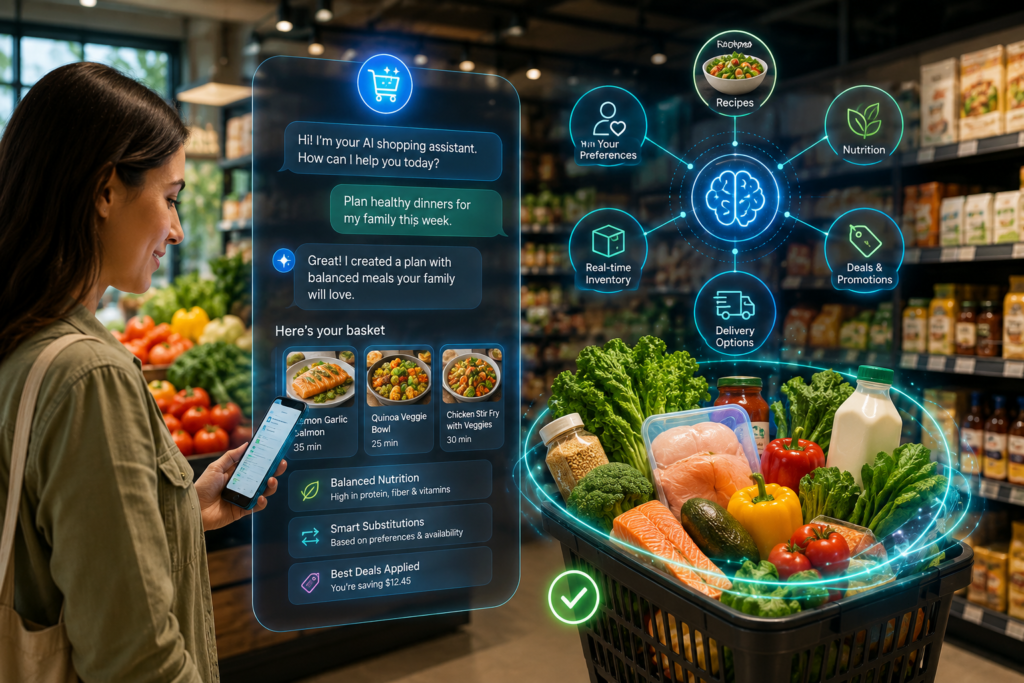
Agentic Commerce represents the next major evolution of digital commerce in the grocery retail industry. Instead of helping shoppers find products, intelligent AI agents help shoppers make decisions, plan meals, optimize budgets, build carts, and increasingly act on behalf of consumers.
This article explores why grocery commerce is uniquely suited for agentic AI, why Food Intelligence and Shopper Intelligence are foundational, how the Perfect Cart becomes possible, and why purpose-built grocery AI will outperform generic AI approaches.
Agentic Commerce for Grocery: A Definition
Agentic Commerce for Grocery is an AI-powered shopping model where intelligent agents understand shopper goals, reason through complex decisions, plan meals, optimize budgets, build carts, and increasingly act on behalf of consumers to simplify grocery shopping.
Unlike traditional eCommerce systems that help shoppers find products, Agentic Commerce helps shoppers achieve outcomes.
A shopper may ask:
- Feed my family for under $175 this week
- Create a high-protein meal plan
- Build my grocery order
- Plan a game-day party
The AI then evaluates food preferences, household needs, recipes, nutrition, promotions, inventory, and budget constraints to create an optimized shopping plan and cart.
In simple terms:
Traditional Commerce helps shoppers find products.
Agentic Commerce helps shoppers make decisions.
Autonomous Commerce will eventually shop on their behalf.
WHAT IS AGENTIC COMMERCE FOR GROCERY?
For more than two decades, grocery eCommerce has focused on helping shoppers find products faster. Retailers invested heavily in search, navigation, recommendations, loyalty programs, mobile apps, and digital merchandising. While these innovations improved convenience, they did not fundamentally change the shopper’s role.
Consumers still spend significant time deciding what to buy, planning meals, comparing products, finding promotions, managing dietary needs, and building carts.
Agentic Commerce changes that equation.
Agentic Commerce for Grocery uses intelligent AI agents that understand shopper goals, reason through complex decisions, and take action on behalf of consumers. Rather than simply presenting choices, AI agents help shoppers achieve outcomes.
Search helped shoppers find products.
Agentic Commerce helps shoppers make decisions.
Autonomous Commerce will eventually shop for them.
THE EVOLUTION OF GROCERY COMMERCE
Traditional Commerce digitized the store.
Conversational Commerce digitized assistance.
Agentic Commerce digitizes decision-making.
Autonomous Commerce digitizes execution.
Industry observers increasingly recognize Agentic AI as the next major evolution beyond generative AI.
Why Agentic Commerce Matters Now
Several trends are converging to make Agentic Commerce possible.
Consumer Expectations Have Changed
Consumers now expect personalized experiences from companies like Amazon, Netflix, Spotify, TikTok, and Google.
These platforms do not simply present options. They actively curate experiences around individual preferences.
Grocery remains one of the last major industries still dominated by search, navigation, filters, and manual decision-making.
AI Has Reached a New Level of Maturity
Recent advances in generative AI, agentic AI, knowledge graphs, and real-time personalization make it possible to automate complex shopping decisions that previously required significant human effort.
Grocery Is Uniquely Complex
Every grocery trip involves hundreds of decisions related to:
- Meals
- Nutrition
- Budget
- Promotions
- Allergies
- Household preferences
- Product availability
This complexity makes grocery one of the strongest use cases for Agentic AI.
The Competitive Pressure Is Increasing
Amazon, Walmart, Instacart, and other digital leaders continue raising consumer expectations through personalization, recommendations, and AI-driven experiences.
Regional and national grocers increasingly recognize that the next competitive advantage will come from intelligent shopping experiences rather than traditional digital merchandising.
WHY GROCERY IS THE PERFECT INDUSTRY FOR AGENTIC AI
Few industries are as well-suited for Agentic AI as grocery.
Most retail purchases are occasional. Grocery shopping happens weekly and often multiple times per week. Every trip involves hundreds of decisions involving budgets, nutrition, allergies, family preferences, recipes, inventory, promotions, and health goals.
At the same time, grocery retailers manage tens of thousands of products across highly complex catalogs.
This combination of frequency, complexity, and personalization creates the ideal environment for Agentic Commerce.
Progressive Grocer and other industry publications continue to highlight personalization and AI-driven shopping experiences as strategic priorities for grocery retailers.
Agentic Commerce vs Traditional Grocery eCommerce
Traditional Grocery eCommerce | Agentic Commerce for Grocery |
Product Search | Goal-Based Shopping |
Browse Categories | Understand Shopper Intent |
Manual Cart Building | AI Cart Building |
Generic Recommendations | Personalized Outcomes |
Static Promotions | Context-Aware Offers |
One-Size-Fits-All Experience | Hyper-Personalized Experience |
Shopper Makes Every Decision | AI Assists Decision-Making |
Transaction Focused | Outcome Focused |
Traditional grocery websites help shoppers navigate catalogs.
Agentic Commerce helps shoppers solve problems.
The difference is subtle but profound.
Instead of asking:
“What products do I need?”
Shoppers can ask:
“What should I eat this week?”
THE FOUR FOUNDATIONS OF AGENTIC COMMERCE
1. FOOD INTELLIGENCE
Food is fundamentally different from other retail categories. Products are not simply items on a shelf. They contain nutrition information, ingredients, allergens, dietary compatibility, flavor profiles, cuisine associations, wellness attributes, sustainability factors, recipe relationships, and health implications.
Traditional grocery catalogs typically contain fewer than ten meaningful attributes.
Food Intelligence transforms product catalogs into intelligent food knowledge systems.
At Delectable AI, FoodHyperGraph™ enriches grocery products with dozens of additional attributes spanning nutrition, allergens, dietary compatibility, flavor, cuisine, health, sustainability, shopper relevance, and meal-planning context.
This allows AI systems to understand food the way a nutritionist, chef, and shopper might understand food.
Food Intelligence enables:
- Better recommendations
- More relevant meal plans
- Improved substitutions
- Health-aware shopping
- More precise advertising
- Better shopper outcomes
2. SHOPPER INTELLIGENCE
Understanding products is only half the challenge.
Retailers must also understand shoppers.
Shopper Intelligence captures:
- Purchase history
- Household composition
- Dietary restrictions
- Health goals
- Brand preferences
- Budget sensitivity
- Shopping patterns
- Saved recipes and meal preferences
- Pantry inventory and consumption patterns
- Real-time intent
Delectable AI’s ShopperHyperGraph™ creates a living understanding of the shopper and household. Over time, it develops memory and context that improve every interaction.
Shopper Intelligence extends beyond understanding who the shopper is. It understands what the household likes to eat, the recipes they return to, the meals they prepare regularly, and what ingredients they already have on hand. Combined with pantry awareness, this allows AI agents to recommend relevant recipes, create personalized meal plans, avoid unnecessary purchases, identify replenishment needs, and build more accurate shopping plans.
This creates the foundation for hyper-personalized shopping experiences.
3. AGENTIC AI
Agentic AI acts as the orchestration layer.
It plans.
It reasons.
It evaluates alternatives.
It makes decisions.
It executes actions.
Examples include:
- AI Meal Planning
- AI Cart Building
- Smart Substitutions
- Budget Optimization
- Promotion Selection
- Shopping Automation
4. HYPER-PERSONALIZATION
The combination of Food Intelligence, Shopper Intelligence, and Agentic AI enables one-to-one personalization at scale.
Every shopper receives a unique experience.
Every cart is personalized.
Every recommendation becomes context-aware.
REAL-WORLD EXAMPLES
Example 1: Feed My Family for Under $175
A shopper says:
“Feed my family of four this week for under $175.”
The AI:
- Creates meal plans
- Selects recipes
- Evaluates pantry inventory
- Builds a cart
- Finds promotions
- Suggests alternatives
- Balances nutrition and cost
Example 2: High-Protein Meal Planning
A shopper says:
“Create a high-protein meal plan under 2,000 calories per day.”
The AI:
- Creates meal plans
- Selects recipes
- Evaluates pantry inventory
- Calculates nutrition
- Builds the cart
- Optimizes protein intake
- Tracks dietary goals
Example 3: Game Day Party Planning
A shopper says:
“I’m hosting ten people Sunday.”
The AI:
- Creates a menu
- Selects recipes
- Calculates quantities
- Evaluates pantry inventory
- Builds the cart
- Applies promotions
- Suggests complementary products
Example 4: Replenish My Household
A shopper says:
“Build my grocery order for the week.”
The AI:
- Reviews pantry inventory
- Identifies replenishment needs
- Evaluates planned meals
- Finds promotions
- Builds the cart
- Suggests healthier alternatives
- Optimizes the basket for value and convenience
THE RISE OF THE AI-POWERED SHOPPING ASSISTANT
Today’s shopping assistants answer questions.
Tomorrow’s shopping assistants will manage entire shopping journeys.
Future assistants will understand:
- Pantry inventory and replenishment needs
- Saved recipes and meal preferences
- Household preferences
- Nutrition goals
- Budget constraints
- Promotions
- Shopping history
“The best shopping assistant doesn’t just understand the shopper. It understands the household.”
The best shopping assistant doesn’t just understand the shopper. It understands the household—including what people like to eat, the meals they prepare regularly, and what is already in the pantry.
By combining recipes, meal plans, and pantry inventory with Food Intelligence and Shopper Intelligence, AI agents can recommend meals, reduce food waste, identify replenishment needs, and create more accurate shopping plans.
Imagine opening your retailer app and seeing:
“I’ve planned five dinners, replenished your essentials, found healthier snack alternatives, and saved you $24. Would you like to review your cart?”
That is Agentic Commerce.
THE PERFECT CART
At Delectable AI, we believe the ultimate outcome of Agentic Commerce is the Perfect Cart.
The Perfect Cart is not a shopping list.
It is a dynamically generated grocery basket optimized around:
- Preferences
- Budget
- Nutrition
- Health goals
- Allergies
- Promotions
- Product availability
- Recipes
- Meal plans
- Pantry inventory
“The Perfect Cart doesn’t start with products. It starts with outcomes.”
The Perfect Cart doesn’t start with products. It starts with outcomes.
Rather than asking shoppers to browse thousands of products, the AI starts with what the household wants to accomplish and works backward to create the optimal cart.
The AI evaluates household preferences, recipes, meal plans, pantry inventory, nutrition goals, budgets, promotions, and product availability to create a grocery basket tailored to each household’s needs.
As shopper needs change, the cart changes.
As promotions change, the cart changes.
As health goals change, the cart changes.
As pantry inventory changes, the cart changes.
The result is a continuously optimized shopping experience.
WHY GENERIC AI IS NOT ENOUGH
Generic AI can understand language.
Purpose-built grocery AI understands food, shoppers, inventory, nutrition, household context, recipes, meal plans, pantry inventory, and retail operations.
Generic AI:
- Knows recipes
- Suggests products
- Answers questions
Purpose-Built Grocery AI:
- Understands food
- Understands households
- Understands pantry inventory
- Creates meal plans
- Builds carts
- Optimizes outcomes
- Executes shopping workflows
Generic AI can tell you what salmon pairs well with asparagus.
Purpose-built grocery AI can actually shop for dinner. It can create meal plans, evaluate pantry inventory, optimize budgets, select products, and build a cart ready for checkout.
Generic AI vs Purpose-Built Grocery AI
Generic AI | Purpose-Built Grocery AI |
Understands language | Understands food |
Answers questions | Builds shopping plans |
Suggests recipes | Creates meal plans |
Recommends products | Builds carts |
Provides information | Optimizes outcomes |
Generic memory | Household intelligence |
General knowledge | Food Intelligence + Shopper Intelligence |
Generic AI can explain a recipe.
Purpose-built grocery AI can plan the meal, evaluate the household, optimize the budget, select products, apply promotions, and build the cart.
That distinction becomes increasingly important as commerce moves from answering questions to taking action.
RETAIL MEDIA AND AGENTIC COMMERCE
Agentic Commerce is equally transformative for retail media.
When AI understands shopper intent, meals, nutrition goals, household preferences, recipes, meal plans, pantry inventory, and purchasing behavior, advertising becomes dramatically more relevant.
Benefits include:
- Higher conversion rates
- Better shopper experiences
- Improved ROAS
- Increased retail media revenue
- Stronger retailer-owned ecosystems
WHY INDUSTRY ANALYSTS ARE PAYING ATTENTION
Leading analysts increasingly view AI as one of the most transformative technologies in retail.
Research from McKinsey suggests AI will fundamentally reshape how consumers discover products, evaluate choices, and make purchasing decisions.
As AI evolves from answering questions to making decisions and taking action, industries with high-frequency, high-complexity purchasing behavior are expected to be among the earliest beneficiaries.
Few industries fit that description better than grocery.
Business Impact for Grocery Retailers
Agentic Commerce is not simply a new user experience.
It represents a new operating model for digital grocery.
Retailers that successfully deploy Agentic Commerce can benefit from:
Larger Baskets
AI systems identify complementary products, complete meal solutions, and cross-category opportunities that shoppers often miss.
Faster Shopping
Consumers spend less time searching, comparing, and planning.
Stronger Loyalty
Shoppers are more likely to return when the experience becomes increasingly personalized over time.
Better Retail Media Performance
Context-aware advertising improves relevance, conversion rates, and return on ad spend.
Increased First-Party Data
Every interaction creates new signals that improve personalization, merchandising, and monetization.
Healthier Shopper Outcomes
Food Intelligence enables recommendations aligned to nutrition goals, dietary preferences, allergies, and wellness objectives.
For many retailers, Agentic Commerce may become the most important digital transformation initiative of the next decade.
THE FUTURE OF GROCERY COMMERCE
Today consumers use separate tools for:
- Recipes
- Meal planning
- Pantry management
- Grocery lists
- Coupons
- Nutrition tracking
- Shopping
Over time these experiences will converge into a single intelligent system.
One system that understands the household.
One system that understands recipes, meal plans, pantry inventory, health goals, budgets, and household preferences.
One system that plans ahead.
One system that continuously optimizes shopping decisions.
This future will be powered by:
- Agentic Commerce for Grocery
- Autonomous Grocery Shopping
- AI Meal Planning
- AI Cart Building
- Hyper-Personalized Grocery Shopping
- Shopper Intelligence
- Food Intelligence
- Retailer-Owned AI Ecosystems
FREQUENTLY ASKED QUESTIONS ABOUT AGENTIC COMMERCE FOR GROCERY
1. What is Agentic Commerce for Grocery?
Agentic Commerce for Grocery uses intelligent AI agents that understand shopper goals, reason through complex decisions, and take action on behalf of consumers. Rather than simply helping shoppers find products, agentic systems help create meal plans, recommend recipes, optimize budgets, build carts, and increasingly automate shopping tasks.
2. How is Agentic Commerce different from traditional eCommerce?
Traditional eCommerce helps shoppers browse and find products. Agentic Commerce helps shoppers make decisions and achieve outcomes. Instead of navigating thousands of products manually, shoppers can describe a goal and allow AI agents to plan meals, recommend products, and create optimized carts.
3. What is the difference between Generative AI and Agentic AI?
Generative AI primarily creates content and answers questions. Agentic AI can reason, plan, evaluate alternatives, make decisions, and execute actions. In grocery, this means moving beyond product recommendations to creating meal plans, managing pantry inventory, and building personalized carts.
4. Why is grocery one of the best use cases for Agentic AI?
Grocery shopping is frequent, complex, and highly personalized. Every shopping trip involves decisions about nutrition, budgets, recipes, pantry inventory, household preferences, promotions, allergies, and health goals. This creates an ideal environment for AI-driven decision-making.
5. What is the Perfect Cart?
The Perfect Cart is a dynamically generated grocery basket optimized around household preferences, nutrition goals, recipes, meal plans, pantry inventory, budgets, promotions, product availability, and shopper intent. It continuously adapts as shopper needs change.
6. How does pantry inventory improve grocery personalization?
Pantry awareness gives AI systems visibility into what shoppers already have at home. This helps avoid duplicate purchases, recommend recipes using available ingredients, identify replenishment needs, reduce food waste, and improve the accuracy of shopping recommendations.
7. What role do recipes and meal plans play in Agentic Commerce?
Recipes and meal plans provide context for shopping decisions. Instead of recommending individual products, AI can build complete meal plans, identify required ingredients, evaluate pantry inventory, and generate grocery carts designed to achieve specific outcomes.
8. What is Food Intelligence?
Food Intelligence is the ability to understand food beyond basic product attributes. It includes nutrition, ingredients, allergens, flavor profiles, cuisine relationships, dietary compatibility, wellness attributes, recipe relationships, sustainability factors, and health considerations.
9. What is Shopper Intelligence?
Shopper Intelligence is a deep understanding of the shopper and household. It includes purchase history, dietary restrictions, health goals, brand preferences, shopping behavior, meal preferences, pantry inventory, and real-time intent. Together, these signals enable highly personalized shopping experiences.
10. How can grocery retailers use Agentic Commerce to increase loyalty?
Agentic Commerce creates more relevant shopping experiences by helping consumers achieve goals rather than simply purchase products. By improving convenience, personalization, health outcomes, and shopping efficiency, retailers can strengthen customer loyalty and increase engagement.
11. How does Agentic Commerce impact retail media?
When AI understands shopper intent, recipes, meal plans, pantry inventory, and household preferences, advertising becomes significantly more relevant. This can improve conversion rates, increase retail media revenue, and deliver better return on ad spend for brands.
12. Can Agentic Commerce reduce grocery shopping time?
Yes. By automatically creating meal plans, identifying needed products, evaluating pantry inventory, finding promotions, and building carts, Agentic Commerce can significantly reduce the time shoppers spend planning and completing grocery purchases.
13. What data is required to build a personalized grocery AI assistant?
Effective grocery AI assistants typically combine product catalog data, Food Intelligence, purchase history, loyalty data, household preferences, recipes, meal plans, pantry inventory, health goals, and real-time shopping behavior to create a complete view of the shopper.
14. Will AI eventually shop for consumers automatically?
Many industry experts believe grocery shopping will evolve from assisted shopping to increasingly autonomous shopping. Future AI agents may proactively create meal plans, replenish pantry items, optimize purchases, and submit orders with minimal shopper involvement while maintaining shopper control and oversight.
15. Why will purpose-built grocery AI outperform general-purpose AI?
General-purpose AI understands language. Purpose-built grocery AI understands food, nutrition, recipes, meal planning, pantry inventory, household preferences, promotions, and retail operations. This specialized intelligence enables more accurate recommendations, better shopping outcomes, and more effective automation.
Ready to see Agentic Commerce for Grocery in action?
Discover how Delectable AI combines Food Intelligence, Shopper Intelligence, Agentic AI, recipes, meal plans, pantry inventory, FoodHyperGraph™, ShopperHyperGraph™, and the Perfect Cart to create faster, smarter, and more personalized grocery experiences.
Discover how grocery retailers are using Agentic Commerce to create the Perfect Cart and reinvent the shopping experience.