
Executive Summary
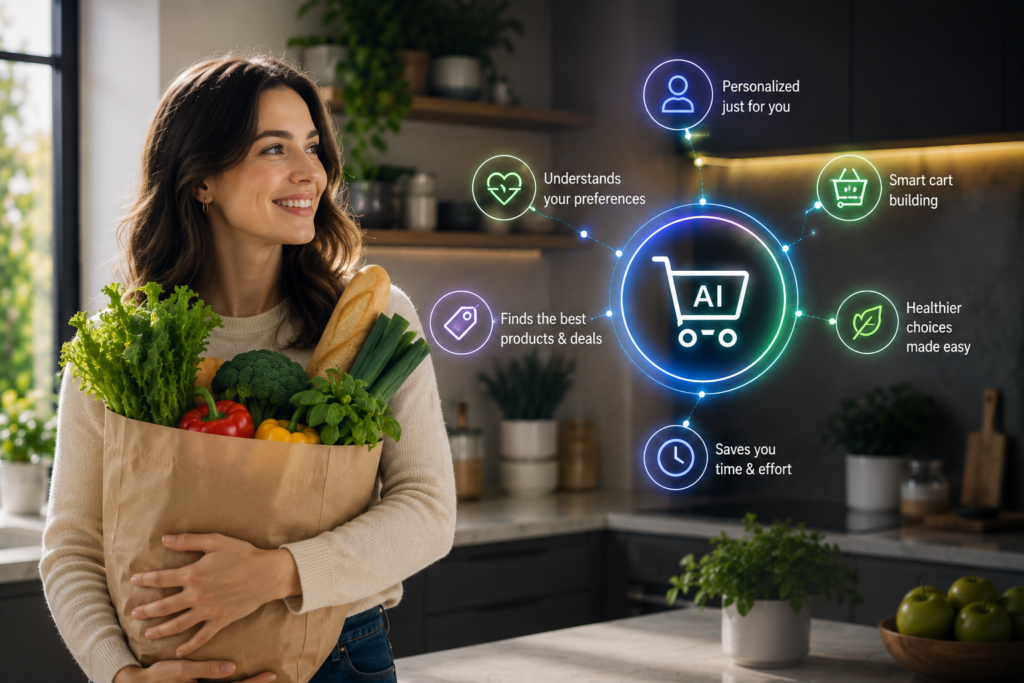
An AI grocery shopping assistant can become much more than a chatbot layered onto an eCommerce site. Built correctly, it becomes a retailer-owned interface that understands what a household is trying to accomplish, translates that intent into meals and products, remembers relevant preferences, connects to live retail data, and helps complete the shopping mission.
That matters because grocery shopping is not a simple product-search problem. A shopper may need five dinners for a family, a lower-cost weekly basket, a lunch plan that works for school and work, a replacement for an out-of-stock ingredient, or a way to use what is already in the pantry. Traditional search makes the shopper translate those goals into dozens of individual queries and decisions.
AI changes the interface from “find this product” to “help me solve this shopping mission.” The strongest grocery assistants combine Food Intelligence, Shopper and Household Intelligence, retailer catalog and inventory data, conversational interaction, meal planning, smart lists, and AI-generated carts. Over time, they can progress from answering questions to taking more actions within shopper-defined guardrails.
Search helps shoppers find products. An AI grocery shopping assistant helps households make decisions and complete shopping missions.
What Is an AI Grocery Shopping Assistant?
An AI grocery shopping assistant is an intelligent digital interface that helps a shopper plan, discover, decide, organize, and buy groceries using natural language and personalized context. Unlike a traditional search box or recommendation widget, the assistant can maintain context across a multi-step journey.
A shopper might say, “Plan dinners for my family this week, keep the grocery total near $150, use the chicken I already have, and make Wednesday something we can cook in 20 minutes.” A grocery-specific assistant should be able to interpret the request, understand household preferences, identify suitable meals, determine which ingredients are missing, map those needs to retailer products, and prepare a list or cart for review.
That is the model behind Delectable Commerce, where grocery assistance connects personalized shopping, meal planning, pantry-aware workflows, smart lists, and automated cart creation rather than treating each capability as a separate tool.
The key word is assistant. The system should reduce effort while preserving control. It can ask clarifying questions, propose a plan, take permitted actions, explain meaningful changes, and learn from feedback. It should not force every shopper into the same level of automation.
Digital Grocery Tool | Primary Job | What the Shopper Still Does |
Search box | Retrieve products matching keywords | Define the mission, compare options, and build the basket |
Recommendation engine | Suggest products likely to interest the shopper | Decide whether recommendations fit the current context |
Chatbot | Answer questions or provide customer-service help | Translate advice into shopping actions |
AI grocery shopping assistant | Understand intent and coordinate planning, discovery, lists, and carting | Guide, edit, approve, and handle exceptions |
Autonomous shopping agent | Execute routine shopping tasks within defined rules | Set permissions, review exceptions, and authorize transactions |
Why Traditional Grocery Search Creates Friction
Grocery websites improved access to the assortment, but they largely preserved the mental model of the store. Shoppers still navigate categories, type product names, compare nearly identical items, remember what the household needs, reconcile coupons and promotions, and assemble the basket themselves.
This works well when the shopper already knows exactly what to buy. It works poorly when the real question is broader: “What should we eat this week?” “What can I make with what I have?” “Which snacks fit our budget?” or “Can you finish the list for me?” These are intent problems, not keyword problems.
AI can reduce this friction by treating conversation as an intent-capture layer. Instead of forcing shoppers to translate a goal into catalog language, the assistant can translate natural language into structured shopping requirements.
Consumer expectations are moving in the same direction. McKinsey research on AI-enabled personalization describes how AI and generative AI can help organizations scale more tailored interactions and experiences. Grocery has an opportunity to apply that principle to a high-frequency journey where the context changes every week.
The next interface for grocery may not begin with an aisle or search box. It may begin with a request: “Help me shop this week.”
From Search Box to Intent Interface
Shopper Goal | Traditional Experience | AI Assistant Experience |
“I need easy dinners this week.” | Search recipes, choose meals, create a list, find every product | Generate meal options, account for schedule and preferences, then prepare the missing items |
“Keep me under $125.” | Compare prices and coupons item by item | Optimize the basket across promotions, private label, quantities, and acceptable swaps |
“Use what I already have.” | Remember pantry items manually | Prioritize on-hand ingredients and add only what is missing |
“Find a substitute for this.” | Browse similar products | Evaluate recipe role, product attributes, preferences, price, and availability |
“Finish my weekly order.” | Recall staples and add products one at a time | Use household memory and current intent to prepare a reviewable basket |
What Makes a Grocery Assistant Grocery-Specific?
A general AI assistant can understand language and generate plausible answers. A grocery assistant must also understand food, the household, the retailer, and the current shopping mission.
That distinction is critical. Grocery decisions connect ingredients to recipes, products to nutrition, households to preferences, and shopper goals to live inventory and promotions. A useful assistant must reason across those relationships without inventing products or ignoring hard constraints.
Intelligence Layer | What It Understands | Why the Assistant Needs It |
Food Intelligence | Ingredients, nutrition, allergens, recipes, cuisines, dietary compatibility, substitutions | Turns product records into food-aware choices |
Shopper Intelligence | Preferences, affinities, behavior, goals, price sensitivity, real-time intent | Makes interactions relevant to the individual shopper |
Household Intelligence | Family composition, pantry, serving needs, shared restrictions, routines, budget | Optimizes for the people actually being fed |
Catalog & Retail Context | SKUs, inventory, prices, promotions, package sizes, fulfillment | Grounds answers in what the retailer can sell now |
Agentic Orchestration | Planning, decisioning, tool use, actions, exception handling | Connects conversation to lists, carts, promotions, and checkout |
Food and Shopper Intelligence: Two Sides of the Same Decision
Personalized grocery assistance requires understanding both the product and the person. If either side is shallow, the recommendation will be shallow.
Food Intelligence: Understanding What the Product Means
Traditional grocery catalog fields such as UPC, brand, category, size, and price are necessary for commerce, but they are not enough for intelligent food decisions. The assistant needs relationships among ingredients, recipes, nutrition, allergens, meal occasions, cuisine, flavor, and dietary compatibility.
Delectable AI describes this capability as Food Intelligence: a structured layer that connects ingredients, recipes, nutrition, allergens, and culinary patterns so AI can reason about food rather than simply match keywords.
External nutrition resources can help ground that understanding. USDA FoodData Central provides extensive food-composition data that can support nutritional analysis when combined with verified retailer product attributes and labels.
Shopper Intelligence: Understanding Why the Shopper Is Buying
Purchase history is useful, but it does not explain intent. Two shoppers can buy the same products for very different reasons. The assistant improves when it understands preferences, budget sensitivity, cooking routines, meal goals, household composition, accepted substitutions, and current mission.
That is the purpose of Shopper Intelligence: moving from a static view of transactions toward a living profile of preferences, behavior, household context, and intent.
The strongest assistant also knows what it does not know. If a shopper suddenly requests a vegetarian week after years of buying meat, it should not assume a permanent lifestyle change. It can honor the current request, ask when needed, and let the shopper decide what should be remembered.
Meal Planning and Recipes: From Inspiration to a Shopping Outcome
Recipes are one of the most natural conversational entry points for grocery, but they are not the end goal. Most people are not looking for another recipe database. They are trying to answer practical questions: What should we make? Will everyone eat it? Do we have time? What is already in the pantry? What do we need to buy?
An AI grocery shopping assistant can connect those questions into one workflow. It can propose meals, refine them through conversation, convert recipes into ingredient needs, account for pantry inventory, calculate quantities, and map the result to products the retailer actually carries.
A useful workflow includes:
- Understand the week: meals, servings, schedule, budget, and constraints.
- Generate meal options that fit preferences and goals.
- Reconcile pantry inventory and use on-hand ingredients first.
- Calculate missing ingredients and quantities.
- Map ingredient needs to relevant in-stock retailer SKUs.
- Optimize around promotions, budget, ingredient reuse, and waste.
- Create a list or cart that the shopper can review and revise.
This is where conversation becomes commercially meaningful. The assistant owns the transition from inspiration to planning to execution, while the retailer keeps the experience inside its own ecosystem.
Smart Lists and Pantry Awareness
The grocery list is one of the most durable shopping interfaces ever created because it works online, in-store, and across households. AI makes the list more useful by turning it from a static note into an intelligent planning object.
A smart list can combine explicit requests, likely replenishment needs, planned meals, pantry gaps, recurring staples, promotions, and household contributions. It can also organize the result around the chosen channel: an online cart, an in-store route, or a hybrid trip.
Pantry awareness makes the assistant materially more accurate. If the household already has rice, olive oil, canned tomatoes, and frozen vegetables, those items should affect meal suggestions and the shopping plan. If a frequently purchased staple is probably running low, the assistant can suggest replenishment without silently adding it.
The important distinction is between suggestion and assumption. An AI assistant can use confidence and shopper permission to determine when something should be recommended, preselected, or simply left for the shopper to decide.
AI-Generated Carts: The Assistant Moves From Advice to Action
The most valuable assistant does not stop after providing a list of suggestions. It can translate intent into a complete, reviewable basket.
Delectable AI calls this outcome the Perfect Cart: a dynamically generated basket optimized around the household, mission, budget, dietary needs, pantry inventory, promotions, and current retail context.
This changes the unit of personalization. Recommendation engines optimize products one at a time. An AI-generated cart can optimize the entire shopping mission. If one product changes, the assistant can reassess quantities, meals, budget, substitutions, and complementary items rather than treating every recommendation independently.
Recommendations answer: “What else might you buy?” AI-generated carts answer: “What does this household need to accomplish the mission?”
Smart Substitutions Inside the Cart
Out-of-stock items are a critical test because the best substitute depends on context. The assistant may need to preserve a recipe, avoid an ingredient, respect a brand preference, fit the budget, match package size, and choose something that is actually available.
The system should also know when not to automate. A routine size change may be easy to approve. A substitution that affects a declared allergy, an important dietary rule, or a strongly preferred brand should trigger a higher level of confirmation.
This is one reason an assistant needs both intelligence and explicit shopper controls.
Conversational and Voice Shopping
Conversation is especially well suited to grocery because shoppers often think in goals and exceptions rather than formal product queries. Natural language makes it easy to say: “Make Thursday vegetarian,” “Use less expensive options,” “I already have pasta,” or “Add school lunches for three days.”
The interface can span text, voice, buttons, visual cards, and traditional browsing. The best design does not force conversation when a tap is faster. It uses conversation to capture ambiguous intent and structured controls when shoppers need precision.
Voice can also reduce friction in moments when hands are busy, such as cooking, checking the pantry, or noticing an item that has run out. Amazon’s Alexa Shopping Kit documentation demonstrates shopping interactions that can recommend products and, with customer confirmation, add items to a cart or initiate purchasing workflows. Grocery retailers can apply the same interaction principle to retailer-owned lists and carts.
The most useful design will probably be multimodal:
- Text conversation for complex planning and comparison.
- Voice for hands-free capture and quick changes.
- Buttons and chips for fast clarification and approval.
- Visual product cards for price, nutrition, substitution, and availability review.
- Traditional browse and search when the shopper already knows what they want.
Why the Assistant Should Be Retailer-Owned
An AI grocery shopping assistant is strategically different when it lives inside the retailer experience rather than on a third-party marketplace or general-purpose AI service.
The retailer can ground the assistant in its own assortment, prices, promotions, inventory, loyalty relationships, fulfillment options, and brand standards.
It also means each interaction can improve the retailer’s understanding of intent. A search query reveals what someone typed. A conversation can reveal the meal, household constraint, budget, occasion, or goal behind the purchase. Used responsibly, those signals can improve future commerce, merchandising, service, and retail media.
The retailer does not need to replace its existing commerce platform to create this experience. The assistant can function as an intelligent layer that orchestrates existing search, product, promotion, cart, loyalty, and checkout services.
Trust, Accuracy, and Shopper Control
As the assistant gains the ability to act, trust becomes more important. An inaccurate chatbot answer is frustrating. An inaccurate product selection or substitution can affect money, meals, and potentially sensitive dietary requirements.
Retailers should design assistants around grounded product data, permission boundaries, transparency, auditability, and clear escalation when confidence is low. NIST’s AI Risk Management Framework provides a cross-industry framework for managing AI risks and trustworthiness through governance, mapping, measurement, and management.
Important design principles include:
- Ground product recommendations in verified catalog and store-level data.
- Separate preferences from hard constraints and treat higher-risk decisions more conservatively.
- Make important assumptions visible and editable.
- Explain material substitutions and price changes.
- Require explicit authorization before payment or other consequential actions.
- Let shoppers control what the assistant remembers and what it may automate.
Retailer Benefits of an AI Grocery Shopping Assistant
The assistant is a shopper-experience innovation, but its business value can extend across commerce, loyalty, merchandising, operations, and media.
Potential retailer benefits include:
- Faster shopping: less manual searching, comparison, list building, and cart assembly.
- Higher conversion: broad intent becomes a concrete plan and reviewable basket.
- Larger, more complete baskets: meals and missions expose complementary products and forgotten needs.
- Stronger loyalty: the retailer provides a useful recurring service that improves with household context.
- Better personalization: the retailer learns why the shopper is shopping, not simply what was purchased.
- Private-label growth: store brands can appear when they genuinely fit preference, value, and mission.
- More relevant retail media: sponsored products can appear within useful context rather than as generic interruption.
- Richer first-party intelligence: plans, questions, edits, approvals, and rejected suggestions create valuable intent signals.
Over time, the assistant can become the digital front door to the retailer. Shoppers may begin with the assistant before they begin with search because the assistant can decide which existing commerce capability should be used next.
The Future: From Shopping Assistant to Autonomous Grocery Agent
The long-term direction is not a sudden jump from search to fully autonomous purchasing. It is progressive autonomy.
- The assistant answers questions and improves product discovery.
- The assistant remembers preferences and maintains context across a session.
- The assistant creates meal plans, smart lists, and suggested carts.
- The assistant takes routine actions such as adding approved staples or applying relevant offers.
- The assistant manages more exceptions and optimization within household-defined rules.
- The assistant increasingly completes recurring shopping missions while shoppers review exceptions and authorize purchases.
This is the progression toward Agentic Commerce for Grocery, where agents move beyond answering questions to planning, deciding, and acting on behalf of shoppers.
The broader commerce market is moving in this direction. McKinsey’s analysis of the agentic commerce opportunity describes emerging shopping agents capable of researching, evaluating, and increasingly handling purchasing tasks for consumers.
The future assistant will not replace shopper judgment. It will remove repetitive work so shopper judgment is used where it matters most.
What Grocery Retailers Should Build First
Retailers do not need to automate the entire journey on day one. The strongest roadmap begins with high-frequency shopper problems where the assistant can create obvious utility and measurable learning.
- Start with conversational product discovery and known-item search assistance.
- Add household preferences and shopper-controlled memory.
- Connect recipes and meal planning to the live retailer catalog.
- Introduce smart lists and pantry-aware planning.
- Generate reviewable carts from complete shopping missions.
- Add substitution intelligence, promotions, and basket optimization.
- Expand autonomy only after trust, data quality, and shopper controls are proven.
This approach creates a compounding advantage. Each layer makes the next layer more useful. Product intelligence improves search. Household intelligence improves meal planning. Meal planning improves lists. Lists and intent improve cart creation. Cart edits improve future personalization.
Frequently Asked Questions About AI Grocery Shopping Assistants
1. What is an AI grocery shopping assistant?
An AI grocery shopping assistant is a digital assistant that uses artificial intelligence to help shoppers plan meals, discover products, create lists, manage pantry needs, build carts, compare alternatives, and complete grocery shopping tasks using personalized context and natural language.
2. How is an AI grocery shopping assistant different from grocery search?
Search retrieves products based on queries and ranking signals. An AI assistant can interpret a broader household goal, maintain context across multiple steps, ask clarifying questions, and connect the goal to planning, products, lists, and carts.
3. How is an AI grocery shopping assistant different from a chatbot?
A chatbot typically answers questions. A grocery shopping assistant can connect conversation to retailer systems and take permitted actions such as generating meal plans, adding products to a list, preparing a cart, or proposing substitutions.
4. What data does an AI grocery shopping assistant need?
Useful assistants combine product catalog data, inventory, pricing, promotions, loyalty and purchase history, shopper preferences, household context, food and recipe intelligence, and real-time session behavior.
5. Why does an AI grocery assistant need Food Intelligence?
Food Intelligence helps the assistant understand ingredients, nutrition, allergens, recipes, dietary compatibility, cuisine, flavor, and substitutions. Without it, the assistant is largely limited to language and basic product metadata.
6. What is Shopper Intelligence?
Shopper Intelligence is a deeper understanding of the shopper and household, including preferences, purchase behavior, budget sensitivity, goals, routines, affinities, and real-time intent. It makes the assistant more relevant than one based on generic segments.
7. Can an AI grocery shopping assistant create meal plans?
Yes. It can create and revise meal plans around household size, preferences, schedule, budget, pantry inventory, and other shopper-provided constraints, then translate those plans into shopping needs.
8. Can an AI grocery assistant build a complete cart?
Yes. More advanced assistants can map a shopping mission or meal plan to retailer products, calculate quantities, account for pantry items, evaluate promotions and substitutions, and prepare a complete basket for review.
9. Can an AI grocery shopping assistant help manage a budget?
Yes. It can evaluate the entire basket rather than one product at a time, considering promotions, private-label options, package sizes, acceptable substitutions, and ingredient reuse to help stay within a stated budget.
10. How can AI improve grocery substitutions?
AI can evaluate recipe purpose, product attributes, price, brand preference, package size, dietary constraints, and availability. The assistant should ask for confirmation when a substitution is uncertain or materially changes an important preference or constraint.
11. Can grocery shopping assistants work with voice?
Yes. Voice is useful for hands-free list capture, quick modifications, pantry updates, and conversational shopping. A well-designed system should also provide visual review for products, prices, substitutions, and approvals.
12. Can an AI grocery assistant work for in-store shopping?
Yes. The same assistant can prepare a smart list for an in-store trip, organize items around the store experience, support voice or mobile interactions, and preserve the option to convert some items to digital purchase.
13. How do grocery retailers benefit from AI shopping assistants?
Potential benefits include faster shopping, higher conversion, more complete baskets, stronger loyalty, better personalization, more relevant promotions, richer first-party intent signals, and a differentiated retailer-owned digital experience.
14. Will AI grocery shopping assistants eventually shop automatically?
They are likely to become progressively more autonomous. Routine, low-risk tasks can be automated first, while shoppers retain control over exceptions, sensitive substitutions, budgets, permissions, and final authorization.
15. What should retailers measure when launching an AI grocery assistant?
Retailers should measure time-to-cart, conversion, basket completeness, assistant engagement, repeat usage, substitution acceptance, shopper edits, satisfaction, and business outcomes such as basket size and retention. Accuracy and trust metrics should be tracked alongside revenue metrics.
Final Thought
The grocery shopping assistant is becoming a new interface for digital grocery. Its value is not that shoppers can chat with a retailer. Its value is that the retailer can understand what the household is trying to accomplish and coordinate the systems required to make that outcome easier.
The winning experience will connect conversation to intelligence, intelligence to decisions, and decisions to action – from meal planning and lists to the final cart.
The best AI grocery shopping assistant does not give the shopper more choices. It helps the shopper make fewer decisions.