
Executive Summary
For most of eCommerce history, the shopping cart has been a passive container. Retailers helped shoppers search, browse, filter, compare, and discover products, but the shopper still did the hard work of deciding what belonged in the basket. Grocery makes that burden especially visible because a single trip can involve dozens of products, multiple household members, meal plans, dietary needs, promotions, pantry inventory, substitutions, and a budget that must work across the entire order.
AI Cart Building changes the role of the cart. Instead of waiting for shoppers to assemble products one by one, an intelligent system can start with the shopper’s goal, reason across household and retail context, generate a complete basket, and continuously improve it as conditions change. The cart becomes a living decision object rather than a static checkout container.
That is a fundamental shift from recommendation to execution. Recommendations suggest what a shopper might buy next. AI Cart Building helps decide what the household needs, selects appropriate products, balances competing objectives, handles changes, and prepares a complete outcome for the shopper to review.
The core idea: Recommendation engines optimize the next item. AI Cart Building optimizes the entire shopping mission.
What Is AI Cart Building?
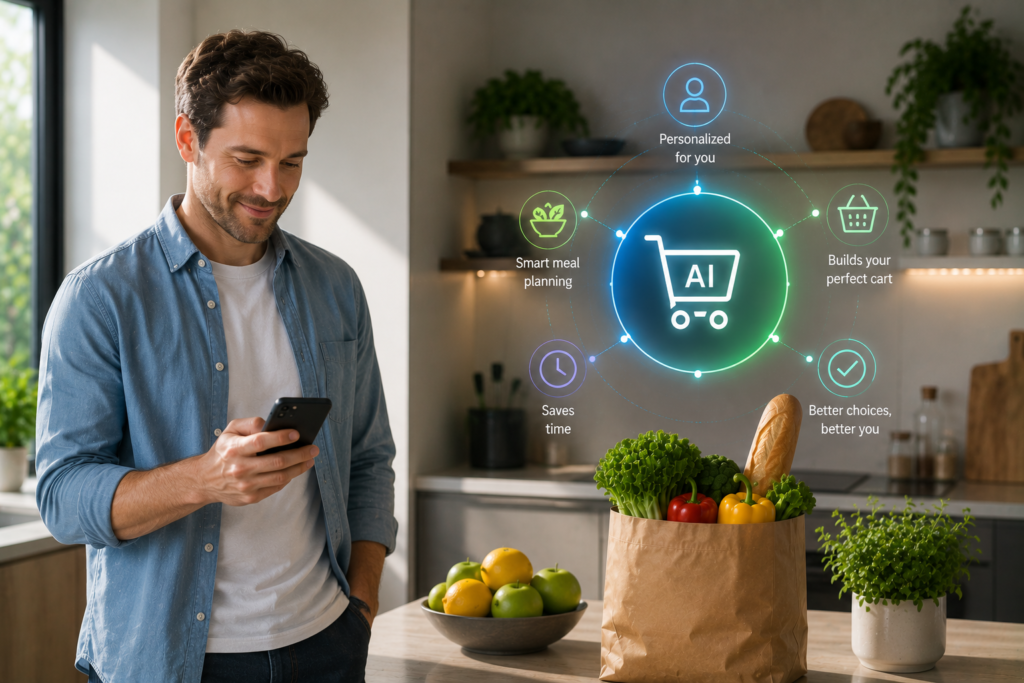
AI Cart Building is the use of artificial intelligence to generate, populate, refine, and optimize a grocery basket on behalf of a shopper based on household needs, meals, preferences, budget, pantry inventory, promotions, product availability, and real-time intent.
A basic implementation might convert a recipe into products. A more advanced system can assemble an entire weekly cart, reconcile multiple missions, evaluate alternatives, adapt to inventory or price changes, and explain why products were added or replaced.
In that sense, AI Cart Building is a practical expression of Agentic Commerce for Grocery: AI does not simply return information. It plans, decides, and takes permitted actions that move the shopper closer to a completed purchase.
The best experience still keeps the shopper in control. AI should reduce the work of building the cart without removing the shopper’s ability to change brands, reject substitutions, lock important preferences, set budgets, or approve sensitive decisions.
Why Grocery Is a Natural Fit for AI Cart Building
Grocery shopping is unusually well suited to cart automation because the basket is both repetitive and complex. Households repeatedly buy many of the same staples, but each trip also changes with meals, schedules, seasons, health goals, guests, promotions, and what is already at home.
A useful grocery cart may need to reconcile recurring household staples, planned meals, pantry inventory, household preferences, dietary restrictions, current budget, loyalty offers, promotions, private-label alternatives, product availability, preferred brands, and real-time shopping intent.
Traditional eCommerce exposes these variables to the shopper and asks the shopper to resolve them manually. AI Cart Building gives the system responsibility for more of that coordination.
Cart Automation vs. Product Recommendations
The difference between recommendations and AI cart automation is not simply the number of products suggested. It is the unit of optimization.
Traditional Recommendation Engine | AI Cart Building |
Optimizes an individual product impression | Optimizes the entire basket and shopping mission |
Usually reacts to clicks or purchase history | Combines history with household context and current intent |
Suggests “you may also like” items | Adds, removes, swaps, and reprioritizes products when permitted |
Often category- or item-centric | Reasons across meals, pantry, budget, promotions, and household needs |
Measures product-level response | Can measure basket completeness, time-to-cart, conversion, and satisfaction |
Leaves assembly work to the shopper | Performs much of the assembly work for the shopper |
A recommendation engine might suggest pasta sauce after a shopper adds pasta. An AI cart builder can recognize that the shopper is planning three Italian dinners, determine which ingredients are already in the pantry, identify a sauce preference, calculate quantities, choose complementary products, apply promotions, and build the relevant portion of the basket automatically.
This is the distinction behind the Perfect Cart: the goal is not to recommend more products. It is to create a basket optimized for a specific household and a specific moment.
The Inputs an AI Cart Builder Must Understand
A cart can only be as intelligent as the context behind it. Grocery cart building requires several layers of understanding that traditional shopping carts were never designed to hold.
Shopper Intelligence includes brand preferences, dislikes, price sensitivity, and purchase patterns.
Household Intelligence includes family size, serving needs, dietary restrictions, routines, budget, and pantry inventory.
Food Intelligence includes ingredients, nutrition, allergens, recipes, cuisines, and substitutions.
Retail Intelligence includes catalog, pricing, inventory, promotions, loyalty programs, and private label.
Real-Time Intent describes what the household is trying to accomplish now: tonight’s dinner, a weekly restock, a party, a health goal, or a budget target.
The product side depends on Food Intelligence so the system can reason beyond UPC, brand, and category. Smart cart decisions require understanding ingredients, dietary compatibility, recipe relationships, flavor, nutrition, and meaningful substitution options.
The human side depends on Shopper Intelligence so the system can distinguish a household preference from a one-time purchase and understand changing goals, routines, budgets, and intent.
How AI Cart Building Works: From Intent to Basket
A useful AI cart builder should behave like a workflow, not like a single recommendation call.
- Understand intent. Interpret the shopper’s mission and constraints.
- Retrieve memory. Load household preferences, purchase patterns, pantry signals, and protected rules.
- Build needs. Translate meals, replenishment, and current requests into item requirements.
- Map to products. Resolve those needs to retailer SKUs.
- Optimize the basket. Balance budget, preferences, promotions, nutrition, quantities, and merchandising rules.
- Handle exceptions. Resolve unavailable products, conflicts, uncertainty, and shopper changes.
- Present and learn. Show the ready-to-review cart and learn from edits and approvals.
Delectable Commerce brings these pieces together through personalized shopping, pantry-aware meal planning, integrated lists and checkout, and a Personalized Agentic Cart Builder that can plan, shop, and adapt to each customer.
Real-Time Personalization Makes the Cart a Living Object
Traditional personalization is often calculated before the shopping session begins. AI Cart Building can personalize continuously because the basket itself becomes a source of intent.
A shopper may begin with a weekly restock and then add a birthday cake. A planned chicken dinner may be removed. A promotion may make salmon a better fit. An item may go out of stock. Each event changes the optimal basket.
This reflects the broader shift toward real-time personalization described by McKinsey: useful experiences increasingly depend on combining signals and adapting interactions to the individual rather than relying on static audience treatment.
If the shopper lowers the weekly budget by $20, AI can reassess the basket rather than merely display a coupon. If a meal changes, the ingredients and quantities can change with it. If the shopper rejects a premium substitute, the cart can learn a price ceiling for that category without assuming the shopper is universally price-sensitive.
A cart should never be “finished” until the shopper is finished.
Smart Substitutions Are a Core AI Cart-Building Capability
Substitution is one of the clearest tests of grocery intelligence.
The right substitute may depend on brand loyalty, ingredient differences, dietary restrictions, flavor, package size, price, recipe purpose, availability, and how flexible the shopper is in that category.
A category match is not enough. Replacing one yogurt with another may be harmless for one household and unacceptable for another. Replacing an ingredient in a recipe can change flavor, texture, nutrition, allergen exposure, or whether the recipe works at all.
Reliable substitutions also depend on strong product identity and data quality. GS1 standards for foodservice and retail grocery support unique product identification, traceability, and better data communication across the grocery supply chain.
A smart substitution engine should ask:
- Does the replacement still work for the planned meal?
- Does it preserve declared restrictions?
- Is the shopper brand-loyal in this category?
- Is the price difference acceptable?
- Will the package size still work?
- Is the replacement actually available?
- Is confidence high enough to act, or should the shopper be asked?
Dynamic Merchandising Moves Inside the Cart
AI Cart Building also changes merchandising.
Traditional digital merchandising is largely page-based: search ranking, category placement, banners, sponsored products, and recommendation modules. An intelligent cart creates a more contextual decision surface because the system understands what the household is trying to accomplish.
Dynamic merchandising can include relevant promotions, private-label alternatives, complementary products, inventory-aware choices, seasonal products, and sponsored products when they genuinely fit the mission and are transparently identified.
The technical direction is already visible in the broader retail market. Google Cloud’s Gemini Enterprise for Customer Experience describes shopping agents that can navigate catalogs, build complex carts, apply loyalty programs and promotions, and guide shoppers toward checkout.
For grocery retailers, the opportunity is to make merchandising more useful because it is attached to intent.
Basket Optimization: From More Items to Better Outcomes
Basket optimization should not be confused with maximizing item count.
A retailer may care about basket size, margin, private-label penetration, promotion performance, fulfillment success, and retail media revenue. The shopper may care about cost, convenience, nutrition, taste, time, brand preferences, and confidence.
The strongest AI Cart Building systems will balance both sides.
They can optimize for basket completeness, budget fit, meal and pantry coherence, substitution quality, promotion relevance, inventory fit, and personalization quality.
This is why AI Cart Building can become more strategic than a front-end convenience feature. It creates a decision layer where retailer economics and household outcomes can be optimized together within transparent rules and shopper-defined guardrails.
Real-World AI Cart Building Use Cases
“Build my normal weekly order.”
AI reviews purchase cadence, pantry signals, household staples, and recent exceptions, then creates a replenishment-first basket for review.
“Feed four people for under $150.”
AI evaluates meals, servings, promotions, pantry inventory, private label, and ingredient reuse to produce a value-optimized weekly basket.
“Make my cart healthier without changing everything.”
AI reviews the current cart, stated goals, food attributes, brand preferences, and substitution tolerance and proposes selective swaps.
“We are hosting ten people Sunday.”
AI evaluates the menu, quantities, beverages, pantry, and promotions to create an occasion-based basket.
“Shop the list but use what is on sale.”
AI preserves list intent while evaluating loyalty offers and acceptable substitutions.
“Finish my cart.”
AI reviews the current basket, household patterns, planned meals, staples, and likely forgotten items and suggests a completed basket.
AI Cart Building Creates New Retailer Opportunities
AI Cart Building can create several retailer benefits:
- Faster time-to-cart
- Higher conversion
- Larger and more complete baskets
- Stronger loyalty
- Better promotion performance
- Increased private-label relevance
- More contextual retail media
- Richer first-party shopper intelligence
- Greater omnichannel flexibility
The most important metric may eventually be how much work the retailer removes. Search ranking will still matter, but time-to-cart, number of manual decisions, basket completeness, substitution acceptance, and repeat use can become equally important indicators.
Trust, Control, and the Right Level of Autonomy
Autonomy should be progressive.
Routine and reversible actions can often be automated more aggressively. High-stakes decisions should require greater shopper involvement.
Replenishing a frequently purchased staple can be highly autonomous when enabled by the shopper. Applying an existing loyalty offer is relatively low risk. Replacing a favorite brand or materially changing package size should usually be surfaced for approval. Allergen-sensitive or similarly high-stakes substitutions require trusted data and explicit control.
Consumer research from Visa on trust in agentic commerce reinforces why these guardrails matter: consumers want control over the data agents access and remain concerned about incorrect selections and decisions made without them.
The goal is not maximum autonomy.
The goal is the right autonomy for the task.
The Future of Autonomous Grocery Shopping
AI Cart Building is an important bridge between today’s assisted eCommerce and tomorrow’s autonomous grocery shopping.
The likely progression is:
- AI recommends individual products and substitutions.
- AI creates smart lists from meals, pantry needs, and shopper goals.
- AI pre-builds portions of the cart.
- AI assembles and continuously optimizes the entire cart for review.
- AI handles routine replenishment and approved substitutions within shopper-defined rules.
- AI agents increasingly coordinate shopping, fulfillment, and payment while preserving authorization and oversight.
That progression matches the broader direction described by IBM’s overview of agentic commerce, where AI agents can manage recurring purchases, compare options, and act within user-defined preferences or constraints.
For grocery, the cart is the natural control point. It gives shoppers a place to see what AI decided, change anything that feels wrong, and approve the outcome.
The interface may become more conversational and the assembly increasingly autonomous, but the basket remains where intent becomes a purchase.
Final Thought
The future of grocery shopping is not an empty cart waiting to be filled.
It is an intelligent cart that arrives already prepared, explains its choices, adapts in real time, and gets better every time the household shops.
Frequently Asked Questions About AI Cart Building
1. What is AI Cart Building?
AI Cart Building uses artificial intelligence to generate, populate, refine, and optimize a grocery cart based on a shopper’s household, meals, preferences, budget, pantry inventory, promotions, product availability, and real-time intent.
2. How is AI Cart Building different from product recommendations?
Product recommendations suggest individual items. AI Cart Building optimizes the entire basket and can add, remove, swap, and reprioritize products to complete a shopping mission.
3. What data does an AI cart builder need?
Useful implementations combine product catalog data, pricing, promotions, inventory, shopper and household preferences, purchase history, meal plans, pantry signals, Food Intelligence, and real-time session intent.
4. Can AI build an entire weekly grocery cart?
Yes. AI can combine recurring household needs, planned meals, pantry inventory, budget, promotions, and preferences to prepare a complete weekly basket for review.
5. What is real-time cart personalization?
It means continuously adjusting the basket as the shopper changes goals, removes meals, accepts or rejects products, modifies the budget, or encounters new price, promotion, or inventory conditions.
6. How do smart substitutions work in AI Cart Building?
They evaluate more than category similarity, including recipe purpose, ingredients, dietary restrictions, brand preference, price, package size, availability, and substitution tolerance.
7. Can AI Cart Building help shoppers save money?
Yes. AI can evaluate promotions, private-label alternatives, ingredient reuse, package sizes, lower-cost substitutes, and the total basket budget.
8. Can AI Cart Building support meal planning?
Yes. Meal plans explain what the household intends to cook, enabling the cart builder to calculate ingredients, quantities, pantry gaps, and appropriate products.
9. How does household memory improve an AI-generated cart?
Household memory helps AI remember serving patterns, preferred brands, dietary rules, budget tendencies, recurring purchases, substitution preferences, and previous feedback.
10. What is dynamic merchandising in an AI-generated cart?
Dynamic merchandising uses current cart intent to surface relevant promotions, private-label options, complementary products, inventory-aware choices, and clearly identified sponsored products.
11. What does basket optimization mean?
Basket optimization evaluates the complete order across multiple goals such as budget, basket completeness, meal coherence, preferences, promotions, inventory, nutrition preferences, and retailer economics.
12. Can AI Cart Building work for in-store shopping?
Yes. The same intelligence can generate a smart shopping list, prepare an online cart, or support a hybrid journey.
13. Will AI replace the grocery shopping cart?
No. The cart is likely to remain important, but its role changes from an empty container into a review and control surface for an AI-generated shopping plan.
14. How much control should shoppers have over an AI-generated cart?
Shoppers should be able to set preferences and budgets, lock important choices, reject substitutions, see meaningful changes, correct assumptions, and approve transactions.
15. How does AI Cart Building connect to autonomous grocery shopping?
AI Cart Building moves AI from suggesting products to assembling and optimizing the purchase itself. Future agents may handle more replenishment, substitution, fulfillment, and payment tasks within shopper-defined guardrails.