
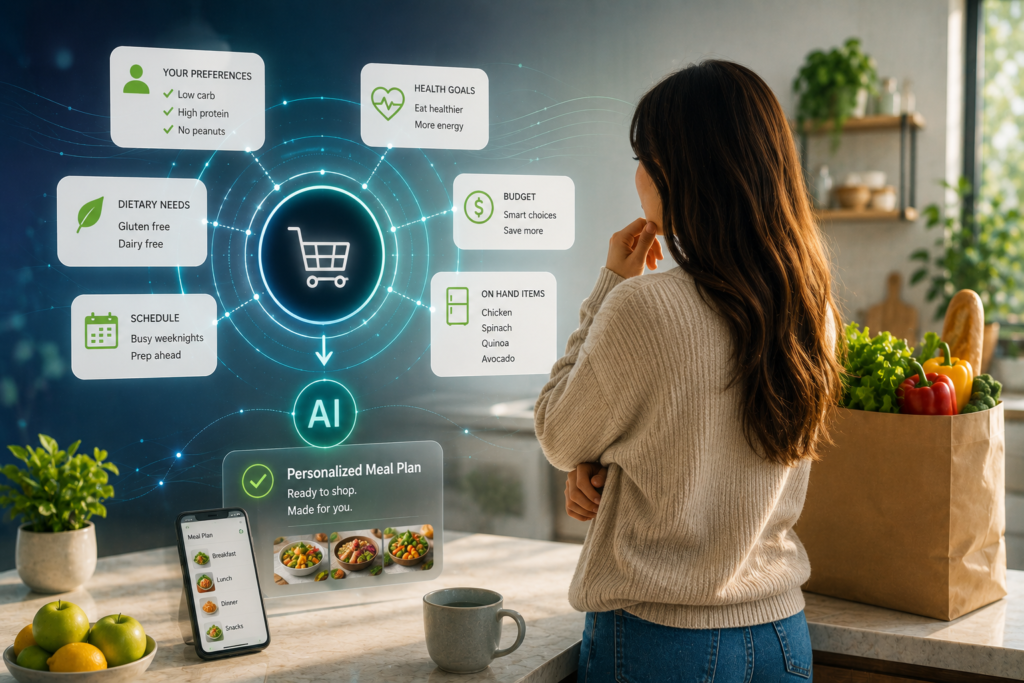
How personalized meal plans turn household intent into smarter lists, better baskets, and more useful grocery experiences
Executive Summary
Meal planning is one of the most important and underappreciated problems in grocery commerce. Shoppers rarely begin with a product. They begin with a household outcome: feed the family this week, eat more protein, stay within budget, use what is already in the pantry, accommodate an allergy, or get dinner on the table in 30 minutes. Traditional grocery eCommerce still asks the shopper to translate that outcome into recipes, ingredients, products, quantities, substitutions, and a cart.
AI Meal Planning changes the starting point. Instead of presenting thousands of products and asking shoppers to assemble the answer, an intelligent system can understand the household goal, create a personalized meal plan, map recipes to required ingredients, account for pantry inventory, apply dietary and budget constraints, connect ingredients to real retailer SKUs, and prepare a shopping list or cart for review.
The strategic implication for grocery retailers is bigger than recipe discovery. Recipes are an input. Meal planning is the decision layer. The list or cart is the commercial outcome. When those layers are connected, AI Meal Planning becomes a practical gateway to Personalized Agentic Commerce: a retailer-owned experience that helps shoppers decide what to eat and then helps them complete the purchase.
The core idea |
What Is AI Meal Planning?
AI Meal Planning is the use of artificial intelligence to create, adapt, and operationalize meal plans around a shopper’s household, food preferences, dietary requirements, schedule, budget, pantry inventory, and current shopping context. The most advanced systems do not stop at generating a menu. They connect the plan to recipes, required ingredients, retailer assortment, promotions, inventory, substitutions, and the shopping workflow.
That distinction separates an AI recipe generator from a grocery commerce system. A recipe generator can suggest five dinners. A grocery-aware planning system must determine whether those meals fit the household, whether ingredients overlap intelligently across the week, what is already available at home, which products are sold by the retailer, what quantities are needed, how much the plan costs, and what should happen when a product is unavailable.
AI Meal Planning is therefore one of the clearest use cases for Agentic Commerce for Grocery: the shopper defines an outcome, AI reasons across multiple constraints, and the system helps turn that outcome into action.
Meal Planning Is a Decision Problem, Not a Recipe Problem
Most households do not struggle because recipes are scarce. The internet already offers an effectively unlimited supply of recipes. The difficulty is deciding which meals make sense for this household, this week, under this set of constraints.
A useful meal plan may need to reconcile all of the following at once:
- Who is eating each meal and how many servings are required.
- Which foods different household members like, dislike, or cannot eat.
- How much time is available to cook on each day.
- What ingredients are already in the pantry, refrigerator, or freezer.
- Which items are on promotion and which alternatives offer better value.
- How much the household wants to spend for the week.
- Whether the shopper is pursuing a dietary preference or nutrition goal.
- Which meals can share ingredients without becoming repetitive.
- What can become leftovers or be repurposed in another meal.
- What is actually available at the shopper’s selected store or fulfillment location.
This is why meal planning is a natural AI problem. It combines preference matching, constraint satisfaction, optimization, memory, product knowledge, and continuous revision. It also happens repeatedly, which gives a retailer an opportunity to become more useful over time as the system learns household routines.
The behavior is already emerging. McKinsey’s 2026 State of Grocery Retail Europe reported that among consumers who had already used AI in their grocery journey, 40 percent used it to create meal plans – the most common use case cited in that survey. That is an early signal that shoppers see planning, not just product search, as a natural job for AI.
The Evolution of Meal Planning: From Inspiration to Execution
Stage | What the Shopper Gets | What the Shopper Still Has to Do |
Recipe discovery | Recipes and cooking ideas | Choose meals, reconcile household needs, make a list, find products, compare prices, build the cart |
Digital meal planner | A calendar of selected meals | Find or enter recipes, identify missing ingredients, shop manually |
AI recipe generation | Personalized recipe ideas | Validate constraints, organize the week, map ingredients to products, build the basket |
AI Meal Planning | A personalized weekly plan optimized across household context | Review choices and exceptions; approve meaningful changes |
Agentic meal-to-cart commerce | Plan, list/cart, substitutions, promotions, and checkout workflow | Guide preferences, review, and approve the outcome |
The important shift is from inspiration to execution. Grocery retailers create the most value when they connect the moment a shopper decides what to eat with the moment the ingredients are purchased. That connection collapses several fragmented tasks into one retailer-owned experience.
How AI-Generated Meal Plans Should Work
A useful AI-generated meal plan should be created as a workflow, not as a block of generated text. The system needs to gather context, create candidate meals, evaluate constraints, revise the plan, and translate it into purchasable items.
Step | AI Planning Task | Example |
1. Understand the mission | Interpret the shopper’s goal and time horizon | “Plan five dinners for a family of four this week.” |
2. Retrieve household context | Use preferences, dietary rules, routines, serving sizes, and prior feedback | Two adults, two children; one vegetarian dinner; mild spice |
3. Add real-world constraints | Consider schedule, pantry, budget, promotions, and store availability | Two late work nights; use chicken already in freezer; target $120 |
4. Generate candidate meals | Create meals that fit the combined constraints | Tacos, sheet-pan chicken, lentil pasta, stir-fry, salmon bowls |
5. Optimize the week | Reuse ingredients, reduce waste, balance variety and effort | Use cilantro in two meals; repurpose roasted vegetables for lunch |
6. Translate recipes to needs | Calculate ingredients and quantities, subtract pantry inventory | Need 2 avocados, 1 bag rice, no additional olive oil |
7. Connect to commerce | Map needs to retailer SKUs, prices, promotions, inventory, and substitutions | Select in-stock products and prepare the list/cart |
The output should remain editable. Shoppers should be able to say, “Swap Tuesday for something vegetarian,” “Make Thursday faster,” “Use the salmon that is on sale,” or “I already have rice.” The plan, list, nutrition totals, quantities, and cart should update together rather than forcing the shopper to start over.
Dietary Personalization Requires Food Intelligence
Personalized meal planning is only as good as the system’s understanding of food. A household can express goals in human language – vegetarian, higher protein, dairy-free, lower sodium, Mediterranean, kid-friendly, no peanuts, quick breakfasts – but a grocery system ultimately has to translate those concepts into ingredients, recipes, and products.
That requires Food Intelligence: structured understanding of ingredients, nutrition, allergens, recipes, dietary compatibility, flavor, cuisines, substitutions, and product relationships. Without that layer, the AI may sound helpful while making weak or inconsistent food decisions.
For example, a shopper asking for “high-protein lunches” is not asking for a keyword match on the phrase high protein. The planning system needs to compare meal options, serving sizes, ingredient combinations, and available products while preserving the household’s tastes, budget, preparation time, and other stated constraints.
Authoritative nutrition data can help ground that reasoning. USDA FoodData Central provides extensive food-composition data that can support nutrition analysis when combined with retailer-specific product information and verified labels.
Dietary personalization also raises the importance of confidence and control. AI should distinguish between preferences, such as “I prefer plant-forward meals,” and hard constraints, such as a declared food allergy. The system should not casually infer sensitive health conditions, and it should allow shoppers to review or correct assumptions.
Food allergies are a particularly important example. FDA guidance on food allergies explains the labeling requirements for major food allergens. Grocery AI should rely on trusted product and ingredient data, clearly surface uncertainty, and preserve shopper approval rather than treating generative output as a substitute for verified labeling.
Household Memory Makes Meal Planning More Useful Over Time
Meal planning is rarely an individual problem. The person using the retailer app may be planning for a partner, children, roommates, visiting relatives, or a multigenerational household. The planner therefore needs memory at the household level, not simply a user profile.
Delectable AI’s Shopper Intelligence approach is designed around persistent household preferences, purchase patterns, budgets, and intent signals. For meal planning, that memory can reduce repetitive questions and improve the usefulness of each future plan.
Household memory can include explicit preferences supplied by the shopper as well as patterns learned from prior choices. The crucial principle is that memory should be editable and explainable. A child’s tastes change. A household budget changes. A dietary preference may be temporary. A favorite meal can become boring. The system should learn without turning yesterday’s behavior into a permanent rule.
Household Signal | What It Can Mean for Meal Planning | How the Plan Can Adapt |
Household size and serving patterns | How much food is typically needed | Adjust recipes, quantities, and package sizes |
Meal acceptance and ratings | Which meals the household actually enjoys | Repeat favorites at the right cadence and reduce weak matches |
Dietary restrictions and preferences | Hard constraints and softer choices across members | Filter incompatible meals and create shared or split options |
Weekly schedule | Which nights are rushed, flexible, or social | Assign fast meals to busy nights and more involved meals to open nights |
Purchase and pantry patterns | Likely ingredients already available or due for replenishment | Reduce duplicates and identify staples to restock |
Budget and promotion sensitivity | How aggressively the household trades price versus preference | Favor sale items, private label, or ingredient swaps when useful |
Budget Optimization: Plan the Week, Not Just the Recipe
Budget-conscious meal planning is not the same as finding the cheapest recipe. A low-cost dinner can become expensive if it requires several one-use ingredients, creates leftovers nobody eats, or causes the shopper to buy package sizes that exceed actual need. AI has an advantage because it can optimize across the week rather than evaluating each meal in isolation.
A budget-aware planner can consider:
- The household’s total weekly grocery target rather than only price per recipe.
- Current retailer promotions and loyalty offers.
- Private-label alternatives that fit the meal and household preferences.
- Ingredient reuse across multiple meals.
- Pantry items that reduce what must be purchased.
- Package sizes and expected leftovers.
- Price-per-serving tradeoffs between meal options.
- Substitutions that preserve the meal while reducing cost.
- Higher-cost meals balanced by lower-cost meals elsewhere in the week.
This is a more practical definition of value. The goal is not to minimize every item price. It is to help the household achieve the weekly meal plan within a reasonable budget while preserving the preferences and constraints that matter most.
Meal Planning Can Reduce Waste by Connecting Plans to Pantry and Quantities
Food waste often begins before checkout. Households buy ingredients without a clear plan, forget what they already have, overestimate quantities, or purchase items for a recipe that never gets cooked. Meal planning can address those problems when it is connected to pantry awareness and shopping decisions.
The U.S. Environmental Protection Agency’s guidance on preventing wasted food at home recommends making a shopping list with weekly meals in mind and buying only what is expected to be used. AI can operationalize that advice by checking pantry inventory, coordinating ingredient reuse, calculating quantities, and adapting the plan when meals change.
For example, if three meals require onions, the system should consolidate the quantity rather than add three separate onion entries. If the household already has two onions, the shopping need should be reduced. If Tuesday’s meal is removed, the list should update automatically. If spinach is purchased for Monday, the planner can deliberately reuse it on Wednesday before it spoils.
The planning advantage |
Recipe-to-Cart Workflows: Where Meal Planning Becomes Grocery Commerce
The commercial value of AI Meal Planning becomes tangible when the meal plan can move directly into the retailer’s shopping workflow. This is the recipe-to-cart problem: translating human food concepts into specific products that can actually be purchased.
A recipe may call for “2 pounds boneless chicken breast,” “one 15-ounce can of black beans,” or “fresh basil.” A retailer sells specific SKUs with brands, pack sizes, prices, inventory status, promotions, and fulfillment rules. The system must bridge those two worlds.
Recipe-to-Cart Task | What the AI Must Do | Why It Matters |
Ingredient normalization | Understand synonyms, forms, and recipe context | “Scallions,” “green onions,” and retailer product names must resolve correctly |
SKU mapping | Connect each ingredient need to products the retailer actually carries | Prevents a recipe from becoming a dead-end shopping experience |
Quantity calculation | Convert recipe quantities and servings into purchasable pack sizes | Reduces shortages, overbuying, and manual math |
Pantry subtraction | Remove or reduce ingredients already available at home | Cuts duplicates, cost, and waste |
Promotion and value selection | Evaluate price, loyalty offers, private label, and shopper preference | Turns meal planning into practical basket optimization |
Substitution logic | Find an alternative when an item is unavailable or unsuitable | Preserves the meal instead of simply replacing a category item |
Cart synchronization | Update products when the shopper changes a meal or serving count | Keeps plan and commerce experience consistent |
Delectable Commerce is designed around this connected workflow: pantry-aware recipes, AI-generated meal plans, one-click recipe-to-cart conversion, personalized shopping, and retailer checkout inside the retailer’s own digital experience.
That integration is important because a standalone meal-planning app creates inspiration but often sends the most commercially valuable moment – product selection and purchase – somewhere else. A retailer-owned meal-planning experience can keep discovery, intent, personalization, merchandising, and purchase connected.
Household Coordination Turns Meal Planning Into a Shared System
The hardest meal-planning problem is often not choosing food. It is coordinating people. Different household members may have different schedules, preferences, cooking responsibilities, and constraints. A useful system should treat the household as a dynamic planning unit.
Consider a family week: one parent works late Tuesday, a child has practice Wednesday, Thursday needs a vegetarian meal, Friday is takeout, and grandparents are visiting Sunday. A static seven-day menu template is not enough. AI can assign the right kind of meal to the right night, adjust servings, reuse ingredients, and update the shopping need when the schedule changes.
Over time, this can support richer coordination features: shared meal calendars, voting or approval, multiple contributor lists, “use this first” pantry reminders, leftovers planning, delegated cooking tasks, and intelligent replenishment. The retailer becomes more than the place where the final transaction occurs. It becomes part of the household’s weekly food-planning workflow.
Grocery Integration Is What Makes AI Meal Planning Retailer-Grade
Generic AI can generate a plausible meal plan. Retailer-grade AI Meal Planning has to operate within the realities of grocery commerce. It needs current data, business rules, and integrations that make the plan executable.
The most important integrations include:
- Product catalog and enriched product attributes.
- Store-level inventory and availability.
- Current pricing and loyalty promotions.
- Private-label assortment and merchandising priorities.
- Shopper identity, loyalty history, and household preferences.
- Pantry or prior-purchase signals where available and permissioned.
- Cart, list, checkout, fulfillment, pickup, and delivery systems.
- Recipe and nutrition intelligence.
- Analytics that capture accepted meals, rejected suggestions, substitutions, and downstream purchase outcomes.
This is also where the retailer’s strategic advantage becomes visible. The grocery retailer knows the assortment, price, promotions, inventory, and purchase history. When that proprietary context is combined with Food Intelligence and household understanding, the meal plan can become grounded in what the shopper can actually buy today – not a generic response detached from the store.
From Meal Plan to Perfect Cart
Meal planning creates one of the richest forms of shopping intent because it explains why products are needed. A shopper purchasing tomatoes, tortillas, yogurt, and chicken may look like four unrelated category events. A meal plan can reveal that those products are part of two dinners and three lunches for a family with a specific budget and schedule.
That context is what makes the Perfect Cart possible. Instead of optimizing products one at a time, AI can optimize the complete basket around meals, pantry inventory, household preferences, budget, promotions, product availability, and shopper goals.
The plan also creates a natural review experience. Shoppers can approve the meals first, then the products. They can replace a meal, reject a substitution, lock a favorite brand, lower the budget, or move an ingredient to the in-store list. AI does the assembly work while the household retains control.
Real-World AI Meal Planning Use Cases
Shopper Request | AI Planning Logic | Commerce Outcome |
“Feed my family of four for under $150 this week.” | Family size, budget, pantry, preferences, promotions, ingredient reuse | Five dinners plus staples, value-optimized list/cart, clear tradeoffs |
“Give me five high-protein dinners that take under 30 minutes.” | Stated nutrition goal, time constraint, cuisine preferences, serving count, product availability | Fast meal plan with nutrition-aware options and mapped grocery products |
“Use what I already have.” | Pantry inventory, leftovers, expiring foods, recipe compatibility | Meals that consume on-hand ingredients and a smaller missing-items list |
“Plan dinners around what is on sale.” | Weekly promotions, household preferences, recipes, private-label alternatives | Promotion-aware meal plan that turns deals into complete meal solutions |
“We have guests on Sunday.” | Guest count, dietary needs, occasion, menu balance, quantities, budget | Event menu, correct quantities, complementary items, ready-to-review basket |
“Make next week easier than this week.” | Prior accepted/rejected meals, prep time, schedule, purchase behavior | Simpler plan with fewer cooking steps and smarter ingredient reuse |
Why AI Meal Planning Matters to Grocery Retailers
AI Meal Planning can improve the shopper experience and retailer economics at the same time because it moves personalization upstream. Instead of waiting until a shopper searches for a product, the retailer can help define the shopping mission before the basket is built.
Retailer Outcome | How AI Meal Planning Contributes |
Larger, more complete baskets | Meal plans naturally identify complementary ingredients and missing items across a full mission. |
Higher conversion | Shoppers move from uncertainty to a concrete plan and a ready-to-review list or cart. |
Stronger loyalty | The retailer becomes useful before the transaction by helping solve a recurring household problem. |
More valuable first-party intent | Meal choices reveal what the household is trying to accomplish, not only what it purchased. |
Better promotion performance | Promotions can be incorporated where they help complete meals or reduce plan cost. |
Private-label growth | Store brands can be recommended as relevant recipe ingredients or value substitutions, not isolated ads. |
More contextual retail media | Sponsored products can appear within a relevant meal, occasion, or basket context when clearly labeled. |
Omnichannel utility | The same plan can become an online cart, a store shopping list, or a hybrid workflow. |
The most important outcome may be habit formation. Grocery is repetitive. A meal-planning assistant that becomes more useful each week has the potential to create a reason to start the shopping journey with the retailer rather than with a search engine, social platform, recipe site, or general-purpose AI assistant.
Trust and Control Are Part of the Product
AI Meal Planning can touch personal preferences, household routines, allergies, dietary choices, and spending limits. That makes trust a product requirement, not a compliance footnote.
- Let shoppers define and edit hard constraints, preferences, and household details.
- Separate verified product facts from generated suggestions.
- Use retailer catalog and inventory data to ground purchasable recommendations.
- Show the reason for important substitutions or budget-driven changes.
- Ask for confirmation when no option satisfies a high-confidence constraint.
- Distinguish sponsored products and retailer merchandising from neutral planning assistance.
- Avoid presenting AI-generated meal guidance as medical advice.
- Keep shoppers in control of final meal, product, and purchase decisions.
The best system should feel increasingly effortless without becoming opaque. Shoppers should understand enough about why the plan changed to trust the result and correct it when needed.
The Future: Meal Planning Becomes the Front Door to Agentic Grocery Commerce
Today, most AI meal planners generate ideas. The next generation will coordinate decisions. They will understand the household, retrieve current retailer context, plan across the week, map recipes to products, optimize the basket, and prepare the purchase workflow.
That direction aligns with IBM’s definition of agentic commerce, in which AI agents can act on behalf of consumers or businesses to research, evaluate, and increasingly complete purchases. Grocery will likely move there progressively, with the shopper maintaining control over budgets, substitutions, sensitive dietary decisions, and final approval.
The likely progression is straightforward:
- AI suggests meals.
- AI builds a personalized weekly meal plan.
- AI converts the plan into a smart grocery list.
- AI maps the list to retailer products and prepares the cart.
- AI continuously optimizes around promotions, inventory, pantry, and household feedback.
- AI handles more routine replenishment and shopping actions with shopper-defined guardrails.
In that future, meal planning is not a content feature sitting next to eCommerce. It becomes an orchestration layer connecting food inspiration, household memory, retailer data, personalization, and purchasing. The retailer that owns that layer has an opportunity to own more of the customer relationship – from “What should we eat?” through “The cart is ready.”
Final thought |
Frequently Asked Questions About AI Meal Planning
1. What is AI Meal Planning?
AI Meal Planning uses artificial intelligence to create and adapt meal plans around household preferences, dietary requirements, schedules, budgets, pantry inventory, and shopping context. Grocery-integrated systems can also connect the plan to recipes, products, shopping lists, and carts.
2. How is AI Meal Planning different from a recipe generator?
A recipe generator produces meal ideas. AI Meal Planning coordinates multiple meals across time and constraints, then can identify required ingredients, account for pantry inventory, calculate quantities, optimize cost, and connect those needs to retailer products.
3. Why is meal planning important for grocery commerce?
Meal planning reveals the shopping mission before products are selected. When a retailer knows what the household intends to cook, it can recommend more complete baskets, relevant substitutions, useful promotions, and products that fit the plan.
4. Can AI create a full weekly meal plan?
Yes. An AI system can generate a weekly plan around household size, preferences, time available, dietary requirements, budget, pantry inventory, and other shopper-provided constraints. The shopper should be able to edit and approve the plan.
5. How does AI personalize meal plans for a household?
Personalization can combine household composition, cuisine and taste preferences, dietary restrictions, previous meal feedback, budget sensitivity, cooking time, pantry patterns, shopping history, and current intent.
6. What is Food Intelligence in AI meal planning?
Food Intelligence is structured understanding of ingredients, nutrition, allergens, recipes, dietary compatibility, flavors, cuisines, substitutions, and product relationships. It helps AI reason about food rather than simply generate plausible text.
7. Can AI Meal Planning support dietary preferences?
Yes. AI can plan around declared preferences such as vegetarian, plant-forward, gluten-free, higher-protein, or other food choices when it has trustworthy ingredient and product data. Sensitive health needs require stronger safeguards and shopper control.
8. Can AI Meal Planning help shoppers stay on budget?
Yes. A budget-aware planner can evaluate the full week, promotions, private-label options, ingredient reuse, pantry inventory, package sizes, substitutions, and price per serving rather than simply choosing the cheapest individual recipe.
9. How can AI Meal Planning reduce food waste?
It can use pantry inventory, planned meals, ingredient reuse, quantities, leftovers, and schedule changes to reduce duplicate or unnecessary purchases. When a meal changes, the shopping list or cart can update automatically.
10. What is a recipe-to-cart workflow?
Recipe-to-cart converts recipe ingredients and serving quantities into specific retailer products. The system maps ingredients to available SKUs, calculates pack sizes, subtracts pantry items, applies substitutions, and adds the resulting products to a list or cart.
11. How does household memory improve meal planning?
Household memory helps the system remember preferences, rejected meals, serving patterns, weekly routines, budget tendencies, and other useful context. This reduces repetitive questions and allows meal plans to become more relevant over time.
12. How does AI Meal Planning work with retailer promotions?
The planner can incorporate relevant promotions when choosing meals or products, for example by building a dinner around an on-sale protein or recommending a private-label ingredient that lowers the weekly cost without violating shopper preferences.
13. Can AI Meal Planning work for in-store shoppers?
Yes. The output does not have to be an online cart. The same plan can create an intelligent grocery list organized for an in-store trip, while preserving the option to convert some or all items to digital purchase.
14. What retailer data is required for AI Meal Planning?
Useful implementations combine product catalog, pricing, promotions, inventory, store or fulfillment context, shopper and loyalty information, recipe and food intelligence, and integration with lists, carts, and checkout.
15. How does AI Meal Planning connect to Agentic Commerce?
AI Meal Planning gives an agent a concrete household mission to solve. Once AI can plan meals, identify needs, map them to products, optimize the basket, and take permitted actions, the experience moves from recommendation toward agentic shopping.
Ready to turn meal inspiration into an intelligent grocery journey?
See how Delectable AI combines Food Intelligence, Shopper Intelligence, household memory, AI Meal Planning, recipe-to-cart workflows, and agentic AI to help retailers make grocery shopping faster, more personal, and more useful.