
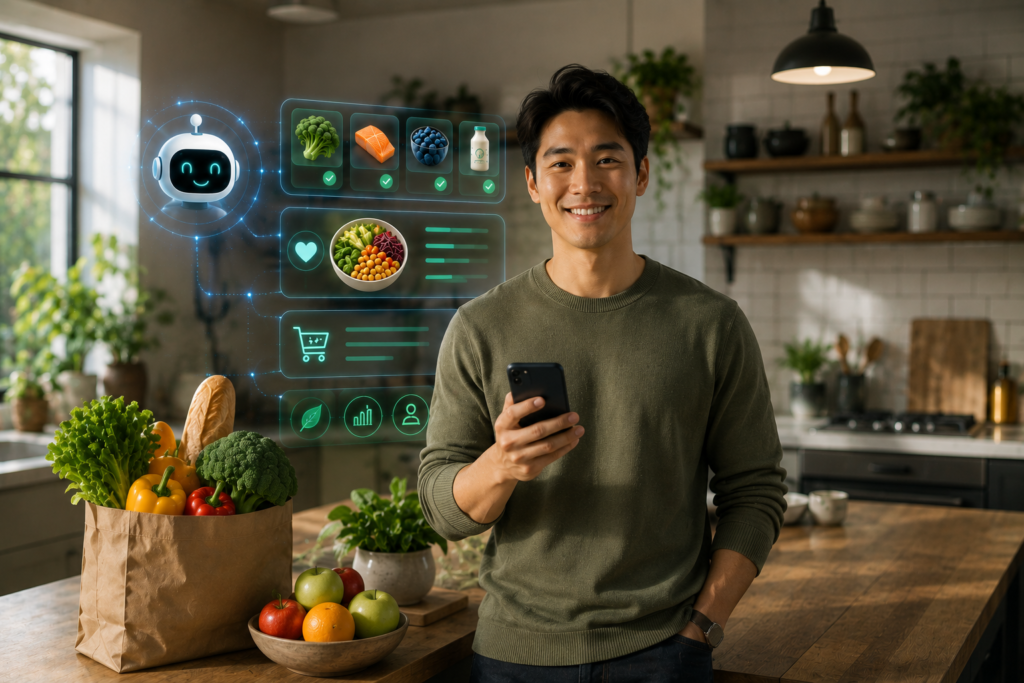
How Food Intelligence, household memory, and real-time intent turn generic personalization into one-to-one grocery experiences
Executive Summary
For decades, grocery retailers have pursued personalization through loyalty programs, digital coupons, recommendation engines, and targeted promotions. Those tools improved relevance, but most still depend heavily on segments and transaction history. They know what shoppers bought. They often do not understand who the shopper is buying for, what the household is trying to accomplish today, or whether a recommendation actually fits the shopper’s diet, budget, pantry, health goals, meal plans, and current intent.
Hyper-Personalized Grocery Shopping represents the next stage. Instead of serving a segment, the experience adapts to an individual household and a specific shopping mission. Recommendations, meal ideas, substitutions, promotions, sponsored products, and even the complete cart can change in real time as context changes.
In grocery, this requires more than a better recommendation algorithm. It requires Food Intelligence to understand the products and Shopper and Household Intelligence to understand the people. It also requires real-time decisioning so the experience can continuously adjust around budget, availability, promotions, nutrition, preferences, and intent.
The result is a shift from personalized marketing to personalized decision-making. That shift matters because the grocery retailer that understands a household most deeply can become more useful every week – and usefulness is a powerful foundation for loyalty.
The core idea Traditional personalization asks: “What is this shopper likely to click or buy?” Hyper-personalization asks: “What is this household trying to accomplish right now, and what is the best grocery outcome for them?” |
What Is Hyper-Personalized Grocery Shopping?
Hyper-Personalized Grocery Shopping is a one-to-one grocery experience in which AI continuously adapts products, meals, carts, offers, content, and guidance to the unique context of an individual shopper or household. It combines persistent shopper understanding with real-time signals so personalization changes as needs, goals, inventory, promotions, and shopping missions change.
The distinction is important. Traditional personalization often starts with a segment: value shopper, health-conscious household, young family, premium buyer. Hyper-personalization starts with the actual household, then asks what is different about this moment.
IBM describes hyper-personalization as the use of AI and real-time data to deliver highly customized interactions at the individual level. Grocery adds another layer of complexity because the system must personalize not only content, but food decisions, meal combinations, quantities, substitutions, health constraints, household needs, and basket economics.
Personalization Stage | What the System Knows | Typical Grocery Experience | Primary Limitation |
Mass marketing | Little individual context | Same circular, same promotion, same digital shelf | Low relevance |
Segment personalization | Cohort, loyalty tier, broad behavior | Offers tailored to a shopper segment | People inside the segment are still treated similarly |
Recommendation engine | Purchase and click patterns | “Recommended for you” products | Predicts products but often misses intent and household context |
Hyper-personalization | Household, food, preferences, behavior, context, intent | Dynamic recommendations, meals, offers, substitutions, and carts | Requires richer intelligence and governance |
Agentic personalization | All of the above plus AI planning and action | AI helps assemble and optimize the shopping outcome | Requires trust, controls, and retailer-grade orchestration |
Shopper Expectations Have Moved Beyond Generic Personalization
Consumers now experience individualized feeds, recommendations, playlists, search results, and offers across much of their digital lives. Grocery shoppers increasingly bring those expectations into retailer apps and websites. Yet grocery still frequently presents the same home page, category hierarchy, search results, and promotion structure to very different households.
The expectation gap is not theoretical. McKinsey research on personalization found that 71 percent of consumers expect personalized interactions and 76 percent become frustrated when they do not receive them. In grocery, that frustration can surface as irrelevant offers, repetitive search, poor substitutions, unsuitable meal suggestions, or a cart that ignores the household’s real constraints.
The problem is that grocery personalization is harder than media or entertainment personalization. A streaming platform can personalize what someone watches. A grocer must personalize decisions that may affect multiple people, a weekly budget, nutrition goals, allergies, meal preparation time, product availability, promotions, and quantities across an entire basket.
That means relevance cannot be reduced to “people who bought this also bought that.” The same shopper may want premium ingredients for a dinner party on Saturday, value-driven staples on Sunday, high-protein lunches on Monday, and a quick pantry-based dinner on Tuesday. The person has not changed. The mission has.
A useful distinction Identity is relatively stable. Intent is dynamic. The best grocery personalization understands both. |
The Five Layers of Hyper-Personalized Grocery Shopping
A useful way to think about hyper-personalization is as five layers of intelligence working together. Each layer adds context that traditional loyalty and recommendation systems often miss.
Layer | Question It Answers | Examples |
1. Identity | Who is the shopper? | Loyalty identity, account, channel, store, known profile |
2. Household | Who are they shopping for? | Family size, children, dietary restrictions, pantry, shared routines, serving sizes |
3. Preferences | What do they generally like? | Brands, cuisines, tastes, price sensitivity, private label affinity, cooking skill |
4. Food Intelligence | What do the products and meals actually mean? | Ingredients, nutrition, allergens, recipes, flavor, dietary compatibility, substitutions |
5. Real-Time Intent | What are they trying to accomplish now? | Dinner tonight, restock, high-protein week, under-$125 trip, party, quick pickup |
The first four layers create memory and understanding. The fifth layer changes the answer in the moment. A household can have stable preferences but different weekly missions, and hyper-personalization should respond accordingly.
Food Intelligence: Personalization Has to Understand Food
Grocery personalization fails when the system understands the shopper better than it understands the food. A recommendation can be behaviorally likely and still be nutritionally inappropriate, allergen-incompatible, irrelevant to the meal, redundant with pantry inventory, or simply a poor substitute.
Delectable AI defines Food Intelligence as the ability to understand food at a scientific, nutritional, and cultural level, connecting ingredients, recipes, nutrition, allergens, flavor relationships, cuisines, health attributes, and product context. This transforms a grocery catalog from a list of SKUs into a set of meaningful food entities that AI can reason about.
For hyper-personalization, that deeper product understanding enables the system to distinguish between products that look similar in a category tree but serve different needs. It can evaluate whether a substitution preserves dietary compatibility, whether a product fits a meal, whether a package size makes sense for the household, or whether a recommendation supports the stated objective.
Trusted nutrition data is one part of that foundation. USDA FoodData Central provides authoritative food-composition data that can support nutrition-aware applications. Retailer-specific AI still needs additional layers – product catalogs, ingredients, recipes, inventory, pricing, and business rules – but reliable food data is essential when personalization moves beyond marketing into actual food decisions.
- Product relevance: Is this item actually appropriate for the shopper’s stated need?
- Meal relevance: Does it fit the recipe, cuisine, preparation method, and serving size?
- Nutrition relevance: Does it align with the shopper’s declared dietary preferences or wellness goals?
- Substitution relevance: Will the alternative preserve function, taste, budget, and dietary compatibility?
- Promotion relevance: Is the promoted item useful in the current mission rather than merely eligible for targeting?
Why this matters A shopper profile without Food Intelligence can personalize the audience. Food Intelligence helps personalize the decision. |
Household Memory: The Shopper Is Not the Whole Shopping Unit
Much of grocery shopping is household shopping. One account may represent parents, children, partners, seniors, athletes, pets, guests, and multiple dietary preferences. Optimizing for only the person holding the phone can produce recommendations that look personalized but fail the household.
This is why Shopper Intelligence must become persistent and household-aware. Delectable AI’s approach combines preferences, purchase patterns, budgets, behavior, and intent with a living memory of the household so the system can adapt over time rather than starting from zero on every visit.
Household memory can include explicit information supplied by the shopper and inferred patterns learned from behavior. The critical design principle is that shoppers should be able to review, correct, and override those assumptions. Memory should reduce work, not trap people inside an outdated profile.
Observed Signal | Possible Context | How Hyper-Personalization Can Respond |
Frequently declines premium substitutions | Price ceiling or value preference | Favor equivalent-value alternatives unless shopper requests premium |
Buys the same staples every four weeks | Recurring replenishment cycle | Surface likely restock needs at the right time |
Often searches for quick dinners on Mondays | Recurring time constraint | Prioritize fast meals and simple preparation early in the week |
Avoids products containing a declared allergen | Household safety requirement | Filter or flag incompatible products and substitutions |
Adds recipes but removes ingredients already purchased | Pantry overlap | Use pantry-aware planning to reduce duplicates |
The value compounds over time. The first interaction may require questions. Later interactions can become shorter because the system remembers what usually matters, then asks only when the current mission is different.
Dynamic Personalization: Relevance Has to Change in Real Time
Hyper-personalization is not a profile stored in a database. It is an ongoing decision process. The system must combine relatively stable preferences with changing conditions: today’s goal, local inventory, promotions, budget remaining, basket composition, time available, weather, events, and the shopper’s responses during the session.
A static recommendation may remain unchanged for weeks. Dynamic personalization can recalculate after every meaningful signal. If the shopper changes Tuesday’s dinner, the meal plan changes. If an item goes out of stock, the substitution changes. If the budget is exceeded, the cart can rebalance. If the shopper says, “This week I care more about convenience than price,” the ranking logic should adjust immediately.
Signal Type | Examples | Personalization Effect |
Persistent | Household size, allergies, favorite brands, cuisine preferences | Sets durable constraints and defaults |
Behavioral | Clicks, purchases, substitutions accepted or rejected | Learns affinities and routines |
Transactional | Basket composition, purchase cadence, price sensitivity | Improves replenishment and basket decisions |
Retail | Inventory, price, promotions, private label, fulfillment slots | Keeps recommendations commercially and operationally grounded |
Real-time intent | Current request, meal mission, budget, urgency, occasion | Changes what is most relevant right now |
This is also where hyper-personalization begins to converge with Agentic Commerce. Once the system can understand context and continuously choose among alternatives, it can do more than rank products. It can plan and optimize the shopping mission.
That progression is central to Agentic Commerce for Grocery: personalization provides relevance; agentic AI turns that relevance into decisions and actions.
The Perfect Cart: Hyper-Personalization at Basket Scale
The strongest expression of grocery personalization is not a personalized banner or one recommended item. It is an entire basket optimized around the household and the shopping mission.
Delectable AI calls this outcome the Perfect Cart – a dynamically generated grocery basket that can consider household preferences, dietary needs, budget, health goals, meal plans, pantry inventory, promotions, product availability, and real-time intent.
Basket-level personalization matters because grocery decisions are interdependent. Choosing one dinner changes the ingredients required. Selecting a larger package can reduce the need for another item. A promotion may make one meal more attractive. A pantry item can eliminate a purchase. A household restriction can change several categories at once.
Recommendation Personalization | Cart-Level Hyper-Personalization |
Optimizes one product at a time | Optimizes the complete shopping mission |
Often based on affinity or prior purchases | Balances household, meal, budget, nutrition, promotion, and availability constraints |
Shopper still assembles the basket | AI can pre-build or continuously improve the basket |
Relevance is local to one placement | Relevance is evaluated across the entire cart |
Success is often a click or conversion | Success can include basket completeness, time saved, value, loyalty, and outcome quality |
The strategic shift Hyper-personalization moves grocery from “the right product for the right shopper” to “the right outcome for this household, in this moment.” |
Retail Media Personalization: From Audience Targeting to Intent
Retail media becomes more useful when personalization improves the shopping experience instead of interrupting it. Traditional targeting often starts with audience segments or past purchases. Hyper-personalized retail media can use the current shopping mission and household context to decide whether an offer or sponsored product is genuinely relevant.
The Interactive Advertising Bureau’s retail media guidance emphasizes retail media’s ability to reach high-intent shoppers. Hyper-personalization can take that idea further by using intent not only to target an audience, but to determine the right moment, product, format, and context for the message.
Delectable AI’s Retail Media & Monetization approach connects Food Intelligence and Shopper Intelligence to precision targeting so sponsored placements can align with the shopper journey while preserving retailer control of the experience and first-party data.
Consider the difference:
- Segment targeting: “This household buys cereal, so show a cereal ad.”
- Context targeting: “This household is building five high-protein breakfasts, so surface a relevant sponsored product that fits those meals.”
- Mission targeting: “The shopper is planning a game-day party; promote products that complete the menu and are available locally.”
- Basket-aware targeting: “The cart already contains the main ingredients; sponsor a complementary item rather than something redundant.”
The retailer must also protect trust. Sponsored content should be distinguishable from neutral recommendations, targeting rules should respect privacy and consent, and sensitive personal data should not be used casually simply because it is technically available.
Hyper-Personalization Requires Trust, Transparency, and Control
The more personalized a system becomes, the more important governance becomes. Grocery can involve sensitive preferences, household information, dietary restrictions, and health-related goals. Retailers should design personalization so shoppers understand the value exchange and retain meaningful control.
The NIST AI Risk Management Framework provides a useful enterprise framework for identifying, measuring, and managing AI risks. For grocery personalization, that translates into practical controls around data quality, explainability, privacy, safety, monitoring, and human oversight.
- Permission and transparency: make it clear what information is being used and why.
- Editable memory: let shoppers correct preferences, household assumptions, and dietary settings.
- Data minimization: collect information that creates real shopper value rather than accumulating data without purpose.
- Grounded recommendations: connect AI outputs to verified retailer catalog, ingredient, nutrition, pricing, and inventory data.
- Sensitive-use boundaries: apply additional safeguards when recommendations touch allergies, health conditions, or other high-consequence decisions.
- Clear sponsored-content labeling: preserve trust by distinguishing advertising from neutral assistance.
- Human control: allow shoppers to review, override, and approve meaningful decisions.
The goal is not maximum personalization at any cost. The goal is useful personalization that earns permission to become more helpful over time.
Retailer Outcomes: Why Hyper-Personalization Matters Economically
Hyper-personalized grocery experiences can create value across the same metrics retailers already manage: loyalty, conversion, basket size, engagement, retail media performance, and the productivity of digital shopping. The strategic difference is that these outcomes come from making the experience more useful rather than simply increasing the volume of messages or promotions.
Retailer Outcome | How Hyper-Personalization Can Contribute | Example |
Higher conversion | Reduces irrelevant choice and improves confidence | Prioritize products that fit the stated mission and household constraints |
Larger, more complete baskets | Connects products to meals, occasions, replenishment, and complementary needs | Build the full dinner solution rather than recommend one ingredient |
Stronger loyalty | Creates a retailer experience that becomes more helpful as it learns | Remember routines, preferences, and recurring household needs |
Faster shopping | Reduces repeated search, filtering, comparison, and list building | Pre-build likely items and let the shopper review exceptions |
Better retail media yield | Improves relevance and timing of sponsored placements | Match paid placements to current intent and basket context |
More valuable first-party data | Captures explicit intent and preference signals through useful interactions | Learn why a shopper rejected a recommendation, not just that they did |
Differentiated digital experience | Moves beyond commodity search and loyalty features | Offer household-aware planning and cart optimization inside the retailer brand |
Importantly, hyper-personalization is not only a front-end experience. It creates a feedback loop. Better intelligence improves recommendations. Better recommendations generate richer signals. Richer signals improve future personalization, merchandising, measurement, and retail media. When that intelligence remains retailer-owned, the retailer’s understanding of the household can become a compounding asset.
What Hyper-Personalized Grocery Shopping Looks Like in Practice
The easiest way to understand hyper-personalization is to compare the same retailer experience across different households and missions.
Shopping Mission | Context the AI Considers | Personalized Outcome |
“Feed my family for under $125.” | Family size, pantry, price sensitivity, promotions, preferred brands, nutrition | Value-optimized meal plan and cart with sensible substitutions |
“I need quick dinners this week.” | Calendar, cooking time, household tastes, pantry, local availability | Fast meal recommendations and a ready-to-review cart |
“Help me eat more protein.” | Stated goal, food preferences, dietary restrictions, meals, current basket | Higher-protein meal and product options that fit the shopper’s normal eating patterns |
“I’m hosting ten people Sunday.” | Guest count, cuisine, budget, quantities, recipes, promotions | Menu, quantities, complementary products, and complete event basket |
“Restock the house.” | Purchase cadence, pantry estimates, household routines, prior substitutions | Likely replenishment cart with exceptions highlighted for review |
None of these outcomes requires the shopper to manually translate the goal into dozens of product searches. The system uses the household’s known context, asks only for missing information that materially changes the answer, and continuously adapts the result as the shopper edits or approves it.
A Practical Maturity Model for Grocery Retailers
Retailers do not need to jump directly from loyalty coupons to autonomous carts. Hyper-personalization can be built progressively, with each stage adding intelligence and shopper value.
Stage | Capability | What Changes |
1. Segment personalization | Rules, loyalty cohorts, static offers | Messages become somewhat more relevant |
2. Predictive personalization | Recommendations from purchase and behavior data | Product ranking becomes individualized |
3. Contextual personalization | Household, food, catalog, and real-time intent | Recommendations reflect the shopping mission |
4. Dynamic basket personalization | Continuous decisioning across the cart | The complete basket adapts to budget, meals, preferences, and availability |
5. Agentic personalization | AI plans, optimizes, and acts with shopper oversight | The system helps complete the shopping outcome, not just recommend products |
The most important architectural decision is to build reusable intelligence rather than a collection of isolated personalization features. Food knowledge, household memory, catalog enrichment, intent, and decisioning should be shared across commerce, promotions, retail media, search, meal planning, and AI assistants.
The Future: From Personalized Products to Personalized Outcomes
For years, the promise of personalization was “the right message or product for the right customer at the right time.” Hyper-Personalized Grocery Shopping expands that promise. The system can personalize not only what a shopper sees, but the way the household plans, decides, and shops.
Over time, the most advanced grocery experiences will become less dependent on manual search. Shoppers will express goals in natural language, and the retailer’s intelligence layer will translate those goals into personalized meals, products, promotions, substitutions, and carts. The experience may begin with conversation, but the value comes from the intelligence behind it.
That is also why hyper-personalization is a critical bridge to Agentic Commerce. An AI agent cannot make useful decisions on behalf of a shopper unless it first understands the household, the food, the retailer, and the current mission. Personalization supplies the context. Agentic AI supplies the planning and action.
The retailers that win will not simply know more about their shoppers. They will use that understanding to remove work, improve decisions, and deliver a grocery experience that feels uniquely useful to every household.
Final thought The future of grocery personalization is not a better recommendation carousel. It is an intelligent, continuously adapting relationship between the retailer and the household. |
Frequently Asked Questions About Hyper-Personalized Grocery Shopping
1. What is Hyper-Personalized Grocery Shopping?
Hyper-Personalized Grocery Shopping is an AI-powered approach that adapts recommendations, meal ideas, promotions, substitutions, and shopping carts to the unique needs of an individual shopper or household. It combines persistent preferences with real-time context such as intent, budget, inventory, promotions, and the current basket.
2. How is hyper-personalization different from traditional grocery personalization?
Traditional grocery personalization often relies on segments, loyalty tiers, purchase history, and product affinity. Hyper-personalization uses richer household, food, behavioral, and real-time intent data to make one-to-one decisions that can change during the shopping journey.
3. How is hyper-personalization different from a recommendation engine?
Recommendation engines typically rank individual products based on historical behavior or similarity. Hyper-personalization evaluates the shopper’s broader mission and household context, allowing the system to personalize meals, substitutions, promotions, and the complete basket rather than one product at a time.
4. Why is grocery especially suited to hyper-personalization?
Grocery is frequent, repetitive, household-based, and highly contextual. Shoppers balance preferences, budgets, allergies, dietary needs, meal plans, promotions, inventory, and time. Those variables create significant opportunity for AI to reduce decision effort and improve relevance.
5. What data is needed for hyper-personalized grocery shopping?
Useful systems combine retailer first-party data with shopper preferences, household context, product catalog data, food and nutrition intelligence, purchase behavior, pantry or replenishment signals, pricing, promotions, inventory, and real-time intent. The exact data should be limited to what creates clear shopper and retailer value.
6. What is Food Intelligence in grocery personalization?
Food Intelligence is structured understanding of ingredients, nutrition, allergens, recipes, dietary compatibility, flavors, cuisines, substitutions, and other food relationships. It helps AI determine whether a product or meal is actually appropriate for the shopper’s stated need.
7. Why is household memory important?
Most grocery trips serve more than one person. Household memory helps AI account for family size, children, dietary restrictions, shared meals, preferred brands, budgets, pantry inventory, and shopping routines so personalization reflects how the household actually shops.
8. What is real-time intent?
Real-time intent is what the shopper is trying to accomplish during the current interaction. Examples include planning dinner tonight, staying under a weekly budget, hosting a party, restocking staples, or finding quick lunches. Intent can temporarily outweigh historical preferences.
9. How does hyper-personalization improve grocery carts?
Instead of optimizing one recommendation at a time, hyper-personalization can evaluate the entire basket. It can balance meals, quantities, pantry inventory, promotions, budget, nutrition, preferences, and availability to create a more complete and useful cart.
10. Can hyper-personalization improve product substitutions?
Yes. A more intelligent substitution system can consider not only category and price, but also dietary compatibility, ingredients, flavor, brand preferences, package size, meal context, budget, and prior substitution behavior.
11. How does hyper-personalization affect retail media?
Retail media can become more contextual by aligning sponsored products and promotions with the shopper’s current mission, household needs, and basket. Retailers should clearly distinguish sponsored content from neutral recommendations and apply appropriate privacy and consent controls.
12. Does hyper-personalization require shoppers to share sensitive data?
Not necessarily. Retailers should use data minimization and collect only information that creates clear value. Shoppers should understand what data is used, be able to edit preferences and household memory, and retain control over sensitive settings and AI-driven decisions.
13. What business outcomes can hyper-personalization improve?
Potential outcomes include higher conversion, larger and more complete baskets, stronger loyalty, faster shopping, improved engagement, better retail media relevance, and richer first-party insight into shopper intent. Results depend on data quality, execution, trust, and integration into the retailer experience.
14. How does hyper-personalization connect to Agentic Commerce?
Hyper-personalization provides the context an AI agent needs to make useful decisions. Once AI understands the household, products, food relationships, retailer conditions, and current intent, it can move from recommending options to planning, optimizing, and taking approved actions on the shopper’s behalf.
15. What is the ultimate expression of hyper-personalized grocery shopping?
The ultimate expression is a dynamically optimized household shopping outcome such as the Perfect Cart: a basket built around the household’s current meals, preferences, restrictions, budget, pantry, promotions, availability, and intent, with the shopper able to review and adjust the result.
Ready to move beyond segments and generic recommendations?
See how Delectable AI combines Food Intelligence, Shopper Intelligence, household memory, real-time intent, and agentic AI to create hyper-personalized grocery experiences and the Perfect Cart for every household.