
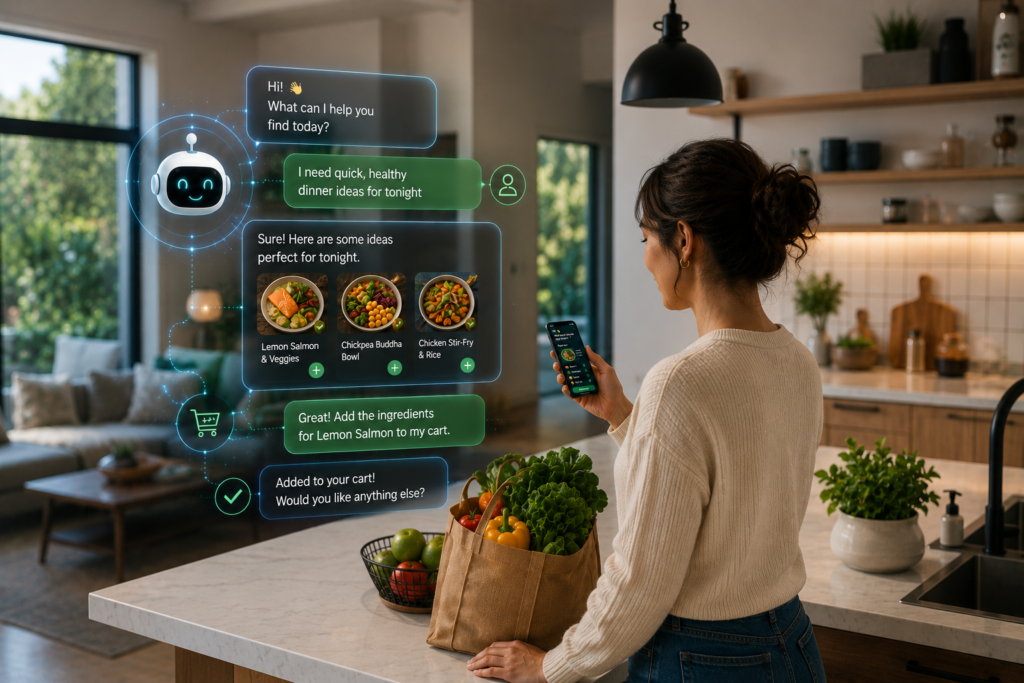
How chat, voice, and AI assistants turn household intent into meal plans, product decisions, and ready-to-review grocery carts
Executive Summary
Grocery eCommerce digitized the store, but it did not eliminate the work of shopping. Consumers still search for products, compare labels, plan meals, remember what is at home, manage budgets, resolve substitutions, and assemble carts one item at a time. The interface changed. The decision burden did not.
Conversational Grocery Commerce changes the interface and, when connected to the right intelligence, begins to change the work. A shopper can describe an outcome in ordinary language: “Plan five dinners under $150,” “What can I make with the chicken in my refrigerator?” or “Add everything we need for school lunches.” The system interprets the request, asks only the questions that matter, and turns the conversation into a useful shopping result.
The strongest conversational grocery experiences combine chat, voice, visual product cards, household memory, Food Intelligence, live retailer data, and shopping actions. They do not stop at answering questions. They help shoppers discover meals, evaluate products, build carts, make substitutions, apply relevant offers, and move toward checkout with less effort.
Conversation is therefore more than a new channel. It is the most natural front door to personalized and eventually agentic grocery commerce. The shopper expresses intent. The retailer-owned intelligence layer translates that intent into decisions and actions.
The core idea |
What Is Conversational Grocery Commerce?
Conversational Grocery Commerce is the use of natural-language chat, voice, and AI assistants to help consumers discover food, plan meals, evaluate products, build carts, and complete grocery shopping tasks. It applies the capabilities described in IBM’s overview of conversational AI to the specific complexity of food and household shopping.
A basic grocery chatbot might answer store hours, order-status questions, or simple product queries. Conversational commerce goes further. It maintains context across turns, understands the shopper’s objective, retrieves information from retailer systems, presents relevant choices, and supports actions such as adding items, changing quantities, selecting substitutions, or building an entire cart.
The conversation may begin in a text box, a retailer app, a voice device, a car, a kitchen display, or a customer-service channel. The channel matters less than the continuity of the intelligence behind it. A shopper should be able to begin with voice, review visually, and finish in the cart without starting over.
Commerce Experience | Primary Interaction | System Role | Typical Grocery Outcome |
Traditional eCommerce | Search, browse, filters | Displays the catalog | Shopper builds the cart manually |
Rule-based chatbot | Menus and scripted questions | Answers predefined requests | Provides information or routes support |
Conversational Grocery Commerce | Natural-language chat or voice | Understands intent and guides decisions | Creates meals, lists, or cart actions |
Agentic Commerce | Goal plus delegated authority | Plans, reasons, and executes multi-step work | Builds and optimizes the complete shopping mission |
A useful distinction |
The Evolution from Search to Conversation
For more than two decades, digital grocery has required shoppers to speak the language of catalogs. Consumers translate real-world needs into keywords, categories, filters, and individual product selections. They may know the outcome they want, but they must decompose it into dozens of item-level decisions.
A parent does not naturally think, “I need SKU 481, SKU 592, and SKU 841.” The parent thinks, “I need quick dinners for three nights, lunches the kids will eat, and enough breakfast food to get through Friday.” Search cannot easily hold that complete objective. Conversation can.
Natural language allows shoppers to express goals, preferences, constraints, and uncertainty in one place. It also lets the system clarify ambiguity. Instead of presenting 200 pasta sauces, the assistant can ask whether the shopper prioritizes low sodium, lower price, a familiar brand, or a sauce suitable for a specific recipe.
This changes digital grocery from a catalog-navigation problem into a guided decision experience. The retailer no longer waits for the shopper to find every product. It participates in understanding and solving the shopping mission.
Shopper Says | Search Interprets | Conversation Can Understand |
“I need easy dinners this week.” | Keywords: easy, dinner | Household size, nights needed, cooking time, preferences, budget |
“Help me eat more protein.” | Keyword: protein | Goal, daily context, meals, preferred foods, budget, dietary constraints |
“We are hosting ten people Sunday.” | Keywords: party, Sunday | Menu, quantities, beverages, dietary needs, pantry, timing |
“Restock the basics.” | No clear product query | Purchase cadence, household essentials, pantry signals, exceptions |
Chat-Based Grocery Shopping
Chat is the most visible form of conversational commerce because it fits naturally inside websites and mobile apps. It gives shoppers the flexibility to describe a need, ask follow-up questions, compare alternatives, and make changes without navigating through multiple screens.
The best chat experiences are not blank boxes that force shoppers to invent the right prompt. They combine open conversation with guided choices, product cards, buttons, editable plans, and visible cart changes. The assistant should reduce effort, not replace familiar controls with a new form of uncertainty.
High-Value Chat Interactions
- Goal-based discovery: “Find three quick dinners my family will eat.”
- Product questions: “Which of these cereals has less added sugar?”
- Meal adaptation: “Make this recipe dairy-free and serve six.”
- Budget guidance: “Keep the cart under $125 and prioritize sale items.”
- Pantry-aware planning: “Use what I already have before adding more.”
- Cart editing: “Swap the premium brands for good private-label options.”
- Fulfillment support: “Show me only items available for pickup tonight.”
Chat also creates an opportunity to capture explicit intent that traditional analytics miss. A click shows what a shopper selected. A conversation can reveal why: a new health goal, a visiting relative, a tight week financially, a child who stopped eating a favorite food, or a desire to reduce cooking time. These signals can improve the current journey and, with permission, future personalization.
Delectable Commerce is designed around this blended model: a conversational shopping assistant supported by meal planning, household context, pantry awareness, product intelligence, and guided or autonomous cart creation inside the retailer’s own experience.
Voice Commerce for Grocery
Voice is especially relevant to grocery because shopping needs often arise away from the retailer’s website. A household notices that milk is low while standing in the kitchen, remembers an ingredient while driving, or decides on dinner while hands are occupied. Voice makes it possible to capture intent at the moment it occurs.
Amazon’s official Alexa Shopping Kit documentation illustrates how voice interactions can support shopping actions such as adding products to a cart or list. For grocery retailers, the strategic opportunity is to connect similar voice moments to a retailer-owned household profile and cart rather than leaving them isolated in a third-party list.
Voice commerce should not be treated as a separate product experience. It should be one input into the same household intelligence layer used by chat, mobile, web, lists, pantry tools, and checkout. A shopper might say, “Add yogurt to the grocery list,” then later review brand, flavor, package size, price, and promotions visually in the retailer app.
Voice Strength | Grocery Example | Design Requirement |
Fast capture | “We are out of olive oil.” | Add intent immediately; resolve product details later |
Hands-free assistance | “What can I make with ground turkey?” | Return concise options and send visuals to the app |
Shared household use | “Add snacks for the soccer tournament.” | Recognize household context and avoid duplicate additions |
Recurring routines | “Start our usual weekend restock.” | Use memory, but clearly show proposed changes before purchase |
Voice also introduces constraints. Long product comparisons are difficult to hear, privacy varies by environment, and errors can be harder to notice without a screen. The strongest design uses voice for capture, clarification, and simple approvals while moving complex review to a visual surface.
AI Assistants: The Intelligence Behind the Conversation
Conversational commerce becomes materially more valuable when an AI assistant can do more than produce fluent responses. The assistant needs memory, domain knowledge, retailer data, tools, permissions, and an orchestration layer that connects language to action.
In grocery, a useful assistant must understand four kinds of context at once:
- Food context: ingredients, nutrition, allergens, recipes, cuisines, substitutions, and meal occasions.
- Shopper and household context: tastes, routines, household members, restrictions, budgets, goals, and prior feedback.
- Retail context: actual SKUs, prices, promotions, availability, private-label priorities, fulfillment, and store location.
- Conversation context: the current request, previous turns, unresolved questions, approvals, and changes already made.
Food Intelligence is particularly important because conversational fluency can create false confidence. The assistant may understand the sentence perfectly but still make a weak grocery decision if it cannot connect ingredients, dietary attributes, recipes, products, and the retailer’s live assortment.
The goal is not to make the assistant sound human for its own sake. The goal is to make the interaction useful: fewer questions, more relevant choices, accurate product grounding, clear explanations, and visible progress toward the shopper’s objective.
Conversational Meal Planning
Meal planning is one of the strongest use cases for Conversational Grocery Commerce because household needs are rarely expressed as precise product requests. The shopper usually starts with an outcome: dinner tonight, lunches for the week, a healthier routine, a holiday menu, or a plan that stays under budget.
As Delectable AI explains in its article on AI Meal Planning for grocery retailers, recipes are only one input. A complete plan also considers pantry inventory, leftovers, household preferences, dietary restrictions, time, nutrition goals, promotions, local inventory, and substitutions.
A Seven-Step Conversational Meal-Planning Workflow
- Capture the objective. The shopper describes the desired outcome in natural language.
- Clarify only material constraints. The assistant asks about household size, nights, budget, time, or dietary needs when the answer changes the plan.
- Use household memory. Known preferences and routines reduce repetitive questions while remaining editable.
- Generate and explain the plan. The assistant presents meals with preparation time, key nutrition or budget tradeoffs, and opportunities to reuse ingredients.
- Check pantry and prior purchases. Items already available are removed or marked for confirmation.
- Map ingredients to real products. The plan is grounded in current assortment, package sizes, promotions, and local availability.
- Build the cart and invite revision. The shopper can change a meal, swap a product, adjust the budget, or approve the result.
Example conversation |
This workflow removes the need to jump among recipe sites, notes, pantry lists, retailer search, nutrition labels, and the cart. Conversation becomes the connective layer that coordinates the full planning process.
Personalized Recommendations Inside a Conversation
Traditional recommendations are usually presented without context: “You may also like” or “Customers also bought.” Conversational recommendations can be more useful because they are connected to an expressed goal and can explain why an option fits.
McKinsey’s research on personalization emphasizes that effective personalization can drive stronger customer and business outcomes. In grocery, conversation adds an important layer by combining historical behavior with current intent.
A shopper who regularly buys premium yogurt may still request a lower-cost week. A household that often purchases meat may be planning vegetarian meals for visiting guests. A familiar brand preference may matter less when the product is unavailable tonight. Conversation reveals the temporary context that transaction history alone cannot provide.
The assistant should also distinguish between a neutral recommendation and a sponsored placement. Retail media can be useful when it helps solve the shopper’s stated objective, but commercial influence should be disclosed and should not override dietary requirements, household preferences, or product suitability.
Recommendation Type | Weak Version | Conversational Version |
Complement | “Customers also bought bread.” | “This soup plan needs a side. Would you prefer lower-cost rolls or a higher-fiber bread?” |
Alternative | “Try this similar item.” | “This private-label option saves $1.80 and matches the size and ingredients you usually choose.” |
Health goal | “High-protein products.” | “For your breakfast goal, this option adds protein without increasing added sugar.” |
Promotion | “Sponsored product.” | “This promoted item fits the recipe and is on sale; the non-sponsored alternative is also available.” |
Conversational Cart Building
The moment conversational commerce becomes economically important is when conversation turns into cart action. Advice may inspire a shopper, but a ready-to-review cart removes work. It shortens the distance between intent and purchase.
Conversational cart building can happen at several levels:
- Item level: add, remove, replace, or change quantities through natural language.
- Recipe level: convert one recipe into exact products and package sizes.
- Meal-plan level: build the ingredients for several meals while reusing overlapping items.
- Mission level: assemble the entire weekly shop, including replenishment, meals, snacks, and household staples.
- Basket-optimization level: adjust the complete cart for budget, nutrition, promotions, preferences, and availability.
At the highest level, the outcome becomes the Perfect Cart: a dynamically generated, household-specific grocery basket built around the shopper’s current objective rather than a generic list of recommended products.
A conversational cart must remain editable. The shopper should be able to say, “Replace Tuesday’s dinner,” “Use more private label,” “Do not change the coffee,” “Remove anything already in the pantry,” or “Get the total below $140.” Each instruction should update the visible cart and preserve the rest of the plan.
This creates a powerful feedback loop. Every accepted product, rejected substitution, protected brand, removed meal, and budget adjustment can improve the assistant’s understanding of the household, subject to the retailer’s privacy and consent policies.
Trust, Control, and Conversation Design
Grocery conversations can involve allergies, dietary restrictions, health goals, budgets, family preferences, and sensitive household patterns. Retailers should not equate a natural-sounding response with a trustworthy decision. Confidence must come from grounded data, transparent logic, and appropriate control.
The NIST AI Risk Management Framework provides a useful general structure for managing AI risk. Applied to Conversational Grocery Commerce, it reinforces the need to govern data, test outputs, define permissions, monitor performance, and keep people appropriately involved.
- Ground product answers in verified retailer catalog, ingredient, allergen, price, promotion, and inventory data.
- Show what changed in the cart after every consequential instruction.
- Ask for approval before checkout, sensitive substitutions, major budget changes, or actions outside established permissions.
- Explain important tradeoffs, especially when price, health, preference, and availability conflict.
- Allow shoppers to correct, pause, delete, or reset remembered preferences and household information.
- Clearly disclose sponsored recommendations and preserve a relevant non-sponsored choice.
- Design for escalation when the assistant lacks confidence or the shopper needs human help.
Trust standard |
Business Benefits for Grocery Retailers
Conversational Grocery Commerce is not only a customer-experience feature. When connected to commerce, intelligence, and measurement, it can improve the economics of digital grocery.
Faster Paths to Purchase
Shoppers can move from a broad need to a curated plan or cart without repeated searches. Reducing decision steps can improve conversion and make large or complex missions easier to complete online.
More Complete Baskets
The assistant can identify missing recipe ingredients, complementary products, replenishment needs, and quantity requirements that shoppers often overlook. Basket growth comes from completing the mission, not merely adding unrelated upsells.
Stronger Loyalty and Habit Formation
A retailer that remembers household routines and makes weekly planning easier becomes increasingly useful. The value compounds as the assistant learns preferences, protected products, accepted substitutions, budget limits, and recurring needs.
Richer First-Party Intent
Conversation reveals goals and context before the transaction. Retailers can learn what the household is trying to accomplish, which tradeoffs matter, and where the experience fails. These signals can improve personalization, merchandising, content, and product strategy.
More Relevant Retail Media
Intent-aware sponsored recommendations can appear when they genuinely help solve a shopping task: a product suited to the recipe, a promoted alternative that meets the budget, or a brand that matches an expressed preference. Relevance, disclosure, and measurement are essential.
A Modern Experience Without Replatforming
Conversational capabilities can be layered into existing retailer sites and apps when the assistant has access to catalog, inventory, pricing, promotions, loyalty, cart, and checkout services. The strategic objective is to make the current ecosystem intelligent, not necessarily replace it.
Retailer Objective | Conversational Capability | Potential Business Effect |
Increase conversion | Goal-based guidance and cart creation | Fewer abandoned, incomplete, or stalled missions |
Grow basket size | Meal and mission completion | More relevant items and complete quantities |
Build loyalty | Persistent household context | A service that becomes easier and more useful over time |
Improve merchandising | Explicit shopper intent and feedback | Better understanding of unmet needs and tradeoffs |
Monetize media | Contextual, disclosed sponsored options | More relevant placements and stronger measurement |
The Evolution Toward Agentic Commerce
Conversational commerce is an important stage in the evolution of digital grocery, but conversation alone is not the destination. A system can be highly conversational and still leave the shopper to perform every meaningful action. The next step is to connect dialogue to planning, decision-making, and execution.
Google Cloud describes this broader transition as the move from passive browsing toward agents that can plan, reason, and act under user supervision. In grocery, this progression leads directly to Agentic Commerce for Grocery, where the system coordinates food, household, retail, and cart decisions to complete an outcome.
The evolution can be understood in four stages:
Stage | Shopper Experience | System Responsibility |
Traditional commerce | Searches and selects | Displays products and processes transactions |
Conversational commerce | Describes needs and refines choices | Understands intent and guides the journey |
Agentic commerce | Sets goals and reviews outcomes | Plans, coordinates tools, and takes approved actions |
Autonomous commerce | Sets policies and handles exceptions | Proactively prepares or executes recurring missions within permissions |
A shopper may begin today by asking for dinner ideas. Tomorrow, the same assistant may create the meal plan and build the cart. Over time, it may prepare the household’s weekly order proactively, ask about exceptions, and wait for approval. Conversation remains important, but it becomes the control surface for a much more capable system.
The strategic progression |
The Future of Conversational Grocery Shopping
The future experience will be multimodal, persistent, and distributed across the household. Shoppers will not think in terms of separate chat, voice, recipe, list, pantry, and cart products. They will expect one intelligent relationship that follows the shopping mission across channels.
A household might save a recipe from a social video, ask by voice whether the ingredients fit its preferences, revise the meal plan in chat, approve a cart in the retailer app, and respond to a fulfillment substitution later that day. Each interaction should share the same understanding of the household, the food, and the current plan.
The assistant will also become more proactive. It may recognize that a recurring item is likely running low, that the family calendar leaves little cooking time, that a planned meal uses ingredients already in the pantry, or that a preferred product is on promotion. Proactivity should remain permission-based and easy to control.
For grocery retailers, the long-term opportunity is to own the trusted conversational relationship before third-party assistants become the default interface between the household and the store. The retailer that owns the intelligence, permissions, product grounding, and cart execution can preserve the shopper relationship while making the experience dramatically more useful.
Conclusion
Conversational Grocery Commerce changes how shoppers express demand. Instead of translating household needs into keywords and individual products, consumers can describe the outcome they want in the language they naturally use.
Chat and voice make the experience easier to enter, but the real transformation happens behind the interface. Food Intelligence gives the assistant product and culinary understanding. Household memory provides context. Retailer data grounds the response in real assortment, price, promotion, and availability. Cart and checkout integrations turn words into useful action.
For shoppers, the result is less searching, remembering, comparing, and rebuilding. For retailers, it is a faster path to purchase, more complete baskets, deeper loyalty, richer intent data, and a direct route from conversation to agentic commerce.
The future of grocery will not be defined by the retailer with the most talkative chatbot. It will be defined by the retailer whose assistant best understands the household and turns every conversation into a trusted, accurate, and increasingly effortless outcome.
Frequently Asked Questions
What is Conversational Grocery Commerce?
Conversational Grocery Commerce uses natural-language chat, voice, and AI assistants to help shoppers discover products, plan meals, compare options, build carts, manage substitutions, and complete grocery shopping tasks. It connects conversation to retailer data and shopping actions.
How is conversational commerce different from a grocery chatbot?
A basic chatbot usually answers predefined questions or routes customer service. Conversational commerce maintains context, understands shopping intent, retrieves product and household information, presents relevant options, and supports actions such as adding items, changing a meal plan, or building a cart.
Why is grocery well suited to conversational commerce?
Grocery needs are often expressed as outcomes rather than exact products. Shoppers want dinner ideas, weekly meal plans, healthier choices, budget help, replenishment, or party planning. Conversation helps translate these broad needs into structured decisions and products.
How does chat-based grocery shopping work?
The shopper describes a need in text. The assistant interprets intent, asks clarifying questions when needed, retrieves relevant products or meals, presents visual options, and supports actions such as adding, removing, comparing, substituting, or building a complete cart.
What is voice commerce in grocery?
Voice commerce allows shoppers to use spoken commands to capture needs, ask questions, add items, start lists, or initiate shopping tasks. It is most useful when connected to the same retailer-owned household profile and cart used across web and mobile.
Can conversational commerce plan meals?
Yes. A conversational assistant can use household size, dietary requirements, preferences, schedule, budget, pantry inventory, promotions, and local availability to create meal plans. It can then map ingredients to products and build the cart.
Can a conversational assistant build an entire grocery cart?
Yes. The assistant can build at the item, recipe, meal-plan, or full-mission level. Shoppers should be able to review the cart, protect preferred products, change meals, adjust the budget, and approve consequential actions.
How does conversational commerce personalize recommendations?
It combines historical behavior with current intent. The assistant can use purchase history, household preferences, pantry context, planned meals, budget, dietary constraints, promotions, and the live cart to explain why an option fits the current mission.
What role does Food Intelligence play?
Food Intelligence helps the assistant understand ingredients, nutrition, allergens, recipes, cuisines, substitutions, dietary compatibility, and meal relationships. Without it, the system may understand the shopper’s words but still make weak or inappropriate grocery decisions.
How should sponsored products appear in a conversation?
Sponsored recommendations should be relevant to the shopper’s stated need, clearly disclosed, and accompanied by appropriate alternatives. Commercial influence should never override allergen safety, dietary requirements, household preferences, or product suitability.
Is Conversational Grocery Commerce safe for dietary and allergy questions?
It can support these needs only when grounded in verified product and ingredient data, supported by clear disclaimers and escalation rules, and designed to avoid presenting recommendations as medical advice. Shoppers should retain control over sensitive decisions.
What are the benefits for grocery retailers?
Potential benefits include faster paths to purchase, more complete baskets, stronger loyalty, richer first-party intent, better merchandising insight, more relevant retail media, and a differentiated digital experience that can extend existing commerce systems.
How does conversational commerce lead to agentic commerce?
Conversational commerce understands and clarifies the shopper’s goal. Agentic commerce adds planning, decision-making, tool use, and approved execution. The conversation becomes the control surface through which shoppers delegate increasingly complex shopping work.
Will voice and chat replace grocery apps and websites?
They are more likely to become an intelligence layer within and across those experiences. Shoppers will still use visual product pages, lists, meal plans, carts, and checkout, but conversation will connect the surfaces and reduce the effort required to move among them.
Ready to make grocery shopping conversational? |