
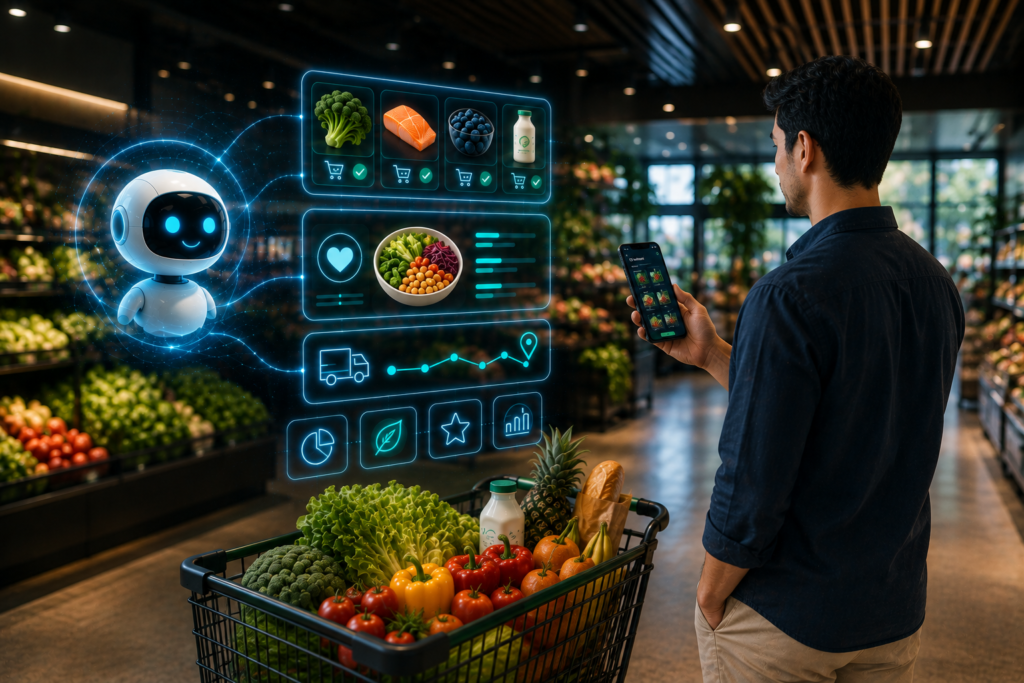
How grocery-specific AI can plan meals, understand households, build carts, and turn conversation into completed shopping missions
Executive Summary
Digital grocery has improved access, but it still places most of the planning and decision-making burden on the shopper. Consumers search for products, compare options, remember what is at home, plan meals, manage budgets, check labels, resolve out-of-stocks, and assemble carts one item at a time. The interface may be digital, but the work remains manual.
The AI-Powered Shopping Assistant changes that relationship. Instead of functioning as another search box or chatbot, a grocery-specific assistant can understand a household goal, reason across preferences and constraints, recommend meals, select products, build a cart, explain tradeoffs, and take approved actions inside the retailer’s own digital experience.
The most valuable assistants will combine natural-language interaction with Food Intelligence, Shopper Intelligence, household memory, live catalog and inventory data, and agentic orchestration. They will help shoppers move from “What should I make this week?” to “Your cart is ready,” while keeping the shopper in control of budgets, substitutions, sensitive dietary decisions, and final approval.
The core idea |
What Is an AI-Powered Shopping Assistant?
An AI-Powered Shopping Assistant is a digital agent that understands a shopper’s goal, uses relevant data and tools, and helps plan, decide, and act across a shopping journey. It combines conversational interaction with the goal-seeking capabilities described in IBM’s overview of agentic AI, including the ability to use memory, retrieve information, coordinate steps, and interact with external systems.
In grocery, the distinction matters. A conventional chatbot can answer “What goes in chicken fajitas?” A capable grocery assistant can adapt the recipe to a household of five, account for a dairy allergy, check pantry ingredients, select products from the retailer’s current assortment, apply promotions, propose acceptable substitutions, and place the complete meal into a cart.
The assistant is therefore not defined by the chat window. Conversation is only the interface. The real value comes from the intelligence and actions behind it.
Experience | Primary Function | What the Shopper Still Does | Grocery Example |
Search | Finds products matching keywords | Defines every need and selects every item | Searches for “low-sodium soup” |
Recommendation engine | Predicts products the shopper may like | Evaluates relevance and builds the basket | Shows “recommended for you” products |
Chatbot | Answers questions in natural language | Translates advice into products and actions | Suggests three dinner ideas |
AI-Powered Shopping Assistant | Understands goals and coordinates decisions and actions | Reviews, guides, and approves the proposed outcome | Plans dinners and builds the cart |
For grocery retailers, this experience can live directly inside a branded website or mobile app. Delectable Commerce is designed around this model: an embedded personal shopper agent that combines meal planning, pantry awareness, personalized recommendations, and guided or autonomous cart creation.
Why Grocery Requires a Purpose-Built Assistant
Many shopping assistants can compare prices, summarize reviews, or answer general questions. Grocery demands something deeper because food decisions are frequent, interconnected, perishable, personal, and often shared across an entire household.
1. Grocery Starts with Outcomes, Not Products
A shopper rarely begins with a precise SKU list. The real objective may be to feed a family for five days, prepare quick lunches, stay within a weekly budget, support a high-protein goal, use ingredients already at home, or host ten people on Sunday. The assistant must translate the outcome into meals, quantities, products, and a complete basket.
2. Food Products Have Meaning Beyond Their Labels
A grocery item is simultaneously a product, an ingredient, a nutrition profile, a potential allergen, a flavor component, a recipe input, a dietary choice, and a household preference. Basic catalog fields such as brand, category, price, and package size do not provide enough context for reliable grocery assistance.
3. Household Needs Are Often Conflicting
One shopping account may serve adults, children, athletes, seniors, guests, pets, different taste preferences, multiple dietary restrictions, and one shared budget. The assistant must optimize across the household rather than personalize only to the person holding the phone.
4. The Correct Answer Changes in Real Time
Inventory, promotions, package sizes, prices, pickup windows, seasonality, pantry contents, and the shopper’s immediate mission can all change. A useful assistant needs access to live retailer data, not only general knowledge learned during model training.
5. Grocery Repeats and Should Become Easier Over Time
The household replenishes many of the same essentials, repeats favorite meals, follows recurring schedules, and develops predictable acceptance patterns for brands and substitutions. Persistent memory allows the assistant to reduce questions and improve decisions with every interaction.
Grocery-specific principle |
The Intelligence Behind a Grocery-Specific Assistant
A convincing conversational interface can be built quickly. A consistently useful grocery assistant requires a much richer foundation. Four capabilities work together.
Food Intelligence
Food Intelligence helps the assistant understand ingredients, nutrition, allergens, recipes, dietary compatibility, flavor relationships, cuisines, meal occasions, and health-related attributes. Authoritative sources such as USDA FoodData Central provide essential food-composition data, but retailers still need an intelligence layer that connects those facts to products, recipes, households, and shopping decisions.
Without Food Intelligence, an assistant may understand the words in a request while missing the food relationships required to answer safely and usefully. It may recommend an item with the wrong ingredient, select a substitution that breaks a recipe, or optimize a single nutrient while ignoring the rest of the meal.
Shopper and Household Intelligence
The assistant needs a living understanding of the people it serves: preferred brands and cuisines, disliked ingredients, dietary restrictions, allergies, health goals, budget sensitivity, cooking skill, schedule, purchase cadence, pantry inventory, saved meals, and accepted substitutions. Household memory turns isolated sessions into an ongoing relationship.
Agentic Orchestration
The system must break a goal into steps, call the appropriate data and tools, evaluate alternatives, and coordinate the result. One agent might create the meal plan, another retrieve product candidates, another calculate quantities, another optimize budget, and another verify that the final cart respects the household’s constraints and retailer rules.
Retailer Integration
The assistant must operate against the retailer’s actual catalog, prices, promotions, loyalty benefits, inventory, fulfillment options, and checkout. That connection is what turns general advice into a retailer-ready shopping experience and keeps the relationship, data, and revenue inside the retailer’s ecosystem.
Intelligence Layer | What It Understands | What It Enables |
Food Intelligence | Ingredients, nutrition, allergens, recipes, flavor, diets, meal context | Relevant meals, better product matching, safer substitutions |
Shopper Intelligence | Individual preferences, behaviors, goals, price sensitivity, current intent | One-to-one recommendations and explanations |
Household Intelligence | Family members, pantry, routines, shared budget, competing needs | Household-level planning and cart optimization |
Retail Intelligence | Catalog, inventory, pricing, promotions, loyalty, fulfillment | Store-ready actions using products the retailer can actually sell |
Agentic Orchestration | Goals, constraints, steps, tools, permissions, feedback | Planning, decision-making, cart building, and approved execution |
Meal Planning Is the Most Natural Assistant Workflow
Meal planning sits at the center of grocery because it connects the household’s real question to the retailer’s catalog. Consumers are usually not searching for recipes as an end in themselves. They are trying to decide what to make, what they can afford, what fits their schedule, what everyone will eat, and what needs to be purchased.
A strong AI meal planning workflow treats recipes as one signal inside a broader decision process. The assistant must combine meal ideas with pantry inventory, household preferences, nutritional goals, promotions, quantities, and available SKUs.
Workflow Step | Assistant Action | Shopper Experience |
1. Understand the goal | Interprets the request, timeframe, household size, budget, and constraints | “Plan four quick dinners under $100.” |
2. Retrieve context | Loads preferences, pantry signals, schedule, purchase history, and saved meals | The assistant already knows the family dislikes mushrooms |
3. Create the plan | Selects meals that share ingredients and fit time, nutrition, and variety goals | A balanced week appears instead of a list of random recipes |
4. Calculate needs | Determines servings, quantities, shared ingredients, and pantry gaps | The list avoids duplicates and excessive package sizes |
5. Map to products | Selects available retailer SKUs, preferred brands, private label, and promotions | Each ingredient becomes a shoppable product |
6. Optimize the cart | Balances price, nutrition, convenience, availability, and household preferences | The shopper sees savings and tradeoffs before checkout |
7. Review and learn | Explains decisions, accepts edits, and stores feedback for the next trip | “Swap Tuesday’s meal” improves future recommendations |
The workflow advantage |
Personalized Recommendations Must Understand Intent
Personalization is already an important retail expectation. McKinsey’s research on retail personalization emphasizes that effective personalization extends across the customer experience and depends on proprietary data, decisioning, design, and delivery. An AI-Powered Shopping Assistant can take that evolution further by personalizing decisions and outcomes, not merely content and offers.
Traditional recommendation engines are usually backward-looking. They infer that a shopper may want something because the shopper or similar customers bought it before. That remains useful, but grocery assistants also need to understand why the person is shopping today.
The same shopper may want very different products for a routine replenishment trip, a child’s birthday, a high-protein week, a holiday meal, a tight-budget week, or a quick dinner after a late meeting. Real-time intent changes the meaning of historical behavior.
- Purchase history suggests familiar brands, sizes, and replenishment cycles.
- Household profiles identify dietary restrictions, tastes, budgets, and serving needs.
- Meal plans reveal the purpose of ingredients and complementary products.
- Pantry awareness shows what should not be purchased again.
- Current cart contents reveal gaps, conflicts, and opportunities to complete the mission.
- Promotions and inventory determine which recommendation is actionable now.
- Conversation reveals immediate intent, urgency, and willingness to make tradeoffs.
A recommendation becomes genuinely useful when the assistant can explain it: “I selected the store-brand chickpeas because they meet the recipe requirement, cost less, and you accepted this substitution twice before.” Explanation gives shoppers confidence and gives retailers a visible standard for relevance.
Smart Substitutions Protect the Meal, Not Just the Category
Out-of-stock substitution is one of the clearest tests of a grocery assistant. A simplistic system finds another item in the same category. A smart assistant understands what role the product plays in the household’s plan and selects an alternative that preserves the intended outcome.
This is especially important when allergens are involved. The FDA’s food-allergen guidance explains the importance of ingredient and major-allergen labeling. An assistant should never infer that a replacement is safe merely because products appear similar. It should rely on verified product attributes, clear confidence thresholds, and shopper approval where risk is material.
Substitution Dimension | Question the Assistant Must Answer | Example |
Intended use | What job does the product perform in the meal or household? | A baking ingredient may need different properties than a snack |
Allergens and diet | Does the replacement respect all household restrictions? | A dairy-free product cannot be replaced with a milk-based alternative |
Flavor and texture | Will the alternative preserve the eating experience? | A mild salsa may be preferable for a child-focused meal |
Nutrition and health | Does the product align with the shopper’s stated goal? | A lower-sodium option may matter more than brand similarity |
Brand and preference | How flexible is this shopper in this category? | The shopper may accept private label for staples but not coffee |
Price and package size | Does the tradeoff fit the budget and required quantity? | A larger package may create waste even when unit price is lower |
Availability and fulfillment | Can the item be fulfilled in the selected store and time window? | The best theoretical substitute is useless if it is not in stock |
The assistant should also learn from corrections. When a shopper rejects a premium substitute, prefers a specific texture, or refuses a brand change in one category, that feedback should improve the next decision. Over time, substitutions become a household capability rather than a last-minute guess.
Conversation Becomes the Interface for Grocery Decisions
Conversation reduces the distance between a shopper’s goal and the retailer’s ability to fulfill it. Instead of knowing the correct search terms, menu path, filter, or product taxonomy, the shopper can describe the situation in ordinary language.
- “Give me three dinners my children will eat, with less than 30 minutes of cooking.”
- “Use what I already have and keep the additional groceries under $60.”
- “Rebuild last week’s cart but replace two dinners with something lighter.”
- “Find a peanut-free snack for the school trip and explain why it fits.”
- “I am hosting ten people. Build the food and beverage list.”
The best experience will not force every interaction through open-ended chat. It will combine natural language with guided buttons, editable plans, visual product cards, one-tap approvals, voice input, notifications, and direct manipulation of the cart. The assistant should be universal across the retailer’s app, available wherever the shopper is planning, browsing, managing a list, reviewing a pantry, or checking out.
Conversation also supports progressive disclosure. The assistant can ask only the question needed to resolve an important ambiguity: “Is the $125 budget for dinners only or the entire weekly cart?” Once the answer is known, it can remember the preference and reduce future friction.
Experience principle |
Real-World Grocery Assistant Use Cases
The Busy Family
“Plan five weeknight dinners. Two nights need to be ready in 20 minutes, and Thursday must use the chicken already in my freezer.” The assistant creates the plan, uses pantry and freezer context, calculates servings, maps ingredients to available products, and builds the cart for review.
The Budget-Conscious Household
“Keep the full order under $150 without removing school lunches.” The assistant protects essential categories, uses shared ingredients across meals, selects relevant promotions and private-label alternatives, and explains which tradeoffs preserve the most value.
The Health-Focused Shopper
“Build a high-protein week with quick breakfasts and lower-sodium dinners.” The assistant creates meals and product options aligned to the stated goals, while presenting nutrition information and avoiding claims that exceed verified data or retailer policy.
The Pantry-First Cook
“What can I make with rice, black beans, spinach, and the vegetables I bought Sunday?” The assistant proposes recipes, identifies missing ingredients, adjusts quantities, and converts the selected meals into a compact shopping list.
The Event Planner
“I am hosting a game-day party for twelve adults and six children.” The assistant recommends a menu, accounts for dietary restrictions, estimates quantities, checks promotions, suggests beverages and serving supplies, and builds a complete event cart.
Across these use cases, the desired outcome is not a stream of recommendations. It is a complete, reviewable basket. Delectable AI describes that outcome as the Perfect Cart: a dynamically generated cart optimized around the household, the mission, the budget, health and dietary needs, pantry inventory, promotions, and real-time retail context.
Retailer Benefits of an AI-Powered Shopping Assistant
The assistant is not only a consumer convenience feature. It changes the economics and strategic position of the retailer’s digital experience.
Retailer Benefit | How the Assistant Creates It | Why It Matters |
Higher conversion | Turns broad goals into complete, shoppable plans and carts | Fewer shoppers abandon the journey because they cannot find or decide |
Larger, more complete baskets | Connects meals, ingredients, replenishment, and complementary needs | The basket reflects the full mission instead of isolated searches |
Stronger loyalty and retention | Remembers the household and improves with every interaction | The experience becomes more valuable and harder to replace |
Richer first-party intelligence | Captures intent, preferences, corrections, plans, and tradeoffs | Retailers learn why households shop, not only what they purchased |
Better merchandising | Makes promotions, private label, seasonal products, and prepared foods contextually useful | Merchandising becomes part of solving the shopper’s goal |
More relevant retail media | Places sponsored products inside meals, plans, and high-intent decisions | Advertising can improve the journey while increasing monetization |
Digital differentiation | Moves the retailer beyond generic search and recommendation experiences | Regional and national grocers can compete on intelligence and service |
Retailers also do not need to replace their entire commerce platform to begin. An agentic experience and intelligence layer can integrate with existing catalog, loyalty, inventory, pricing, promotion, fulfillment, and checkout systems. The strategic goal is to make the current stack more intelligent and coordinated, not to discard every system that already works.
Trust, Control, and Responsible Assistance
The more an assistant can do, the more important trust becomes. Grocery includes sensitive information, health-related preferences, allergen risk, children’s needs, budgets, and sponsored recommendations. The assistant must be designed to earn confidence through accurate data, transparency, permissions, and clear escalation.
The NIST AI Risk Management Framework provides a useful foundation for incorporating trustworthiness into the design, development, use, and evaluation of AI systems. For grocery assistants, that principle should translate into practical controls.
- Ground product recommendations in verified retailer catalog and inventory data.
- Separate general wellness guidance from medical advice and high-risk health claims.
- Use explicit rules and approval steps for allergens, sensitive substitutions, unusual spending, and recurring orders.
- Explain why products, promotions, and sponsored placements are being recommended.
- Allow shoppers to edit, reject, correct, and reset remembered preferences.
- Protect household data through clear consent, security, retention, and access policies.
- Measure errors, rejected recommendations, substitution acceptance, and escalation patterns, not only conversion.
Trust standard |
From Shopping Assistant to Household Agent
Today’s assistants mainly answer questions, recommend products, and help build carts. The next generation will manage longer-running household goals. It will remember recurring needs, monitor pantry and purchase cadence, prepare weekly plans, coordinate shared lists, recognize schedule changes, and proactively suggest a cart before the shopper starts searching.
This progression is the practical path toward Agentic Commerce for Grocery. Conversation becomes the starting point, but the system’s value increasingly comes from planning, reasoning, orchestration, and action.
The assistant will also become more distributed. A shopper may begin by speaking to a phone, add an item through a voice device, approve a meal plan in the retailer app, receive a substitution notification during fulfillment, and review a replenishment suggestion later in the week. One household memory should connect those moments.
The retailer that owns this relationship becomes more than a place to buy groceries. It becomes a trusted decision partner that helps the household plan, save time, manage budgets, discover food, and make better choices every week.
Conclusion
The rise of the AI-Powered Shopping Assistant is not primarily about adding a chat box to grocery eCommerce. It is about changing who performs the work. Search asks shoppers to translate goals into products. Recommendation engines present likely options. A grocery-specific assistant understands the goal, coordinates the decisions, and helps deliver the outcome.
To do that well, the assistant needs more than a language model. It needs Food Intelligence, Shopper and Household Intelligence, persistent memory, retailer data, agentic orchestration, and a trust framework that keeps shoppers informed and in control.
For consumers, the result is less planning, searching, comparing, remembering, and rebuilding. For retailers, it is a more differentiated experience, stronger loyalty, more complete baskets, richer first-party intelligence, and new opportunities to make merchandising and retail media genuinely useful.
The winning grocery assistant will not be the one that talks the most. It will be the one that understands the household best and completes the most work accurately, transparently, and effortlessly.
Frequently Asked Questions
What is an AI-Powered Shopping Assistant?
An AI-Powered Shopping Assistant is a digital agent that understands a shopper’s goal and helps plan, decide, and act across the shopping journey. In grocery, it can recommend meals, identify products, build lists and carts, suggest substitutions, apply relevant promotions, and learn from household feedback.
How is an AI shopping assistant different from a chatbot?
A chatbot primarily answers questions. An AI shopping assistant can use data, memory, tools, and retailer systems to complete tasks. Conversation is the interface, while planning, product selection, cart building, optimization, and approved actions provide the practical value.
Why does grocery need a purpose-built AI assistant?
Grocery decisions require knowledge of food, ingredients, nutrition, allergens, recipes, households, budgets, pantry inventory, promotions, live inventory, and fulfillment. General assistants may understand language but lack the structured grocery intelligence and retailer integration needed to make consistently useful decisions.
Can an AI shopping assistant plan meals?
Yes. The assistant can interpret a household’s schedule, preferences, dietary needs, budget, pantry inventory, and retailer promotions to create a meal plan. It can then calculate quantities, identify missing ingredients, map them to available products, and build a cart.
Can an AI shopping assistant build an entire grocery cart?
Yes. A grocery assistant can convert a goal such as “feed my family for the week under $175” into meals, quantities, product selections, promotions, substitutions, and a complete cart. The shopper can review and edit the result before checkout.
How does an AI shopping assistant personalize recommendations?
It combines purchase history with preferences, household composition, current intent, pantry context, planned meals, budget, promotions, and live cart contents. This allows recommendations to reflect why the household is shopping today rather than relying only on past product affinity.
How do smart grocery substitutions work?
The assistant evaluates the intended use, ingredients, allergens, dietary requirements, flavor, texture, nutrition, brand preferences, price, package size, and availability. It should use verified product data and request shopper approval when the substitution carries meaningful risk or tradeoffs.
Can an AI shopping assistant support household members with different needs?
Yes. Household Intelligence allows the assistant to balance multiple tastes, age groups, dietary restrictions, allergies, health goals, schedules, and one shared budget. The goal is to optimize the complete household outcome rather than personalize only to one account holder.
Can shoppers use voice with an AI shopping assistant?
Yes. Voice can be one input method alongside chat, guided buttons, visual plans, product cards, and cart editing. The strongest experience will allow shoppers to move naturally among voice, text, and direct interaction without losing household context.
How can an AI shopping assistant help shoppers save money?
The assistant can use promotions, private-label alternatives, shared ingredients across meals, pantry awareness, lower-cost substitutions, package-size tradeoffs, and basket-level optimization to help the household stay within budget while protecting important preferences and needs.
What are the benefits for grocery retailers?
Retailers can improve conversion, increase basket completeness, strengthen loyalty, capture richer first-party intent signals, improve merchandising relevance, create better retail media placements, and differentiate their digital experience without necessarily replacing the current commerce platform.
What data does a grocery shopping assistant need?
Useful assistants typically combine retailer catalog data, ingredients and nutrition, inventory, pricing, promotions, loyalty and purchase history, household preferences, pantry signals, recipes, shopping behavior, fulfillment options, and real-time intent. Data quality and governance are essential.
How should retailers manage trust and risk?
Retailers should ground recommendations in verified data, define permissions and confidence thresholds, disclose sponsored content, require approval for sensitive actions, protect household data, provide explanations, and allow shoppers to correct or reset memory. Performance should be measured through quality and trust metrics as well as sales.
Will AI shopping assistants replace grocery websites and apps?
They are more likely to become the universal intelligence layer within those experiences. Search, browse, recipes, lists, pantry, meal planning, promotions, and checkout will remain useful surfaces, but the assistant will connect them and help the shopper move through the journey with less manual effort.
Ready to explore the AI-Powered Shopping Assistant? |