
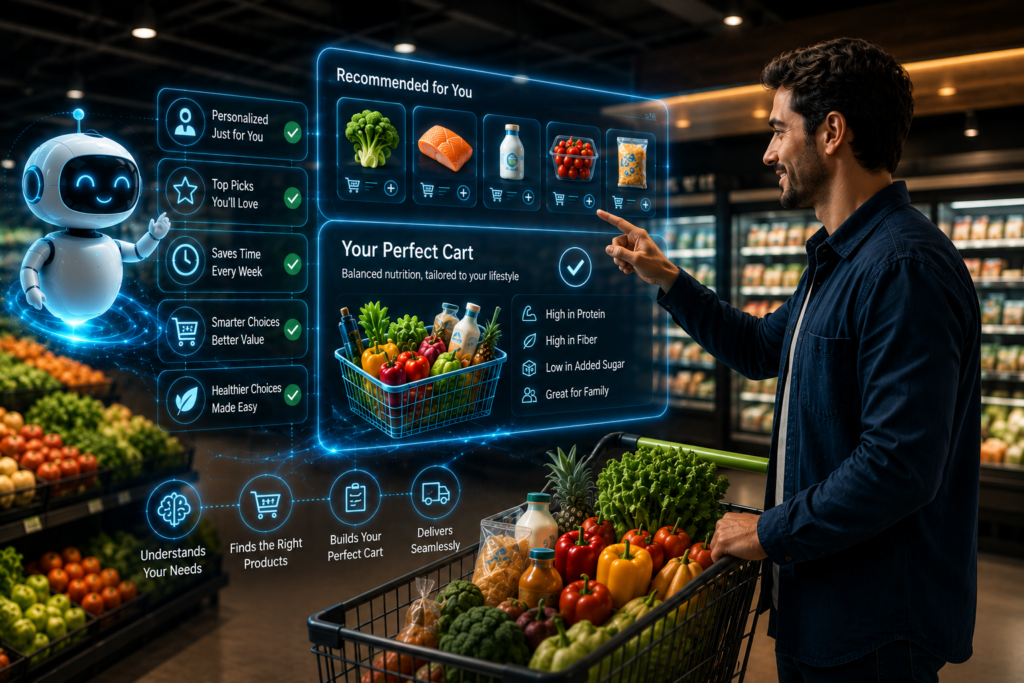
How intelligent agents are moving grocery from recommendations and chatbots to coordinated shopping, merchandising, and retail media execution
Agentic AI for Grocery Retail
Grocery retailers have spent years applying artificial intelligence to isolated tasks such as search, recommendations, forecasting, customer service, and promotion targeting. These systems can improve individual decisions, but most still wait for a shopper or employee to initiate every step and connect the results manually.
Agentic AI changes the operating model. Instead of generating a single answer or ranking a list of products, AI agents can interpret a goal, create a plan, coordinate data and tools, evaluate alternatives, and execute actions within retailer-defined rules. In grocery, that can mean planning meals, building carts, selecting substitutions, optimizing promotions, assisting merchants, and activating retail media as one connected workflow.
The opportunity is not simply a better chatbot. It is a retailer-owned intelligence and orchestration layer that connects shopper intent, household context, Food Intelligence, catalog data, inventory, pricing, promotions, commerce, and media. That is how Agentic AI for Grocery Retail can transform both the shopper experience and the retailer operating model.
Definition |
What Is Agentic AI?
Agentic AI refers to AI systems that can pursue a goal with limited supervision. Unlike a conventional chatbot that responds to a prompt, an agent can determine which steps are required, use tools or data sources, assess the result, and continue working until the objective is achieved or human approval is needed.
That capability rests on four behaviors:
- Understand the goal and the constraints surrounding it
- Plan a sequence of actions rather than produce one isolated response
- Use data, software tools, APIs, models, and business rules to complete the work
- Evaluate progress, adapt to changing conditions, and escalate when confidence is low
For grocery retail, the goal is rarely as simple as “find a product.” A shopper may want to feed a family for a week, follow a diet, host a party, replenish essentials, or save money. A merchant may need to improve a category, respond to excess inventory, or create a promotion. A retail media team may need to identify the most relevant sponsored placement without compromising shopper trust.
Agentic AI can turn each of those objectives into a coordinated workflow. It does not replace all human judgment. It reduces repetitive decision-making, connects fragmented systems, and brings the right human into the process when policy, uncertainty, or strategic judgment requires it.
From Generative AI to Agentic AI
Capability | Generative AI | Agentic AI |
Primary role | Creates an answer, summary, image, or recommendation | Works toward a goal and coordinates the steps required |
Typical interaction | Prompt and response | Plan, act, evaluate, and adapt |
Connection to systems | Often limited to retrieved information | Uses tools, APIs, data, rules, and workflows |
Decision scope | One task at a time | A connected mission across multiple tasks |
The transformation |
Why AI Agents Matter in Retail
Retail is built on thousands of interconnected decisions. Shoppers search, compare, plan, respond to promotions, adjust for availability, and assemble baskets. Retail teams forecast demand, manage assortments, create campaigns, approve content, allocate media, and monitor performance. Most of these activities cross multiple systems and organizational boundaries.
McKinsey research on agentic commerce describes a rapidly emerging ecosystem in which shopping agents can influence discovery, evaluation, and transactions. McKinsey estimates that agents could mediate trillions of dollars in global consumer commerce by 2030. The strategic implication for retailers is significant: the primary interface to commerce may increasingly become an intelligent agent rather than a traditional search box or category page.
Retail agents can operate on both sides of the business:
Shopper-Facing Agents
- Interpret natural-language goals and shopping missions
- Plan meals, events, and recurring household needs
- Build, explain, and continuously improve a cart
- Compare products and select appropriate substitutions
- Apply relevant promotions and request approval for tradeoffs
Retailer-Facing Agents
- Assist merchants with assortment, promotion, and category decisions
- Monitor performance signals and surface exceptions that need attention
- Automate campaign setup, content review, and workflow approvals
- Coordinate retail media placements with shopper context and inventory priorities
- Generate analysis and recommended actions from fragmented operational data
The larger opportunity appears when these agents share an intelligence layer and coordinate rather than operate as disconnected copilots. A shopper agent can understand the mission, a food agent can evaluate compatibility, an inventory agent can verify availability, a promotion agent can optimize value, and a media agent can introduce relevant sponsored choices. Orchestration turns those specialized capabilities into one coherent experience.
Why Grocery Requires Purpose-Built Agentic AI
Every retail category has complexity, but grocery combines several forms of complexity in every transaction. Products are consumed together, households have competing needs, inventory changes quickly, prices and promotions matter, and many decisions affect nutrition, allergens, health goals, culture, and daily routines. A fluent general-purpose model is not enough. Agentic AI for Grocery Retail must reason with structured, retailer-specific intelligence.
1. Food Is More Than a Product Record
A grocery item has a UPC, brand, size, category, price, and package description. It also has ingredients, nutrients, allergens, dietary compatibility, flavor, cuisine, recipe relationships, meal occasions, and health implications. USDA FoodData Central demonstrates the depth of nutrient and food-composition data that may be relevant to a single decision. Effective grocery agents must connect that type of knowledge to the retailer catalog and the shopper mission.
2. Foundational Product Data Must Become Decision Intelligence
Standards such as the GS1 Global Data Model help retailers and brands exchange consistent foundational product attributes. Agentic shopping requires an additional layer of intelligence that connects those records to recipes, diets, substitutions, household preferences, promotions, and real-time context. A product record tells the system what the item is. Decision intelligence helps the agent determine when and why it belongs in a particular cart.
3. The Household Is the Real Unit of Grocery Demand
One person may place the order, but the basket often serves several people. A household can include different tastes, age groups, allergies, schedules, health goals, and budget priorities. The agent must balance those needs across the entire mission rather than optimize for a single account holder or a single product click.
4. Grocery Decisions Are Basket-Level Decisions
A substitution affects the meal. A promotion affects the budget available for another category. A larger package can reduce unit cost but create waste. A healthy item may be nutritionally appropriate but rejected by the family. Grocery agents must reason across the full cart, not optimize each recommendation independently.
5. Real-Time Conditions Change the Answer
Inventory, prices, promotions, fulfillment windows, weather, events, and shopper intent can change quickly. The best decision at the start of a session may not be the best decision at checkout. Agentic systems need to retrieve current conditions, recalculate options, and explain meaningful changes.
6. Trust and Safety Are Part of the Product
Dietary restrictions, allergies, wellness goals, sponsored placements, privacy, and automated purchasing introduce risk. A retailer must define which decisions an agent may make, which require confirmation, what data may be used, and how recommendations are explained. Trust cannot be added after the agent is deployed. It must be designed into the workflow.
How Agentic Orchestration Works in Grocery Commerce
No single model should be expected to understand every shopper, product, promotion, policy, and operational constraint. A more practical architecture uses specialized agents and services coordinated by an orchestration layer. Each component performs a bounded role, while shared context keeps the experience coherent.
The Delectable Agentic Experience Platform (AXP) illustrates this model by unifying Food Intelligence, shopper and household context, real-time personalization, retailer data, and agentic orchestration across commerce and media.
Agent or Service | Primary Responsibility | Example Output |
Intent Agent | Interprets the goal, constraints, urgency, and required approvals | “Plan five dinners under $150” becomes a structured mission |
Shopper and Household Agent | Retrieves preferences, routines, dietary needs, and household memory | Identifies accepted cuisines, dislikes, allergies, and portion needs |
Food and Catalog Agent | Understands products, ingredients, nutrition, recipes, and substitutions | Finds compatible products and meal relationships |
Planning Agent | Creates meals, lists, quantities, and task sequences | A weekly meal plan with required ingredients |
Cart Optimization Agent | Balances budget, nutrition, convenience, availability, and basket completeness | An optimized cart with explained tradeoffs |
Inventory and Fulfillment Agent | Checks availability, location, delivery windows, and substitution options | Replaces an unavailable item while preserving the meal |
Promotion Agent | Evaluates offers, loyalty eligibility, and private-label alternatives | Applies the most relevant savings to the mission |
Retail Media Agent | Selects contextually appropriate sponsored opportunities within policy | A sponsored product that fits the recipe and household constraints |
The orchestration layer manages sequence, shared context, tool access, business rules, and confidence thresholds. It can also record why a decision was made, making the system easier to measure, audit, and improve.
Orchestration principle |
Real-World Use Cases for Agentic AI in Grocery Retail
1. Goal-Based Shopping and Cart Building
A shopper says, “Build my weekly order, include five family dinners, and keep it under $175.” The agent translates the request into a plan, checks household preferences and pantry signals, selects meals, calculates quantities, evaluates promotions, confirms availability, and creates a cart for review.
This experience can be delivered through Delectable Commerce, which embeds a grocery-focused AI assistant, meal planning, pantry-aware shopping, and automated cart creation into retailer websites and mobile apps.
2. The Perfect Cart
The shopper does not want a random collection of individually relevant products. The shopper wants the right complete basket for the household and the current mission. Agentic AI can optimize the full cart around meals, preferences, health goals, dietary needs, budget, promotions, pantry inventory, and availability.
At Delectable AI, this outcome is called the Perfect Cart: a dynamically generated grocery basket built by AI and guided by the shopper.
3. Intelligent Substitutions
When an item is unavailable, a conventional substitution engine may prioritize category, brand, size, or price. An agent can evaluate the intended meal, allergen restrictions, dietary compatibility, flavor, quantity, household acceptance, and budget. It can then select a better alternative or ask the shopper when no option meets the required confidence threshold.
4. AI Meal Planning and Recipe-to-Cart Automation
A meal-planning agent can create a plan around schedule, cuisine preferences, nutrition goals, available pantry items, preparation time, and weekly budget. It can convert recipes into purchasable SKUs, consolidate duplicate ingredients, calculate quantities, and update the cart when the shopper swaps a meal.
5. Automated Replenishment with Shopper Control
Recurring purchases are well suited to progressive autonomy. The agent can estimate when staples are likely to run low, prepare a suggested replenishment cart, apply promotions, and ask for approval. The shopper remains in control while avoiding repetitive list building.
6. Merchant and Category Decision Support
Retailer-facing agents can monitor category performance, promotion results, product availability, search behavior, substitutions, and shopper intent. Instead of producing another dashboard, the system can identify the exception, recommend an action, draft the campaign or assortment change, and route it for approval. Merchants spend less time assembling reports and more time applying judgment to the decisions that matter.
7. Dynamic Merchandising
Traditional digital shelves are often configured through static rules, manual placements, and broad segments. Agentic merchandising can adapt product order, content, meal solutions, and offers to the shopping mission while respecting margin, inventory, brand, and policy constraints. The same category page can become budget-aware, health-aware, occasion-aware, or pantry-aware depending on the shopper context.
8. Retail Media Orchestration
Agentic retail media can coordinate audience, context, inventory, bidding, creative, approvals, and measurement. The goal is not to insert more ads. It is to identify moments where a sponsored product improves the shopping mission and meets the retailer’s policies.
Delectable Ads applies this retailer-first model through context-aware targeting, workflow automation, retailer-owned monetization, and measurable return on ad spend.
Business Benefits for Grocery Retailers
The value of Agentic AI for Grocery Retail should be measured through business and shopper outcomes, not the novelty of the interface. The most important benefits span growth, loyalty, efficiency, and retailer control.
Faster, Easier Shopping
Agents reduce the time spent searching, comparing, planning, and rebuilding routine orders. A shorter path from intent to cart can improve conversion and digital satisfaction.
More Complete Baskets
Mission-level reasoning helps identify the ingredients, quantities, pantry gaps, complementary products, and household essentials required to complete the job.
Stronger Loyalty
An experience that remembers the household and becomes more useful over time gives shoppers a reason to return to the retailer rather than outsource the relationship to a third-party agent.
Better Personalization
Agentic systems combine long-term preferences with real-time intent. This produces decisions tailored to the current mission, not just the historical segment.
Operational Efficiency
Agents can automate repetitive analysis, workflow preparation, campaign setup, content review, and exception monitoring while preserving human approval for strategic decisions.
Higher-Quality Retail Media
Context-aware placements can improve relevance for shoppers and performance for CPGs while giving retailers greater control over monetization and measurement.
A Richer First-Party Data Flywheel
Every goal, clarification, cart edit, substitution response, and approval creates explicit intent signals that can improve future experiences when used with appropriate consent and governance.
Retailer-Owned Intelligence
A purpose-built intelligence layer helps the grocer retain control of shopper context, product understanding, decision policies, and the branded customer experience.
What Grocery Retailers Need to Deploy Agentic AI
Agentic AI is not a feature that can be added safely by connecting a generic model to the storefront. Retailers need a deliberate operating and technology foundation.
- Start with a high-value mission. Choose a workflow where the shopper or employee spends meaningful time making repeatable decisions, such as weekly cart building, substitutions, meal planning, promotion setup, or campaign approvals.
- Build a grocery intelligence layer. Connect product records to Food Intelligence, Shopper Intelligence, household context, recipes, inventory, promotions, and business rules so agents can make grounded decisions.
- Integrate the systems required for action. Agents need controlled access to catalog, inventory, pricing, loyalty, promotions, eCommerce, content, fulfillment, retail media, and analytics tools.
- Define autonomy by decision type. Allow low-risk actions to proceed automatically, require approval for higher-impact tradeoffs, and prohibit actions that should remain human decisions.
- Create measurement and feedback loops. Track business outcomes, shopper edits, rejection reasons, substitution acceptance, model confidence, policy exceptions, and operational time saved.
- Design for trust from the beginning. Explain meaningful decisions, disclose sponsored influence, protect sensitive data, record approvals, and provide an easy way for shoppers and employees to correct the system.
The NIST AI Risk Management Framework provides a useful structure for considering governance, measurement, transparency, privacy, safety, and accountability. Retailers should translate those principles into practical controls for every agentic workflow.
A Practical Maturity Model
Stage | Shopper Experience | Retailer Operations | Human Role |
1. Assist | Answers questions and suggests products | Summarizes information and drafts recommendations | Makes every decision and executes every action |
2. Coordinate | Connects multiple steps into a guided workflow | Combines data and prepares actions across systems | Reviews each major step |
3. Act | Builds carts and completes approved tasks | Executes bounded workflows within policy | Approves exceptions and high-impact decisions |
4. Anticipate | Proactively prepares likely needs and recurring missions | Continuously optimizes operations and media | Sets goals, policies, and oversight |
Most retailers will progress through these stages by use case rather than move the entire enterprise at once. Replenishment may become highly autonomous, while health-related substitutions or major merchandising changes continue to require explicit human approval.
The Future of Agentic AI for Grocery Retail
The next several years will bring a gradual shift from isolated assistants to coordinated retailer ecosystems. The most important applications are likely to develop in five directions.
Progressive Shopping Autonomy
AI will prepare more of the routine trip, including replenishment, meal plans, lists, promotions, and carts. Shoppers will move from building every order to reviewing and guiding a prepared solution.
Always-On Household Intelligence
Retailer experiences will remember accepted meals, rejected products, replenishment patterns, budget preferences, and changing goals. That household memory will improve relevance across every channel.
Agentic Merchandising Operations
Merchants will increasingly direct goals and guardrails while agents monitor performance, investigate exceptions, simulate options, and prepare actions for approval.
Intent-Aware Retail Media
Media decisions will shift from broad audience targeting toward the immediate shopping mission, with stronger controls around relevance, disclosure, inventory, and shopper value.
Interoperable Agent Ecosystems
Consumer agents, retailer agents, brand agents, payment systems, and fulfillment services will need trusted methods to exchange identity, intent, product information, permissions, and transaction status.
The winning model will not be unrestricted autonomy. It will be useful autonomy: AI handles repetitive complexity, the retailer defines policy, and the shopper or employee retains visibility and control. Grocery is too personal and consequential for a black-box approach.
Future outlook |
Conclusion
Agentic Commerce for Grocery represents a larger change than adding AI to search or customer service. It moves the industry from systems that present choices to systems that help people and retail teams accomplish outcomes.
Agentic AI for Grocery Retail can automate shopping, personalization, merchandising, and retail media because it connects reasoning with action. It interprets the mission, coordinates specialized intelligence, uses retailer systems, follows policies, evaluates the result, and asks for human judgment when needed.
For shoppers, that means less searching, planning, comparing, and cart building. For retailers, it means more complete baskets, stronger loyalty, more relevant media, faster operations, and greater ownership of the intelligence that shapes the customer relationship.
The retailers that lead this transition will not be the ones with the most chatbots. They will be the ones that turn grocery-specific intelligence into trusted, measurable, agentic experiences.
Frequently Asked Questions
What is Agentic AI for Grocery Retail?
Agentic AI for Grocery Retail uses goal-driven AI agents to interpret shopper or retailer objectives, reason across grocery-specific data, coordinate systems, and take actions such as planning meals, building carts, selecting substitutions, preparing merchandising decisions, or activating retail media.
How is Agentic AI different from generative AI?
Generative AI primarily creates content or responses. Agentic AI plans and executes a sequence of actions toward a goal. It can use tools, retrieve data, apply business rules, evaluate results, and continue working until the task is complete or human approval is required.
How are AI agents different from grocery chatbots?
A chatbot usually answers questions within a conversation. An AI agent can use the conversation to identify a goal, connect to retailer systems, make decisions, and complete work such as building a cart or preparing a campaign.
Why is grocery especially suited for Agentic AI?
Grocery shopping is frequent, complex, household-driven, and connected to meals, budgets, nutrition, allergies, inventory, promotions, and routines. These repeatable, interconnected decisions create substantial opportunities for AI assistance and automation.
What data do grocery agents need?
Effective grocery agents combine catalog and product data, Food Intelligence, loyalty and purchase history, household preferences, real-time intent, inventory, pricing, promotions, recipes, pantry signals, fulfillment data, and retailer policies.
Can Agentic AI build a grocery cart automatically?
Yes. An agent can interpret a shopping mission, create a plan, select products, calculate quantities, apply promotions, check availability, and prepare a cart. The shopper can review, edit, and approve the result before purchase.
How can Agentic AI improve substitutions?
The agent can evaluate the intended meal, product attributes, allergens, dietary compatibility, flavor, brand preference, size, price, and household acceptance rather than relying only on category similarity.
How can Agentic AI help grocery merchants?
Retailer-facing agents can monitor performance, identify exceptions, analyze root causes, simulate options, prepare assortment or promotion changes, create content, and route decisions for approval.
How does Agentic AI affect grocery retail media?
Agentic AI can coordinate targeting, context, inventory priorities, sponsored products, campaign workflows, bidding, and measurement. It can make placements more relevant while enforcing retailer policies and disclosure requirements.
Will Agentic AI replace grocery employees?
The strongest near-term model is augmentation and selective automation. Agents handle repetitive research, preparation, coordination, and execution, while employees set strategy, define policy, approve exceptions, and apply judgment.
Does a retailer need to replace its eCommerce platform?
Not necessarily. An agentic experience and intelligence layer can integrate with existing commerce, loyalty, catalog, inventory, pricing, promotion, fulfillment, content, and retail media systems.
How should grocery retailers manage AI risk?
Retailers should define permitted actions, confidence thresholds, approval requirements, data-use rules, sponsored-content policies, audit trails, and escalation paths. Shoppers and employees should be able to understand and correct important decisions.
Ready to see Agentic AI for Grocery Retail in action? |