
The Intelligence Layer: Food Intelligence, Shopper Intelligence, Grocery Brain™, AI Agents, and the Perfect Cart™
This is Part 2 of a three-part series. Read Part 1: The Executive Guide to Artificial Intelligence, Food Intelligence, Shopper Intelligence, and the Future of Intelligent Commerce first.
Part 2 Executive Summary
Artificial intelligence is only as intelligent as the information it can access.
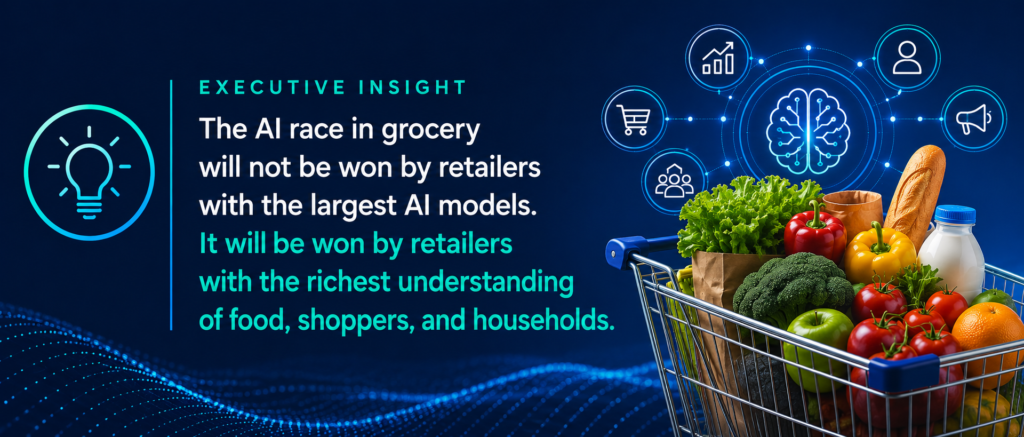
Many organizations mistakenly believe that implementing AI begins by selecting a large language model. In reality, successful AI initiatives begin much earlier—with the creation of rich, trustworthy, domain-specific intelligence.
For grocery retailers, that intelligence extends far beyond product catalogs.
It requires understanding:
- Food
- Nutrition
- Recipes
- Ingredients
- Shopper behavior
- Household dynamics
- Budgets
- Health
- Promotions
- Inventory
- Shopping intent
Together, these become the foundation for every intelligent shopping experience.
In this section, we’ll explore the five capabilities we believe will define the next generation of grocery retail:
Chapter 5: Food Intelligence — The Missing Foundation of Grocery AI
See also: Food Intelligence Explained: The Missing Foundation of Grocery AI
Artificial intelligence has become remarkably good at understanding language.
But grocery is not fundamentally a language problem.
It is a food knowledge problem.
A shopper asking, “What’s a healthy dinner under $25?” isn’t simply requesting information.
They’re asking AI to simultaneously understand:
- Nutrition
- Recipes
- Cooking
- Family size
- Budget
- Dietary preferences
- Available products
- Store inventory
- Promotions
- Taste
That level of reasoning requires far more than a product catalog.
It requires Food Intelligence.
What Is Food Intelligence?
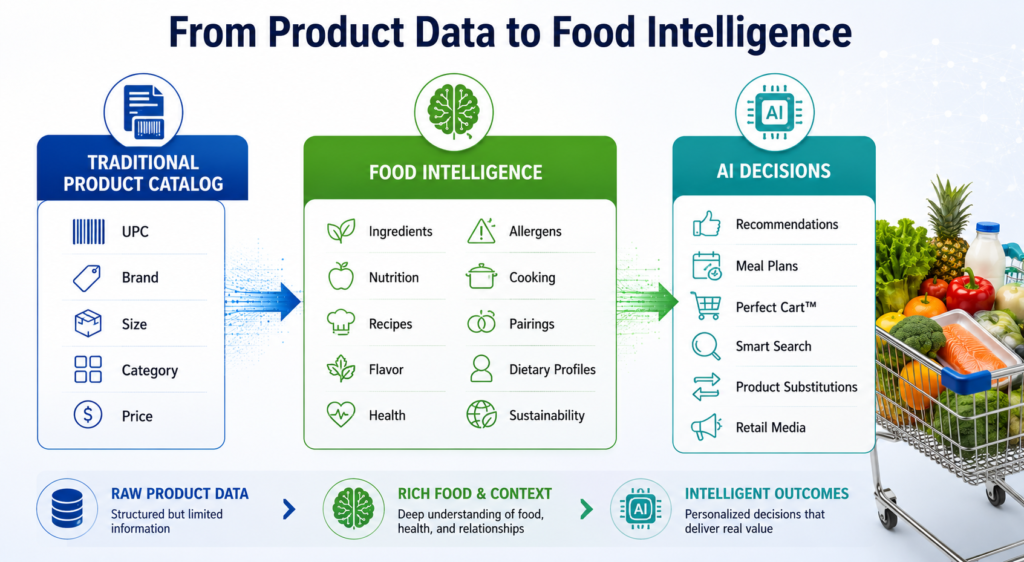
Food Intelligence is a structured understanding of food and its relationships.
Rather than viewing products as isolated inventory items, Food Intelligence understands how products relate to one another within the real world.
For every product, AI can understand:
- Ingredients
- Nutrition
- Allergens
- Flavor profiles
- Recipe compatibility
- Dietary lifestyles
- Cooking techniques
- Health benefits
- Product substitutions
- Seasonal relevance
- Meal occasions
- Cuisine types
- Sustainability attributes
- Pantry staples
- Complementary products
Food becomes knowledge. Knowledge becomes intelligence. Intelligence becomes decisions.
Why Food Intelligence Matters
Food Intelligence enables AI to answer questions that traditional ecommerce systems simply cannot.
Examples include:
- “Build a week’s worth of Mediterranean dinners for under $175.”
- “Find healthier alternatives with lower sodium.”
- “Use ingredients already in my pantry.”
- “Recommend meals my children will actually eat.”
- “Create a high-protein shopping cart using products currently on promotion.”
These are not search queries.
They are decision-making problems.
“Food Intelligence gives AI context. Context transforms recommendations into decisions.”
Chapter 6: Shopper Intelligence — Understanding Households Instead of Transactions
See also: Beyond Loyalty Cards: Why Shopper Intelligence Is the Future of Grocery AI
For decades, personalization has been driven primarily by loyalty cards.
Loyalty programs transformed grocery retail.
But they were never designed to understand people.
They were designed to record purchases.
Artificial intelligence changes the objective.
Instead of asking, “What did this shopper buy?”
AI asks, “Why do they shop the way they do?”
That distinction changes everything.
Shopper Intelligence Goes Beyond Purchase History
Purchase history explains behavior.
Shopper Intelligence explains motivation.
It combines hundreds of signals that help AI understand each household.
Examples include:
Household
Family size, Children, Pets, Empty nesters, Multi-generational households
Lifestyle
Vegetarian, Vegan, Keto, Mediterranean, Biohacker, Budget-conscious, Busy professional, College student
Health
Diabetes, GLP-1 programs, High protein, Heart health, Food allergies, Gluten-free, Weight management
Preferences
Favorite brands, Preferred retailers, Organic preferences, Local products, Taste profiles
Behavior
Shopping cadence, Basket size, Promotion sensitivity, Meal planning habits, Digital engagement
Intent
Perhaps most importantly… What is this household trying to accomplish today?
That answer changes every recommendation.
Reality Check: Two shoppers can purchase identical baskets for completely different reasons. Traditional personalization sees identical transactions. Artificial intelligence understands different intentions.
“Personalization predicts. Intelligence understands.”
Chapter 7: Grocery Brain™ — The Enterprise Intelligence Layer
See also: What Is a Grocery Brain? The Intelligence Layer Powering the Future of Grocery
Food Intelligence understands food.
Shopper Intelligence understands people.
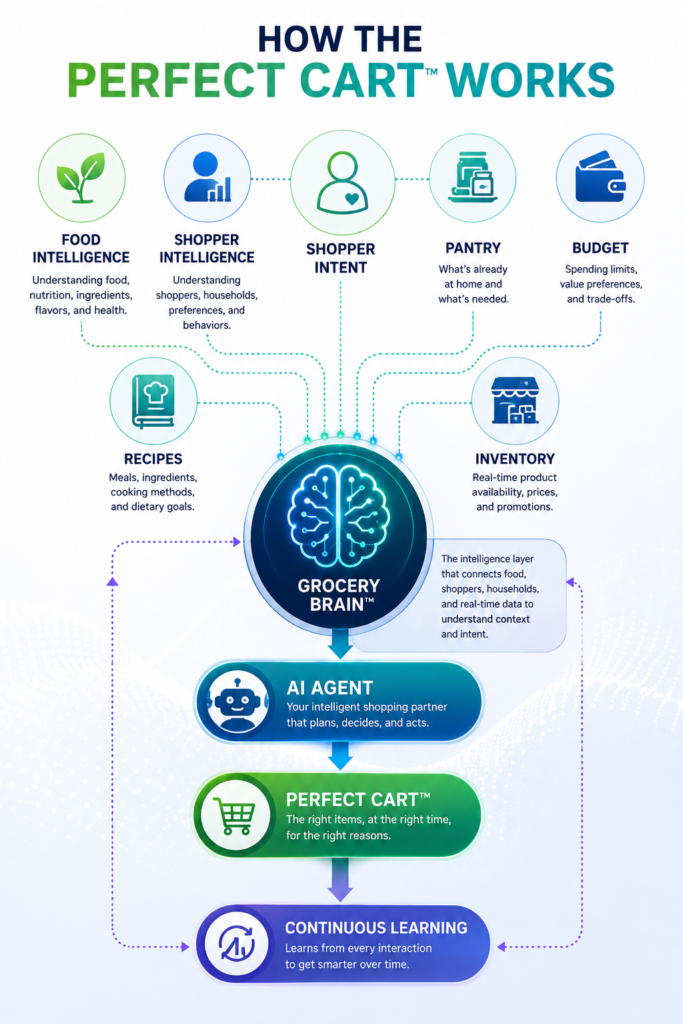
The Grocery Brain™ connects everything together.
Think of it as the retailer’s central nervous system.
Every AI application connects to the Grocery Brain.
Every application becomes smarter.
Every customer interaction becomes more personalized.
Every business decision gains richer context.
What Lives Inside the Grocery Brain™?
The Grocery Brain continuously connects knowledge about:
- Products
- Ingredients
- Recipes
- Nutrition
- Promotions
- Prices
- Inventory
- Shopper preferences
- Household context
- Pantry inventory
- Health goals
- Retail media
- Shopping intent
Rather than duplicating intelligence across dozens of applications, retailers create a reusable enterprise intelligence layer.
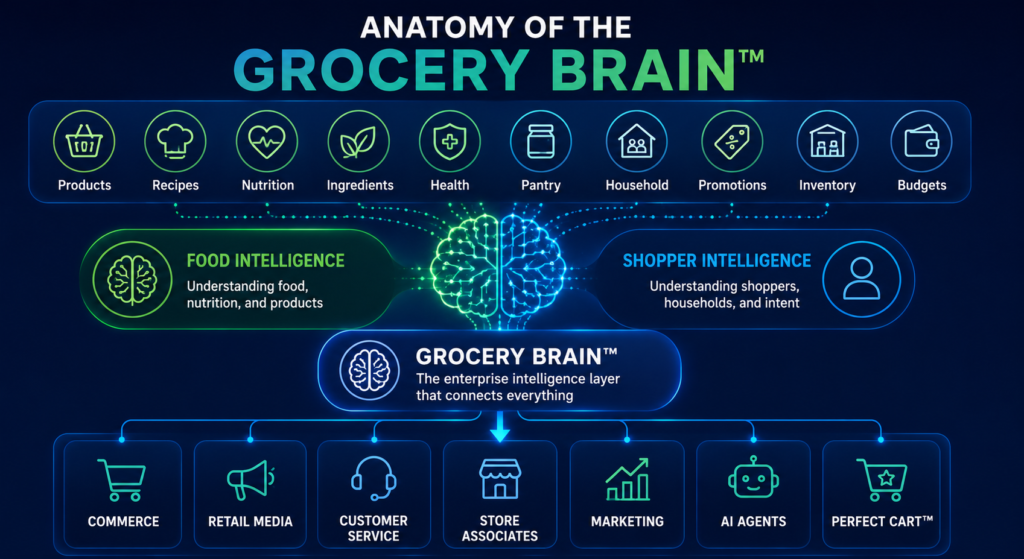
CIO Perspective: Think of the Grocery Brain™ as enterprise middleware for intelligence. Instead of moving data between systems, it moves understanding.
Executive Insight: Retailers won’t compete on AI models. They’ll compete on the intelligence that surrounds those models.
Chapter 8: Grocery AI Agents — From Answers to Action
See also: What Is a Grocery Agent? How AI Agents Will Transform Grocery Shopping
Chatbots answer questions.
AI Agents complete work.
That is one of the most important shifts occurring in artificial intelligence today.
Imagine asking: “Help me shop for healthy lunches next week.”
A chatbot returns a list.
A Grocery Agent may:
- Ask clarifying questions
- Build recipes
- Check pantry inventory
- Compare prices
- Apply promotions
- Optimize nutrition
- Build the shopping cart
- Schedule pickup
- Learn from future purchases
That is no longer conversational search.
It is collaborative shopping.
Executive Perspective: Consumers don’t want another search box. They want an intelligent shopping partner.
“AI doesn’t replace grocery expertise. It scales it.”
Chapter 9: The Perfect Cart™ — The Ultimate Expression of Grocery AI
For nearly thirty years, retailers have optimized individual product recommendations.
The next generation of grocery AI optimizes the entire basket.
We call this the Perfect Cart™.
The Perfect Cart is not simply personalized.
It is continuously optimized.
Every recommendation considers:
- Budget
- Health
- Household
- Pantry
- Promotions
- Recipes
- Nutrition
- Inventory
- Shopper intent
- Time
No two households receive the same cart.
Every shopping experience becomes unique.
Food for Thought: The grocery industry has spent decades trying to personalize products. The next decade will be about personalizing outcomes.
“The Perfect Cart™ is where Shopper Intelligence meets Food Intelligence.”
Why This Changes Everything
Historically, grocery retailers have optimized for efficiency.
Artificial intelligence allows retailers to optimize for outcomes.
Instead of helping shoppers navigate complexity… Retailers can remove complexity altogether.
Instead of asking consumers to assemble baskets… Retailers can assemble intelligent baskets for consumers.
Instead of reacting to shopping behavior… Retailers can anticipate shopper needs.
This represents one of the most significant shifts in the history of grocery retail.
If every household could have its own personal grocery expert… What would your shopping experience look like?
Continue to Part 3: Building the AI-Powered Grocery Retailer — Architecture, Strategy, and the Road Ahead