
The Executive Guide to Artificial Intelligence, Food Intelligence, Shopper Intelligence, and the Future of Intelligent Commerce
About This Report
Artificial intelligence is reshaping every industry, but grocery retail presents a unique opportunity. Unlike most retail sectors, grocery decisions are influenced by nutrition, recipes, health, household dynamics, budgets, culture, inventory, promotions, and rapidly changing shopper intent.
This report is designed for grocery executives, digital leaders, CIOs, CMOs, ecommerce teams, merchandising organizations, and AI strategists who want to understand not only how AI is changing grocery, but how to build a long-term competitive advantage.
Throughout this guide, we introduce the concepts of Food Intelligence, Shopper Intelligence, Grocery Brain™, Grocery Agents, and the Perfect Cart™—foundational ideas that we believe will define the next decade of grocery innovation.
Executive Summary
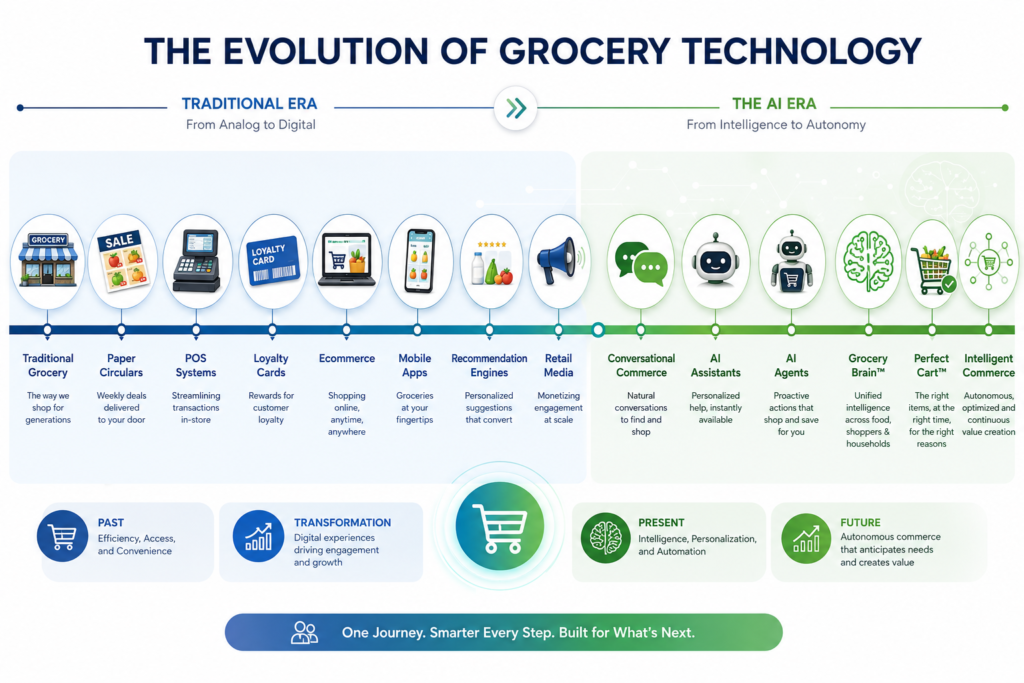
For more than thirty years, grocery retailers have invested in technology to make shopping faster, more efficient, and more personalized.
They introduced loyalty programs. They built ecommerce websites. They launched mobile apps. They implemented recommendation engines. They created retail media networks. They digitized weekly flyers.
These innovations transformed grocery operations and expanded digital commerce. Yet from the shopper’s perspective, one fundamental problem remains:
Shopping is still work.
Consumers still spend valuable time deciding what to cook, searching for products, comparing prices, checking nutrition labels, remembering forgotten ingredients, and trying to balance convenience, health, and budget.
Artificial intelligence changes the role of technology.
Instead of helping shoppers navigate a digital catalog, AI can understand why people shop, what they are trying to accomplish, and how to help them reach those goals.
This marks a shift from digital commerce to intelligent commerce.
The grocery retailers that lead this transformation will not simply deploy AI chatbots or integrate large language models. They will build intelligent systems that understand food, households, products, health, and shopper intent—and use that intelligence to simplify every shopping journey.
We believe the next generation of grocery leaders will differentiate themselves through five strategic capabilities:
- Rich Food Intelligence
- Deep Shopper Intelligence
- An enterprise Grocery Brain™
- Autonomous Grocery AI Agents
- Dynamic Perfect Cart™ experiences
Together, these capabilities create something far more valuable than personalization. They enable retailers to deliver truly intelligent shopping experiences that save shoppers time, improve health outcomes, increase loyalty, grow basket size, and create new revenue opportunities.
Key Takeaways
By the end of this report, you’ll understand:
✔ Why AI represents the largest technology shift in grocery since loyalty programs
✔ Why traditional personalization has reached its limits
✔ Why intelligence—not AI models—will become the industry’s competitive advantage
✔ Why Food Intelligence and Shopper Intelligence are emerging as foundational capabilities
✔ How Grocery Brain™ will become enterprise intelligence platforms
✔ Why AI Agents will fundamentally change the shopping experience
✔ How grocery retailers should prepare their organizations for the AI era
Reality Check: Consumers do not wake up wanting to search through 42,000 grocery products. They want dinner solved. They want healthier choices. They want to save money. They want confidence that they bought the right products. The future belongs to retailers that optimize outcomes—not searches.
The AI in Grocery Retail Learning Series
This executive report serves as the cornerstone of Delectable AI’s educational series on artificial intelligence in grocery retail.
Each topic introduced here is explored in greater depth through dedicated articles.
Continue Your Learning
- What Is Grocery AI? A Practical Guide for Grocery Retail Executives
- What Is a Grocery Brain? The Intelligence Layer Powering the Future of Grocery
- What Is a Grocery Agent? How AI Agents Will Transform Grocery Shopping
- Building an AI Strategy for Grocery Retail
- 25 AI Use Cases Every Grocery Executive Should Know
- Food Intelligence Explained: The Missing Foundation of Grocery AI
- Beyond Loyalty Cards: Why Shopper Intelligence Is the Future of Grocery AI
- What Makes a Modern Grocery AI Platform?
- Why Every Grocery Retailer Needs an Intelligence Layer Before Deploying AI
- The AI Operating System for Grocery Retail
- AI Grocery Assistants: From Search Engines to Shopping Companions
- The Future of Grocery AI: 10 Predictions Every Retail Executive Should Understand
- Why Grocery Catalog Intelligence Is Becoming Competitive Infrastructure
- AI in Grocery: How Artificial Intelligence Is Reinventing Food Retail
Chapter 1: Grocery Is Entering the Intelligence Era
Every major technology shift changes the basis of competition.
The barcode improved inventory accuracy. Point-of-sale systems improved operational visibility. Loyalty programs introduced customer-level marketing. Ecommerce brought grocery online. Mobile apps put the store in every shopper’s pocket.
Artificial intelligence is different.
Rather than digitizing existing processes, AI changes how decisions are made.
For the first time, retailers can build systems that understand context, reason across thousands of variables, and proactively help shoppers accomplish their goals.
That shift—from information retrieval to intelligent decision-making—will redefine grocery retail over the next decade.
If Amazon rebuilt grocery from scratch today using AI, what would it look like? More importantly… What would your customers expect after experiencing it?
Chapter 2: Why Grocery Is Different from Every Other Retail Category
Artificial intelligence has the potential to transform every retail segment.
But grocery is unlike fashion, electronics, or home improvement.
Every shopping trip is influenced by dozens of interconnected decisions.
A shopper purchasing chicken breast may also need:
- Vegetables
- Seasonings
- Rice
- A recipe
- Cooking instructions
- Wine pairing
- Dessert
- Lunch leftovers
- School lunches
- Pantry replenishment
Those decisions depend on factors such as:
- Household size
- Budget
- Nutrition goals
- Food allergies
- Health conditions
- Cultural preferences
- Time available to cook
- Pantry inventory
- Weekly promotions
- Local product availability
Grocery shopping is not a product search problem.
It is a decision-making problem.
That distinction is why grocery requires far richer intelligence than most other retail categories.
“Catalogs describe products. Intelligence understands food.”
Chapter 3: From Search to Understanding
Traditional ecommerce platforms answer one question:
“What products match this search?”
Artificial intelligence answers a much more valuable question:
“What is this household actually trying to accomplish?”
Those questions may appear similar.
They are not.
A shopper searching for “pasta” may actually be trying to:
- Prepare a quick dinner after work
- Stay under a $150 weekly grocery budget
- Feed three children
- Follow a Mediterranean diet
- Increase protein intake
- Cook with ingredients already in the pantry
- Buy products currently on promotion
- Reduce sodium
- Prepare meals for the next three days
None of those objectives can be inferred from a keyword alone.
They require context.
Context is where intelligent grocery experiences begin.
Chapter 4: Why Intelligence Matters More Than AI Models
Many AI strategies begin with a discussion about models.
Should we use one model or another? Should we build our own? Should we fine-tune an existing model?
These are important technical questions.
But they are not the most important business questions.
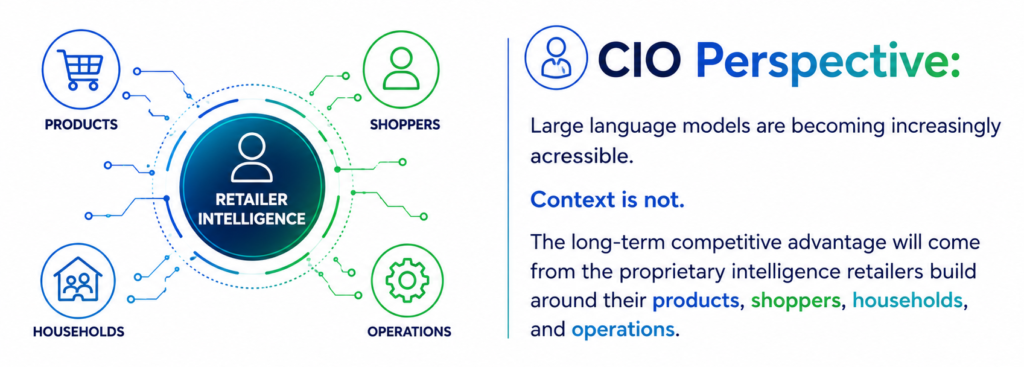
The quality of an AI system depends less on the model itself than on the intelligence surrounding it.
A large language model can reason effectively.
It cannot invent knowledge that does not exist.
If a retailer’s product catalog lacks nutrition, ingredient relationships, recipe compatibility, allergen information, or household context, no model can reliably compensate for that missing intelligence.
The winning retailers will therefore invest in two distinct capabilities:
- Reasoning, provided by AI models.
- Understanding, provided by rich enterprise intelligence.
That intelligence becomes the foundation for every future AI capability.
Executive Perspective: The conversation should shift from: “Which AI model should we deploy?” to “What intelligence will make every AI model smarter?” That is a far more durable competitive advantage.
Food for Thought: Retailers already possess enormous amounts of data. Very few possess intelligence. Data answers: What happened? Intelligence answers: Why did it happen? And AI enables retailers to ask: What should happen next?
Continue to Part 2: The Intelligence Layer — Food Intelligence, Shopper Intelligence, Grocery Brain™, AI Agents, and the Perfect Cart™