
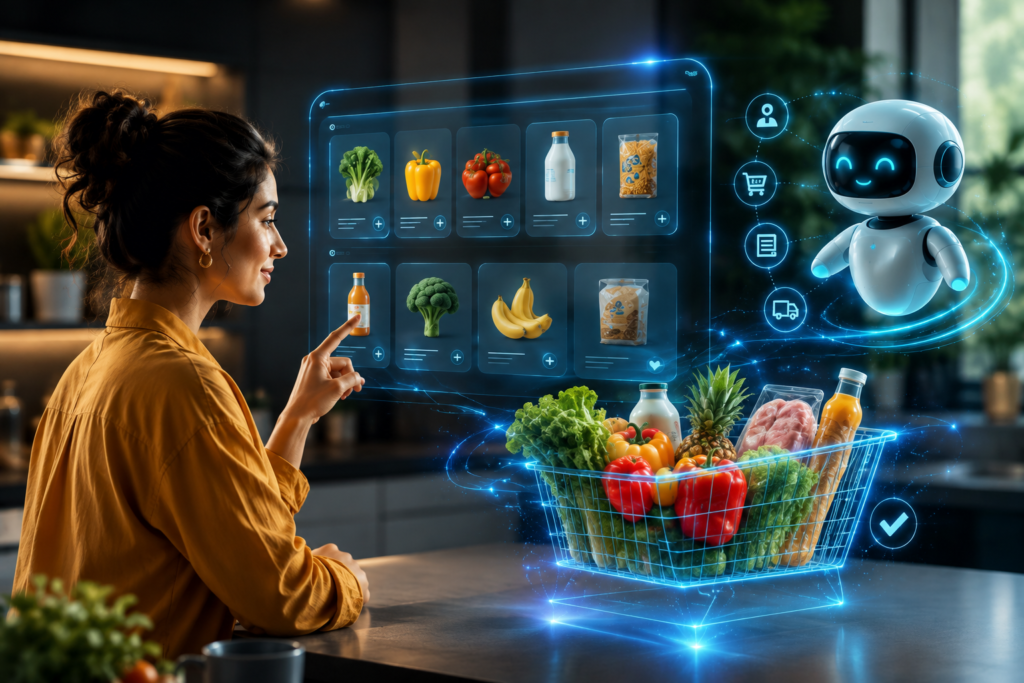
How AI agents, Shopper Intelligence, and household context move grocery beyond recommendations toward personalized outcomes
Executive Summary
For more than two decades, grocery personalization has focused on predicting which products a shopper might buy. Loyalty programs, digital coupons, and recommendation engines improved relevance, but they left the hardest work to the consumer. Shoppers still had to decide what to make, balance household preferences, manage budgets, compare products, and build the cart themselves.
Personalized Agentic Commerce represents the next evolution. It combines deep Shopper Intelligence, Food Intelligence, real-time context, and AI agents that can reason, plan, and act. Instead of merely recommending products, the system helps each household accomplish a goal, such as planning five dinners, staying within a weekly budget, supporting a health objective, or replenishing essentials.
The result is a shift from product-level personalization to outcome-level personalization. The clearest expression of that shift is the Perfect Cart™, a dynamically generated basket built around the shopper, the household, and the mission at hand.
Definition Personalized Agentic Commerce is an AI-powered commerce model in which intelligent agents use shopper, household, food, and real-time context to make decisions, create plans, and take actions that help each shopper achieve a personalized outcome. |
What Is Personalized Agentic Commerce?
Personalized Agentic Commerce brings two major advances together: hyper-personalization and agentic AI. IBM describes agentic AI as systems that can pursue goals with limited supervision, which is the critical shift from simply responding to actively planning and acting.
Hyper-personalization creates an experience tailored to one shopper or household. Agentic AI gives the system the ability to understand a goal, evaluate alternatives, make decisions, and take action. Combined, they allow grocery retailers to move beyond predicting the next product and begin solving the entire shopping mission.
A traditional personalized experience might recommend a brand of yogurt based on purchase history. A personalized agentic experience can understand that the household wants five high-protein breakfasts, recognize that two family members prefer different flavors, account for what is already in the pantry, compare current promotions, and add the right quantities to a cart.
That distinction is fundamental:
- Traditional personalization asks: What is this shopper likely to buy?
- Personalized Agentic Commerce asks: What is this household trying to accomplish, and what actions will help them accomplish it?
The first predicts. The second plans and acts.
Why Personalization Alone Is No Longer Sufficient
Personalization remains essential, but most personalization systems were designed for a different era of commerce. They improve the relevance of products, promotions, and content while assuming the shopper will continue to do most of the work. McKinsey research has shown that effective personalization can materially improve revenue, confirming its value even as the model evolves toward agentic experiences.
1. Transaction History Does Not Explain Intent
Purchase history can reveal what happened, but it rarely explains why. A shopper who repeatedly buys Greek yogurt may be pursuing a high-protein diet, feeding a child, looking for convenient breakfasts, or simply responding to promotions. The same transaction can represent very different goals.
Personalized Agentic Commerce incorporates explicit goals, real-time behavior, saved preferences, household context, and conversational signals. This allows the retailer to understand not only what the shopper purchased before, but what the shopper needs now.
2. Product Recommendations Do Not Solve Shopping Missions
Most recommendation engines optimize one product at a time. Grocery shopping, however, is a connected system of decisions. Meals require multiple ingredients. Dietary restrictions affect substitutions. A budget decision in one category can change choices in another. A promotion only creates value when it fits the household and the overall basket.
A shopper does not experience a grocery trip as hundreds of unrelated recommendations. The shopper experiences one mission: feed the household, restock the pantry, prepare for an event, improve nutrition, or stay on budget. Personalization becomes far more valuable when it operates at the mission and cart level.
3. Individual Profiles Miss the Household
Grocery is rarely an individual purchase. One person may place the order, but the cart often serves a family, roommates, guests, caregivers, or multiple dietary needs. A single household may include a vegetarian, a child with a peanut allergy, a parent focused on heart health, and a teenager who needs more calories.
Systems that personalize only to the account holder can easily make recommendations that are individually relevant but wrong for the household. Personalized Agentic Commerce must understand the collective needs behind the cart.
4. Static Segments Cannot Keep Up With Changing Context
Traditional personalization often places shoppers into segments such as value seeker, health-conscious consumer, or busy parent. Those labels may be useful, but they are not permanent. The same shopper can be budget-focused on a routine weekly trip, convenience-focused on a busy evening, and indulgence-focused when hosting friends.
Agentic systems adapt to the immediate mission. They can combine durable preferences with changing context, including budget, time, occasion, inventory, season, promotions, and current intent.
The strategic shift Personalization improves the choices shown to shoppers. Personalized Agentic Commerce reduces the number of choices shoppers must make. |
AI Agents vs. Recommendation Engines
Recommendation engines and AI agents may use some of the same data, but they perform different jobs. A recommendation engine ranks options. An AI agent works toward a goal.
Capability | Recommendation Engine | Personalized AI Agent |
Primary purpose | Predict relevant products | Achieve a shopper or household goal |
Typical output | A ranked list of items | A plan, decision, cart, or completed action |
Context used | Past purchases and similar-user behavior | Household, intent, food, pantry, budget, promotions, and real-time signals |
Decision scope | One item or placement at a time | The full mission and basket |
Adaptation | Updates when data or models refresh | Continuously adjusts as conditions change |
Shopper role | Reviews options and makes every decision | Guides, approves, and retains control while the agent does more of the work |
Consider the difference in a common grocery scenario.
A recommendation engine sees pasta in the cart and suggests pasta sauce. A personalized agent understands that the shopper wants three quick dinners for a family of four, one child avoids dairy, the household already has pasta and canned tomatoes, chicken is on promotion, and the total grocery budget is $150. The agent can create the meal plan, choose compatible recipes, calculate quantities, reuse pantry items, apply promotions, and build the cart.
The recommendation is useful. The agent completes the mission.
Household-Aware Shopping Changes the Model
The household is the true unit of grocery personalization. The person using the app is often acting as the buyer, planner, nutrition manager, budget manager, and coordinator for several people at once. A useful grocery agent must understand that broader responsibility.
Household-aware shopping can incorporate:
- Who lives in the household and who is being served by the current trip
- Food preferences, dislikes, cuisines, brands, and meal patterns
- Allergies, dietary restrictions, health goals, and nutrition priorities
- Pantry inventory, replenishment cycles, and frequently used staples
- Weekly budget, promotion sensitivity, and private-label preferences
- Saved recipes, planned meals, upcoming events, and time constraints
- Different needs by person, meal, occasion, and shopping mission
This intelligence creates a form of household memory. The system learns which meals work, which substitutions are accepted, which products are rejected, how quickly staples are consumed, and how the household balances competing needs. Every interaction can make the next shopping experience faster and more accurate.
The best grocery agent does not simply know the shopper. It understands the household the shopper is responsible for.
The Intelligence Required to Personalize Decisions
A personalized agent cannot rely on language models or transaction history alone. It needs a purpose-built intelligence layer that understands both the shopper and the products being considered.
Shopper Intelligence
Shopper Intelligence creates a dynamic understanding of preferences, behavior, intent, goals, and household context. It combines durable signals, such as dietary restrictions or brand preferences, with changing signals, such as tonight’s dinner need, this week’s budget, or an upcoming party.
Food Intelligence
Food Intelligence helps the AI understand ingredients, nutrition, allergens, recipes, dietary compatibility, flavors, cuisines, health considerations, and relationships between foods. Authoritative resources such as USDA FoodData Central provide a foundation for nutrient-level food data, but grocery agents also need to understand how products connect to meals, diets, cultures, and household goals. Grocery products are not interchangeable inventory units. They have meaning within meals, diets, cultures, and health goals.
Catalog Intelligence
Catalog Intelligence turns retailer product records into intelligent entities. It connects each SKU to the food knowledge required for better search, substitutions, meal planning, health-aware recommendations, and cart creation. Without enriched product understanding, an agent may communicate fluently while making weak or unsafe decisions.
Agentic Orchestration
Agentic orchestration brings the intelligence together. Specialized agents can interpret the goal, plan the workflow, evaluate options, retrieve relevant products, calculate quantities, optimize the budget, resolve conflicts, and present a cart for review. The retailer remains in control of inventory, pricing, promotions, business rules, and the customer relationship.
The Perfect Cart: Personalized Agentic Commerce in Action
At Delectable AI, the ultimate expression of Personalized Agentic Commerce is the Perfect Cart. The Perfect Cart is a dynamically generated grocery basket optimized around the household, its goals, and the current shopping mission.
It does not begin with products. It begins with an outcome.
Example 1: A Week of Family Dinners Under Budget
A shopper asks: “Plan five dinners for my family of four and keep the total weekly order under $175.”
The agent can:
- Select meals that fit the household’s tastes and dietary needs
- Use pantry items before adding duplicate ingredients
- Choose recipes that share ingredients to reduce cost and waste
- Apply promotions and suggest appropriate private-label alternatives
- Calculate quantities for the household
- Build the complete cart and explain the tradeoffs made
Example 2: High-Protein Shopping for Two Different Goals
One adult is training for a race while another is using a GLP-1 medication and prefers smaller, nutrient-dense meals. A product recommendation engine may simply surface high-protein items. A personalized agent can create a plan that differentiates portions, meal formats, calorie needs, and preferences while using overlapping ingredients where practical.
Example 3: Allergy-Safe Substitutions
A household with a peanut allergy needs a replacement for an out-of-stock snack. The agent must do more than find a similar price and flavor. It must evaluate allergen information, cross-contact warnings where available, household acceptance, package size, and the role the snack plays in the shopping mission. The right substitution is not merely similar. It is appropriate for that household.
Example 4: Replenish the Household
A shopper asks the retailer app to “build my usual weekly order.” The agent reviews purchase patterns, estimated pantry inventory, planned meals, upcoming events, current promotions, and products that are likely to need replenishment. It creates a starting cart, identifies uncertain items, and asks the shopper only for the decisions that require human judgment.
The Perfect Cart principle The perfect cart is built by AI and guided by the shopper. The agent reduces effort, but the shopper retains visibility, control, and final approval. |
Business Impact for Grocery Retailers
Personalized Agentic Commerce is not only a new interface. It can reshape the economics of digital grocery by improving the shopping experience, the quality of decisions, and the value of each customer relationship.
Higher Conversion and More Complete Baskets
When an agent solves the complete mission, shoppers are less likely to abandon the process midway through planning or cart building. Meal-aware and household-aware carts also identify missing ingredients, complementary items, and replenishment needs that product-by-product shopping can overlook.
Faster Shopping and Lower Friction
Retailers have spent years improving search speed and navigation. Personalized agents address a larger source of friction: the time required to decide. Shoppers can move from browsing thousands of products to reviewing a thoughtful plan and an editable cart.
Stronger Loyalty Through Accumulated Intelligence
A useful agent becomes more valuable as it learns. It remembers preferences, accepted substitutions, recurring meals, disliked products, and household routines. This accumulated intelligence creates a differentiated relationship that is difficult for another retailer to replicate without the same history and trust.
More Relevant Retail Media
Agentic shopping creates richer context for retail media. Instead of targeting a broad segment, a retailer can understand the current mission, such as planning school lunches, preparing for game day, managing a high-protein diet, or staying under budget. Sponsored products and offers can be introduced when they genuinely improve the plan, producing a better shopper experience and stronger return on ad spend.
A Stronger First-Party Data Flywheel
Each conversation, cart edit, acceptance, rejection, and substitution generates new signals. These interactions reveal intent more directly than transactions alone. With appropriate consent and governance, retailers can use those signals to improve personalization, merchandising, loyalty, and media performance while keeping the customer relationship retailer-owned.
A Differentiated Retailer-Owned Experience
Personalized Agentic Commerce gives grocers an opportunity to compete on intelligence rather than assortment and price alone. The retailer can offer a branded experience that understands its catalog, promotions, shoppers, and households while integrating with the eCommerce and loyalty systems already in place.
What Retailers Need to Get Started
Retailers do not need to replace their entire technology stack to begin moving toward Personalized Agentic Commerce. They do need a deliberate foundation.
- Enrich the catalog. Product data should build on standards such as the GS1 Global Data Model, then extend those foundational attributes to support reasoning about nutrition, ingredients, allergens, diets, recipes, substitutions, and meal context.
- Create a unified understanding of the shopper and household. Loyalty history is useful, but it must be combined with preferences, goals, intent, household needs, and explicit consent.
- Start with high-value missions. Meal planning, weekly replenishment, budget optimization, substitutions, and cart building create visible shopper value and measurable retailer outcomes.
- Connect agents to retailer systems. The experience should work with current catalog, inventory, pricing, promotions, loyalty, eCommerce, and retail media capabilities.
- Design for shopper control and trust. The NIST AI Risk Management Framework emphasizes characteristics such as transparency, explainability, privacy, and accountability. Grocery agents should apply those principles by explaining key decisions, disclosing sponsored influence, respecting dietary and privacy constraints, and making it easy for shoppers to review or change the cart.
- Measure outcomes, not novelty. Success should be evaluated through time saved, conversion, cart completion, basket size, loyalty, engagement, substitution acceptance, and shopper satisfaction.
The Future Outlook: From Personalized Experiences to Personalized Outcomes
The first generation of digital grocery replicated the store online. The next generation added recommendations, loyalty offers, and conversational assistance. Personalized Agentic Commerce will increasingly coordinate the entire experience.
In the near term, AI agents will help shoppers plan meals, create lists, find products, compare alternatives, and build carts. As trust grows, agents will manage more recurring work, including replenishment, promotion optimization, pantry coordination, and routine order preparation.
The future is not necessarily a fully autonomous system that removes the shopper from every decision. Grocery is personal, emotional, and variable. The more likely model is progressive autonomy: the agent handles predictable tasks, presents thoughtful recommendations for uncertain decisions, and asks for approval when preferences, health considerations, or tradeoffs require human judgment.
This will change what personalization means. The standard will no longer be whether the retailer can show a relevant product. The standard will be whether the retailer can understand the household, anticipate the mission, and create a better outcome with less effort.
Conclusion
Personalization was an important step in the evolution of grocery commerce, but it was never the destination. Recommendation engines made digital shopping more relevant while leaving consumers responsible for planning, deciding, and assembling the solution.
Personalized Agentic Commerce moves the industry forward. It combines Food Intelligence, Shopper Intelligence, household memory, and AI agents to transform a shopper’s goal into a personalized plan and cart. The retailer shifts from presenting products to helping households make better food decisions.
The winners in the next era of grocery will not be the retailers with the most recommendations. They will be the retailers that use intelligence to deliver the most useful outcomes.
That is the promise of Personalized Agentic Commerce. And it is how the Perfect Cart becomes possible for every household.
Frequently Asked Questions
What is Personalized Agentic Commerce?
Personalized Agentic Commerce is an AI-powered shopping model in which intelligent agents use shopper, household, food, and real-time context to plan, decide, and act on behalf of the shopper. It moves beyond recommending products to helping the household achieve an outcome.
How is Personalized Agentic Commerce different from grocery personalization?
Traditional grocery personalization typically selects products, promotions, or content that may be relevant to a shopper. Personalized Agentic Commerce uses that intelligence to complete broader tasks, such as planning meals, optimizing a budget, selecting substitutions, and building a cart.
How are AI agents different from recommendation engines?
Recommendation engines rank or suggest items. AI agents work toward a goal. They can break a mission into steps, evaluate alternatives, make decisions, use tools and data, and create an output such as a meal plan or grocery cart.
Why does household context matter in grocery?
One shopper often buys for multiple people with different tastes, health goals, allergies, ages, and schedules. Household context helps the AI balance those needs instead of personalizing only to the account holder.
What is household memory?
Household memory is the accumulated understanding of preferences, recurring meals, pantry patterns, accepted substitutions, budget behavior, dietary constraints, and shopping routines. It helps each future interaction become faster and more accurate.
What is the Perfect Cart?
The Perfect Cart is a dynamically generated grocery basket optimized around the household, its preferences, goals, budget, dietary needs, planned meals, pantry inventory, promotions, and current shopping mission.
Can shoppers control an AI-generated cart?
Yes. Effective agentic commerce is guided by the shopper. The agent can do more of the planning and cart-building work while providing transparency, editable choices, and final approval to the consumer.
How can Personalized Agentic Commerce improve retail media?
It gives retailers a deeper understanding of the current shopping mission and household need. Offers and sponsored products can be introduced in relevant moments, improving usefulness for shoppers and performance for advertisers.
Does a retailer need to replace its eCommerce platform?
Not necessarily. A grocery intelligence and agentic experience layer can integrate with existing catalog, loyalty, inventory, pricing, promotion, eCommerce, and retail media systems.
What data is needed for Personalized Agentic Commerce?
The strongest systems combine enriched product and food data, purchase history, loyalty data, shopper preferences, household information, pantry signals, inventory, pricing, promotions, and real-time intent. Consent, privacy, and governance are essential.
Will grocery shopping become fully autonomous?
Some routine tasks will become increasingly autonomous, especially replenishment and recurring cart preparation. Most shoppers will still want control over important tradeoffs, new products, health considerations, and final purchase approval.
Why is grocery especially suited for Personalized Agentic Commerce?
Grocery shopping is frequent, complex, household-driven, and connected to health, budget, culture, and daily life. Those characteristics create many repeatable decisions that AI agents can simplify while delivering visible value.
Ready to see Personalized Agentic Commerce in action? Discover how Delectable AI combines Food Intelligence, Shopper Intelligence, household context, and Agentic AI to create the Perfect Cart and reinvent grocery shopping. Request a demo at DelectableAI.com. |
See how Delectable Commerce brings Personalized Agentic Commerce, household intelligence, meal planning, and Perfect Cart creation directly into retailer websites and mobile apps.