
Building the AI-Powered Grocery Retailer: Architecture, Strategy, and the Road Ahead
Part 3 Executive Summary
Artificial intelligence is no longer an experimental technology reserved for innovation labs.
It is becoming the next enterprise platform.
Over the next decade, every grocery retailer will deploy AI across merchandising, ecommerce, operations, customer service, retail media, supply chain, and the shopper experience.
The question is no longer whether retailers should invest in AI.
The question is how they should build an intelligence-driven organization that creates lasting competitive advantage.
Retailers that treat AI as another application will struggle.
Retailers that build an enterprise intelligence platform will lead.
This final section explores the organizational, architectural, and strategic capabilities required to become an AI-powered grocery retailer.
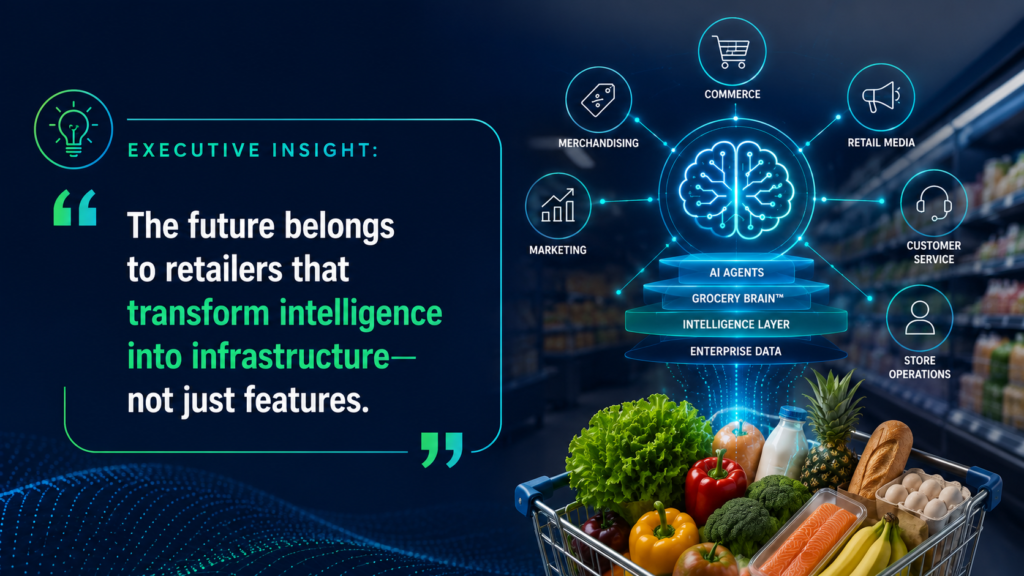
The Core Capabilities of a Grocery AI Platform
While implementations will vary, leading platforms will share common capabilities.
Intelligence
- Food Intelligence
- Shopper Intelligence
- Grocery Brain™
- Catalog Intelligence
AI
- Conversational AI
- Grocery AI Agents
- Decision Engine
- Recommendation Engine
Shopper Experience
- AI Grocery Assistant
- Perfect Cart™
- Meal Planning
- Pantry Management
- Personalized Promotions
Enterprise
- APIs
- Analytics
- Governance
- Continuous Learning
- Security
Each layer strengthens every other layer.
This is why AI platforms scale more effectively than isolated AI applications.
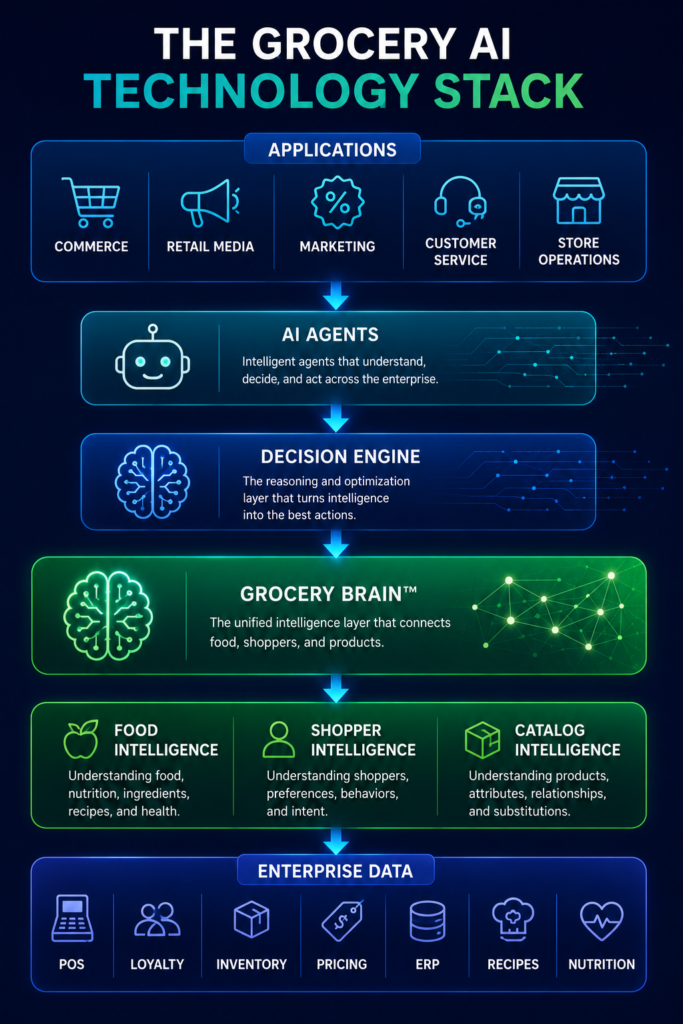
CIO Perspective: The AI Platform is not designed to replace your existing systems. Its purpose is to make every existing system more intelligent.
Chapter 11: The Grocery Intelligence Layer
See also: Why Every Grocery Retailer Needs an Intelligence Layer Before Deploying AI
Many organizations refer to artificial intelligence as a model.
We believe that is incomplete.
The real competitive advantage comes from the intelligence layer surrounding the model.
The Grocery Intelligence Layer connects information from across the enterprise into reusable knowledge.
Instead of rebuilding intelligence inside every application, retailers build it once and make it available everywhere.
This intelligence supports:
- Ecommerce
- Mobile
- Customer Service
- Retail Media
- Merchandising
- Marketing
- Store Associates
- AI Agents
Every application benefits.
Every shopper receives a more consistent experience.
“Large Language Models provide reasoning. The Grocery Intelligence Layer provides truth.”
Why Intelligence Layers Matter
Without an Intelligence Layer: Every AI application develops its own understanding of products and shoppers. Knowledge becomes fragmented. Results become inconsistent.
With an Intelligence Layer: Every AI application draws from the same trusted enterprise intelligence. The result is consistency, speed, and scalability.
Executive Perspective: Data answers questions. Intelligence answers better questions.
Chapter 12: Grocery Catalog Intelligence
See also: Why Grocery Catalog Intelligence Is Becoming Competitive Infrastructure
Traditional grocery catalogs were built for inventory management.
Tomorrow’s catalogs must be built for reasoning.
A product is no longer simply: UPC, Brand, Size, Category, Price.
Instead, every product becomes an intelligent object that understands:
- Ingredients
- Recipes
- Nutrition
- Allergens
- Sustainability
- Flavor
- Cooking
- Health
- Meal occasions
- Pantry relationships
- Product substitutions
This richer understanding enables dramatically better shopping experiences.
Reality Check: Your catalog may contain millions of products. But if AI cannot understand those products… it cannot make intelligent decisions.
Chapter 13: The AI Operating System for Grocery Retail
See also: The AI Operating System for Grocery Retail
Historically, retailers implemented separate systems for:
- Pricing
- Loyalty
- Digital Commerce
- Customer Service
- Merchandising
- Retail Media
Artificial intelligence changes this architecture.
Instead of functioning independently, these systems become coordinated through an intelligent orchestration layer.
We call this the AI Operating System.
It coordinates:
- AI Agents
- Enterprise Intelligence
- APIs
- Business Rules
- Shopper Context
- Automation
- Recommendations
- Decision Making
Every interaction improves every future interaction.
Executive Insight: The AI Operating System becomes the digital nervous system of the grocery enterprise.
Chapter 14: Retail Media Becomes Intelligent
Retail media has become one of grocery’s fastest-growing revenue opportunities.
Yet many retail media platforms remain audience-centric rather than intent-centric.
Artificial intelligence changes targeting.
Instead of asking: “Who purchased cereal last month?”
Retailers begin asking:
- “Who is currently planning healthy breakfasts?”
- “Who recently started a high-protein diet?”
- “Who is shopping for back-to-school lunches?”
Intent becomes dramatically more valuable than historical transactions.
Consumers receive more relevant offers.
Brands reach better audiences.
Retailers improve monetization while creating a better shopping experience.
Everyone wins.
“The best retail media doesn’t interrupt shopping. It improves shopping.”
Chapter 15: Organizational Transformation
Artificial intelligence is not an IT initiative.
Nor is it solely a marketing initiative.
It is an enterprise transformation.
Successful retailers will align:
- Executive Leadership
- Technology
- Merchandising
- Marketing
- Digital Commerce
- Store Operations
- Customer Experience
- Data Science
- Retail Media
- Suppliers
Everyone contributes to enterprise intelligence.
Everyone benefits from it.
Board Question: Who owns AI strategy inside your organization? If the answer is “IT” or “Marketing” alone… you’re probably thinking too narrowly.
Chapter 16: What Delectable AI Believes
Technology shifts create new winners.
Artificial intelligence will be no different.
Based on our experience working with grocery retailers, we believe the following trends are inevitable.
- Every grocery retailer will deploy AI. The differentiator will be intelligence.
- Food Intelligence becomes critical infrastructure.
- Shopper Intelligence replaces traditional personalization.
- Every retailer builds a Grocery Brain™.
- The Perfect Cart™ becomes the primary shopping experience.
- Retail Media becomes conversational and context aware.
- AI Agents complete shopping missions.
- Consumers stop searching. They simply ask.
- Catalog Intelligence becomes as important as product assortment.
- Retailers with the deepest intelligence become the industry’s next leaders.
“Winning retailers won’t simply sell groceries. They’ll understand households better than anyone else.”
Executive AI Readiness Assessment
Strategy
□ Executive AI vision
□ Success metrics
□ Governance
□ Change management
Data
□ Product catalog
□ Recipes
□ Nutrition
□ Inventory
□ Promotions
□ Shopper data
Intelligence
□ Food Intelligence
□ Shopper Intelligence
□ Household Intelligence
□ Grocery Brain™
□ Catalog Intelligence
Consumer Experience
□ AI Assistant
□ Perfect Cart™
□ Pantry
□ Meal Planning
□ Personalized Promotions
Enterprise
□ Retail Media
□ APIs
□ Security
□ Analytics
□ Agent Framework
Food for Thought: The companies that complete this checklist first will likely define the next decade of grocery innovation.
Chapter 18: Questions Every Grocery Executive Should Ask
As your organization evaluates its AI strategy, these questions can help guide executive discussions.
- Do we have an enterprise AI vision, or are we pursuing isolated AI projects?
- How well does our organization understand shopper intent beyond purchase history?
- Is our product catalog enriched with the intelligence AI needs to make meaningful decisions?
- Do we have a strategy for building or acquiring Food Intelligence?
- Are we creating a reusable Grocery Brain™, or duplicating intelligence across applications?
- What shopping missions should our first Grocery AI Agent solve?
- How could the Perfect Cart™ change customer loyalty and basket size?
- Can our retail media network become more context-aware and intent-driven?
- How will AI reshape the roles of merchants, marketers, and store associates?
- If a technology company launched a grocery business tomorrow using AI from day one, how would our experience compare?
These questions are not simply about technology. They are about organizational readiness, competitive differentiation, and long-term strategy.
Chapter 19: Glossary of Key Terms
AI Agent
An autonomous software system that can reason, plan, and complete tasks on behalf of a user.
Catalog Intelligence
The enrichment of product catalogs with relationships, nutrition, recipes, health attributes, substitutions, and contextual knowledge.
Context Engineering
The practice of providing AI with the right information, relationships, and constraints so it can make better decisions.
Food Intelligence
Structured knowledge about food, ingredients, recipes, nutrition, allergens, health attributes, flavor profiles, and product relationships. (Learn more)
Grocery Brain™
An enterprise intelligence layer that connects Food Intelligence, Shopper Intelligence, Catalog Intelligence, promotions, inventory, and business data to power AI across the organization. (Learn more)
Grocery Intelligence Layer
The reusable knowledge layer that provides trusted context to every AI application.
Grocery AI Platform
An enterprise platform combining intelligence, AI agents, decision engines, analytics, and integrations to support intelligent commerce.
Household Intelligence
Knowledge about household composition, routines, preferences, and life stage that helps AI make more relevant recommendations.
Intent
The underlying objective a shopper is trying to accomplish, such as saving money, eating healthier, planning meals, or preparing for an event.
Perfect Cart™
A dynamically generated grocery basket optimized for a shopper’s goals, household context, health preferences, budget, promotions, and real-time inventory. (Learn more)
Shopper Intelligence
A comprehensive understanding of shoppers based on behavioral, contextual, demographic, lifestyle, and health signals—not just purchase history. (Learn more)
Final Thoughts
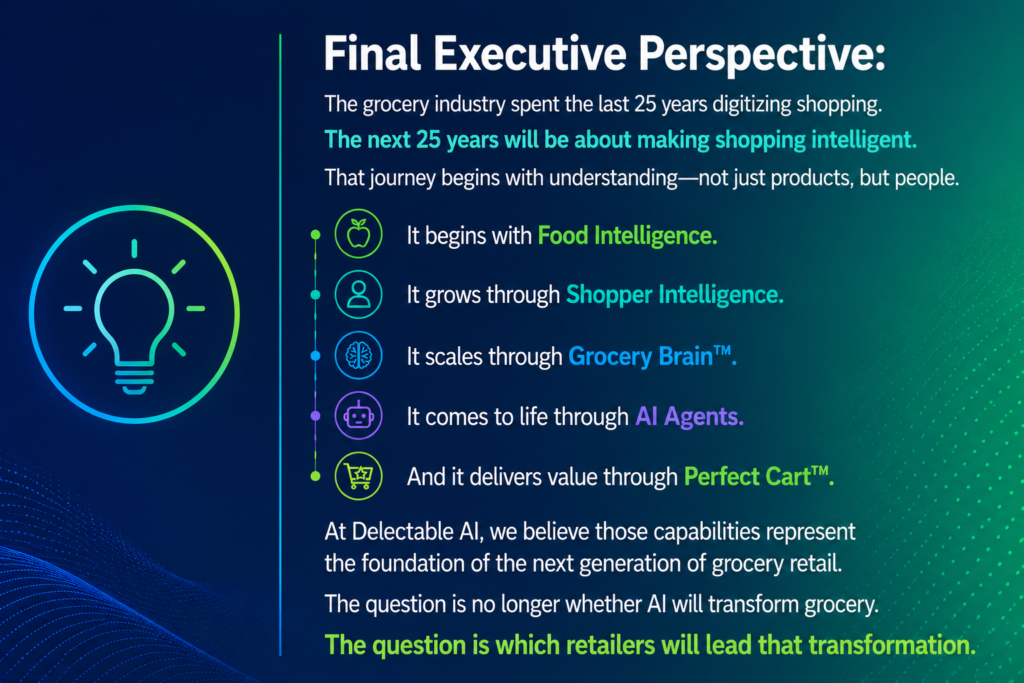
Every major shift in grocery retail has expanded what retailers could do.
Artificial intelligence expands what retailers can understand.
That distinction matters.
The future of grocery will not be defined by bigger stores, more digital features, or faster websites.
It will be defined by intelligence.
Retailers that understand food more deeply.
Retailers that understand households more completely.
Retailers that understand shopper intent more accurately.
Those organizations will deliver shopping experiences that feel personal, proactive, and remarkably helpful.
The future of grocery belongs to retailers that don’t simply digitize commerce.
It belongs to retailers that make commerce intelligent.
About the Author
Bill Zujewski is Chief Marketing Officer at Delectable AI, where he leads marketing strategy, thought leadership, brand development, and go-to-market initiatives focused exclusively on grocery retail. He works with retailers, technology partners, and industry leaders to help shape the future of AI-powered grocery commerce through concepts including Food Intelligence, Shopper Intelligence, Grocery Brain™, and the Perfect Cart™.
About Delectable AI
Delectable AI is the AI company for grocery retailers.
Its Agentic Experience Platform helps retailers transform digital commerce through Food Intelligence, Shopper Intelligence, Grocery Brain™, AI Agents, and the Perfect Cart™—enabling highly personalized shopping experiences, stronger customer loyalty, increased basket sizes, and new retail media revenue opportunities.
Learn more: https://delectableai.com/