
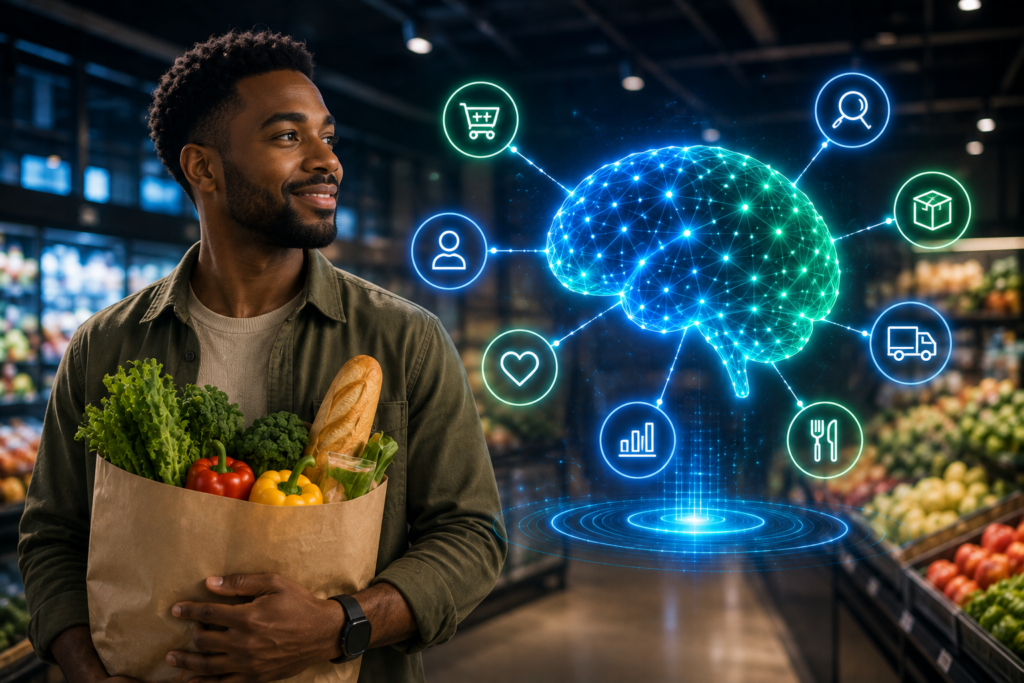
Artificial intelligence is rapidly changing how consumers shop. Search boxes are becoming conversations. Recommendation engines are becoming personal assistants. AI agents are beginning to help shoppers compare products, build baskets, and make purchasing decisions.
But an AI model alone does not understand a retailer’s products, customers, inventory, business rules, or the context behind a shopping mission.
That is the role of the AI intelligence layer.
An AI intelligence layer sits between a retailer’s data and the AI-powered experiences shoppers use. It turns fragmented product, shopper, transaction, behavioral, and contextual data into connected intelligence that AI assistants and agents can use to understand, personalize, decide, and act.
The architecture can be summarized simply:
Retail Data → AI Intelligence Layer → AI Models & Agents → Personalized Commerce
As AI becomes a bigger part of commerce, the intelligence layer may become one of the most important parts of the retail technology stack.
What Is an AI Intelligence Layer?
An AI intelligence layer is a shared intelligence foundation that gives AI systems the business-specific context they need to make better decisions.
It connects information traditionally spread across systems such as:
- Product information management
- Customer data platforms
- Loyalty platforms
- Commerce systems
- Point-of-sale data
- Inventory and order management
- Pricing and promotions
- Shopper behavior
- Search and browsing activity
- External market and social signals
The goal is not simply to collect more data. It is to transform data into relationships, context, and understanding.
Domo describes modern AI as a layered architecture spanning data, models, inference, interaction, orchestration, and governance. Domo’s overview of AI layers The intelligence layer adds an important business dimension: the proprietary knowledge that helps those technologies understand the specific company, customer, product catalog, and industry in which they operate.
In other words:
Data tells AI what happened. Intelligence helps AI understand what it means.
Why AI Models Alone Are Not Enough for Retail
Large language models are remarkably good at language, reasoning, and conversation. But they do not inherently know the details required to make reliable retail decisions.
A generic AI model does not automatically know:
- What every SKU really represents
- Which products are compatible, complementary, or substitutes
- What a specific shopper prefers
- Who else is in the shopper’s household
- What the shopper already owns
- What the shopper is trying to accomplish right now
- Which products are available locally
- Current prices and promotions
- A retailer’s merchandising and brand rules
A retailer can connect an LLM to a chatbot and create a conversation. Creating a truly useful AI shopping assistant requires much more.
AI needs context before it can deliver intelligent commerce.
Angela Harney describes the intelligence layer as a connective foundation that allows systems and AI to work together using richer organizational context. Read more about AI and the intelligence layer
That distinction becomes increasingly important as AI moves from answering questions to recommending products and eventually taking actions on a shopper’s behalf.
Where the AI Intelligence Layer Fits in the Retail Technology Stack
An AI intelligence layer does not need to replace the systems retailers already use. It makes those systems more useful to AI.
A simplified retail AI architecture looks like this:
Experience Layer
Website · Mobile App · Search · Social · Email · Store · Voice
AI Agents and Decisioning
Shopping Assistant · Search Agent · Recommendation Agent · Merchandising Agent · Service Agent
AI Intelligence Layer
Product · Shopper · Household · Intent · Context · Market Intelligence
Retail Data and Systems
Commerce · PIM · CDP · CRM · Loyalty · POS · Inventory · OMS · ERP
The retailer’s existing technology stack continues to manage transactions, products, customers, inventory, and operations. The AI intelligence layer creates a common understanding across those systems that AI models and applications can use.
The Core Types of Retail Intelligence
The specific intelligence required varies by retail category, but several building blocks apply broadly.
Product Intelligence
Product Intelligence transforms basic catalog records into richer product entities.
Instead of knowing only that an item belongs to a category, AI can understand its features, attributes, materials, ingredients, use cases, compatibility, benefits, alternatives, and relationships with other products.
This richer product data becomes especially important as AI agents take a larger role in product discovery and buying decisions. Deloitte’s work on agentic commerce highlights the importance of accurate product, inventory, customer, and transaction data as commerce shifts toward AI-mediated purchasing. Deloitte on agentic commerce
Shopper Intelligence
Shopper Intelligence builds a dynamic understanding of the individual behind the transaction.
It can include preferences, purchase history, brand affinities, price sensitivity, behaviors, goals, shopping patterns, and real-time signals.
The objective is to move beyond broad segments such as “frequent buyer” toward an evolving one-to-one understanding of the customer.
Household Intelligence
Many purchases are made for more than one person.
Household Intelligence can understand family members, pets, the home, shared preferences, recurring needs, previous purchases, budgets, and other household context.
This becomes particularly important in categories such as grocery, pet, home, and consumer electronics.
Intent Intelligence
Historical data tells a retailer what someone did before.
Intent Intelligence attempts to understand:
What is this shopper trying to accomplish right now?
A shopper searching for a black jacket might be preparing for a business trip, replacing an old coat, buying a gift, or building an outfit for an event.
Conversation, search terms, clicks, location, seasonality, cart activity, and other real-time signals can help AI recognize the current mission.
Market and Social Intelligence
Retail decisions do not happen in isolation.
Trends, creators, social conversations, competitors, cultural moments, seasonal events, and emerging consumer behaviors can all affect what shoppers want.
An intelligence layer can connect these external signals with a retailer’s own products and customer data.
The AI Intelligence Layer Powers the Personal Shopping Assistant
The most visible application of an intelligence layer may be the next generation of the personal shopping assistant.
Without deep intelligence, a shopping assistant can answer questions.
With deep intelligence, it can help shoppers make decisions.
Consider the difference.
A generic assistant might answer:
“What should I buy?”
An intelligent retail assistant can consider:
Who are you? What do you like? What do you already own? What are you trying to accomplish? Which products fit the need? What is available? What is within your budget?
The result can support:
- Conversational product discovery
- Product comparisons
- Personalized recommendations
- Bundles and complete solutions
- Cross-sell and upsell
- Replenishment
- Personalized lists
- Cart building
- Shopping automation
The intelligence layer becomes the brain behind the assistant.
Delectable AI applies this model to grocery, where a grocery AI shopping assistant must simultaneously understand food, products, shoppers, households, and the shopping mission.
From Personalization to Hyper-Personalization
Traditional retail personalization has largely been predictive:
“People like you also bought this.”
An AI intelligence layer makes a different kind of personalization possible:
“Given what I know about you, your household, these products, your current goal, and the situation right now, here is the best next action.”
This is the shift from conventional personalization toward hyper-personalization.
Retailers can use the same shared intelligence across search, recommendations, AI assistants, website content, offers, promotions, retail media, email, mobile applications, and store experiences.
Instead of every application creating its own incomplete view of the customer, the intelligence layer creates a shared understanding that can improve every experience.
AI Intelligence Layer Examples Across Retail
The need for intelligence is not unique to one retail category.
But the intelligence required by each category is different.
Retail Category | Intelligence AI Needs | Example Personal Assistant Request |
Grocery | Food, diet, household, pantry, budget, taste | “Plan five healthy dinners for my family under $100.” |
Pet | Pet type, breed, age, size, needs, preferences | “What should I buy for my new Labrador puppy?” |
Apparel | Style, fit, size, occasion, climate, wardrobe | “Build a business-casual outfit for Chicago in October.” |
Home & Housewares | Home, rooms, dimensions, style, existing products | “What do I need for my first apartment kitchen?” |
Beauty | Skin, hair, routines, preferences, sensitivities | “Build a skincare routine for my needs and budget.” |
Electronics | Devices, compatibility, usage, requirements, budget | “Which laptop and accessories should I buy for college?” |
Every Retail Vertical Needs Different Intelligence
A pet retailer needs deep Pet and Household Intelligence.
An apparel retailer needs Product, Style, Fit, and Shopper Intelligence.
A home retailer needs to understand the home, room, household, and existing products.
A grocery retailer needs deep knowledge of food, products, recipes, nutrition, shoppers, households, budgets, pantry inventory, and shopping missions.
This is why the future of retail AI is unlikely to be purely generic.
General AI can provide reasoning. Industry-specific intelligence provides understanding.
For grocery, Delectable AI calls this proprietary intelligence layer the Grocery Brain™, combining specialized Food, Shopper, Household, Catalog, Social, and Market Intelligence.
Which Retail Categories Benefit Most?
The value of an AI intelligence layer generally increases with three factors.
Decision Complexity
How many variables must the shopper consider?
Buying batteries may require little assistance. Planning meals for a family with different dietary preferences involves hundreds of possible decisions.
Purchase Frequency
How often does the shopper return?
Frequent interactions give the system more opportunities to learn and improve.
Context Dependence
How much does the right product depend on the individual, household, situation, or goal?
The greater the context required, the more valuable proprietary intelligence becomes.
This helps explain why categories such as grocery, pet, beauty, apparel, home, and electronics are strong opportunities for intelligent commerce.
Grocery may be the most extreme example because it combines very high purchase frequency with extraordinary decision complexity and household context.
AI Intelligence Layer vs. CDP, PIM, Recommendation Engine, and LLM
An intelligence layer complements technologies retailers already have.
Technology | Primary Role |
PIM | Stores and manages product information |
CDP | Unifies customer data |
Recommendation Engine | Predicts relevant products |
LLM | Understands language and performs general reasoning |
AI Intelligence Layer | Connects and interprets business context to support AI decisions |
The AI intelligence layer is therefore not simply another database.
Its purpose is to create an intelligent representation of the relationships among products, shoppers, households, intent, business context, and outcomes.
The Intelligence Layer Is the Foundation for Agentic Commerce
AI-powered commerce is progressing through several stages:
Search:
“Find running shoes.”
Assistant:
“Help me choose running shoes.”
Agent:
“Find the best running shoes for me under $150.”
Agentic Commerce:
“Keep track of my running needs and help me replace what I need.”
Each stage transfers more decision-making from the shopper to AI.
That transfer requires increasingly accurate intelligence.
NIQ describes agentic commerce as a shift in which AI increasingly participates in product discovery, evaluation, and purchasing, increasing the importance of connected consumer, product, retailer, and availability intelligence. NIQ on agentic commerce
Delectable AI applies the same principle to grocery through its Agentic Commerce and Grocery Brain architecture, connecting retailer data with specialized intelligence and AI reasoning.
The more AI is allowed to act, the more important context, accuracy, governance, and trust become.
Why Proprietary Intelligence Gets More Valuable Over Time
An intelligence layer can become more valuable with every shopper interaction.
Every search, conversation, click, purchase, recommendation, rejection, return, list, and cart can create another signal about the relationship between shoppers, products, context, and outcomes.
That creates an intelligence flywheel:
Better Intelligence → Better Experiences → More Engagement → More Signals → Better Intelligence
Block describes a similar shift toward systems that learn from proprietary customer and business signals and use that understanding to determine which capabilities are most appropriate for a particular customer and moment. Block’s “From Hierarchy to Intelligence”
That accumulated intelligence may ultimately be more defensible than access to any individual AI model.
Models will change.
Interfaces will change.
AI vendors will change.
A retailer’s proprietary understanding of its products and customers can continue to compound.
The Future of Retail: Every Retailer Needs a Brain
The future retail technology stack will not simply contain more AI tools.
It will increasingly require a shared intelligence foundation that allows models, agents, and applications to understand the retailer’s products, shoppers, business, and market.
The architecture becomes:
Retail Data → Proprietary Intelligence → AI Agents → Personalized Commerce
For some retailers, that might mean deep Product and Shopper Intelligence.
For others, it may require intelligence about pets, homes, wardrobes, beauty routines, electronics, or other complex domains.
For grocery, it means creating a purpose-built Grocery Brain™ that understands food and households in ways a generic AI model does not.
The larger opportunity extends across B2C commerce.
Wherever consumers face complex choices, a personal AI assistant can reduce uncertainty and effort. Wherever personalization matters, an AI intelligence layer can help the retailer understand the shopper at a deeper level.
AI models will provide the reasoning. The retailers that win will increasingly be the ones that provide the intelligence.
FAQ: AI Intelligence Layer
What is an AI intelligence layer?
An AI intelligence layer is a shared foundation that connects and interprets product, customer, transaction, behavioral, and contextual data so AI models and agents can make better business decisions.
What does an AI intelligence layer do in retail?
It gives AI systems context about products, shoppers, households, inventory, intent, pricing, promotions, and other retail information required for personalized recommendations and actions.
How is an AI intelligence layer different from an LLM?
An LLM provides general language understanding and reasoning. An AI intelligence layer provides proprietary knowledge about a retailer’s products, customers, business rules, and market.
Is an AI intelligence layer the same as a CDP?
No. A CDP primarily unifies customer data. An AI intelligence layer can combine shopper data with product, household, intent, commerce, and contextual intelligence to support AI decision-making.
How does an AI intelligence layer enable hyper-personalization?
It connects historical shopper knowledge with product intelligence and real-time intent, allowing AI to determine what is most relevant to a particular shopper in a particular situation.
How does an AI intelligence layer power an AI shopping assistant?
The layer gives the assistant the context required to move beyond generic answers and deliver personalized product discovery, recommendations, comparisons, bundles, lists, carts, and actions.
What industries benefit from AI intelligence layers?
Retail categories with complex, frequent, or highly personalized buying decisions can benefit significantly, including grocery, pet, apparel, beauty, home and housewares, electronics, and other consumer retail categories.
What is the role of an intelligence layer in agentic commerce?
Agentic commerce allows AI to make or execute more shopping decisions on behalf of consumers. The intelligence layer provides the product, shopper, contextual, and business knowledge those agents need to make reliable decisions.
Should retailers own their AI intelligence layer?
Retailers have an opportunity to build proprietary intelligence from their first-party product, customer, transaction, and behavioral data. Because that intelligence can improve over time and work across multiple AI models, it can become a valuable strategic asset.
Why is grocery a strong use case for an AI intelligence layer?
Grocery combines high shopping frequency, large catalogs, household decision-making, food complexity, budgets, nutrition, dietary needs, recipes, promotions, and real-time inventory. That makes grocery one of the most intelligence-intensive forms of retail commerce.