
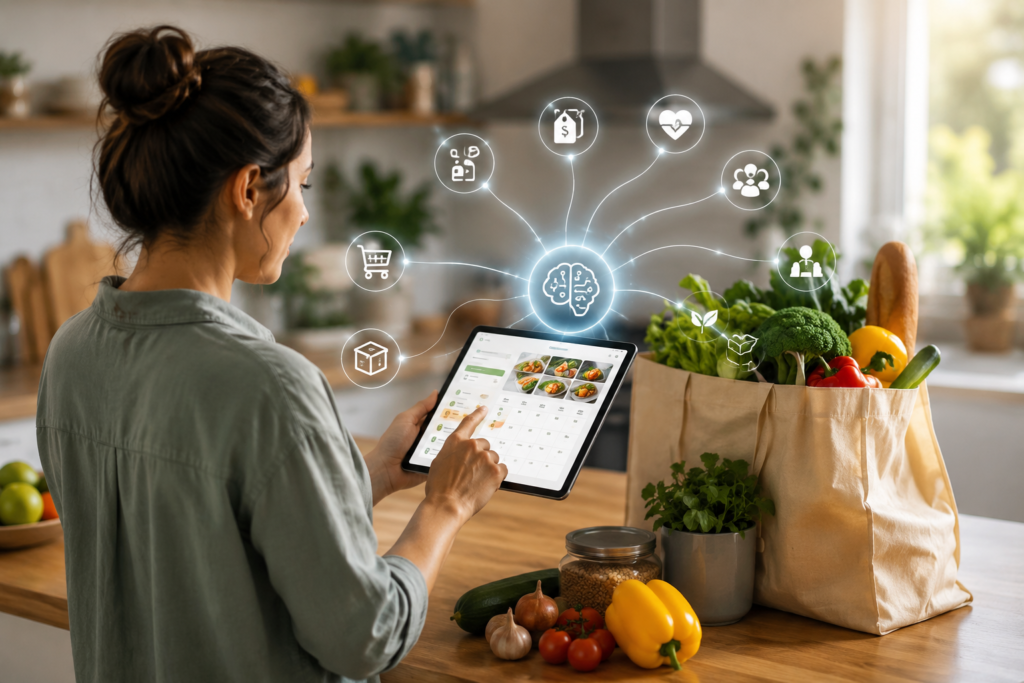
Social media creates meal inspiration. Food Intelligence transforms recipes, pantry data, budgets, and inventory into personalized meal plans and Perfect Carts™.
EXECUTIVE TAKEAWAY
Recipe integrations solve one task. AI Meal Planning solves an entire household decision. The retailers that combine Food Intelligence, household context, pantry awareness, and real-time inventory will create better shopping experiences, larger baskets, lower waste, and stronger loyalty than retailers relying on recipe APIs alone.
Every week, millions of households find out what they will have for dinner via TikTok, Instagram, food blogs, and increasingly AI Meal Planning experiences. There is a strong desire among consumers when they view these recipes, and it is extremely fast and urgent: they want to prepare the dish that night.
The challenge is not finding recipes. It is turning meal inspiration into a practical plan for the household and then into an accurate online grocery shopping cart.
Shoppers may find it frustrating to turn inspiration into a cart. They must jump from app to app, copying and pasting ingredients, searching for items—such as choosing between low-sodium and regular soy sauce—checking inventory, estimating quantities, and remembering what is already in the pantry.
In enterprise eCommerce, friction is a conversion killer. In grocery eCommerce, it is a hemorrhage of margin.
At Delectable AI, we built the Food HyperGraph™ to solve exactly this problem—turning unstructured recipe inspiration into a personalized meal plan and a store-ready cart in a single tap.
If an inspired shopper must search repeatedly to assemble a single recipe, the risk of abandonment rises quickly. Some give up on the meal entirely; others take their high-intent data and high-margin baskets straight to third-party aggregators that have figured out how to streamline convenience—at the cost of the grocer’s brand, data, and profitability.
To capitalize on the growth of the “inspiration-to-cart” economy, grocery retailers need to understand how traditional search practices fall short in the current shopping environment. They also need to understand how a specialized Food Intelligence layer can turn chaos into profit. Online grocery is a key growth channel, with its share of U.S. grocery sales expected to continue rising.
The future is not recipe integration. It is AI Meal Planning.
Recipe Discovery Is Not Meal Planning
Consumers are not simply looking for recipes. They are trying to answer a set of recurring household questions:
- What should I make tonight?
- What can I cook with what is already in my pantry?
- What is healthy enough for our goals?
- What is on sale or available at my local store?
- Can I stay within my weekly budget?
Those are meal-planning problems, not recipe problems. Recipes are one input into AI Meal Planning, alongside pantry inventory, expiration dates, leftovers, budgets, nutrition goals, household preferences, promotions, inventory, and substitutions.
A recipe API can retrieve ingredients and instructions. AI Meal Planning must determine whether the household can and should make the meal—and then convert that decision into an achievable shopping outcome. That is why recipe APIs alone fail.
From Inspiration to AI Meal Planning: Two Purpose-Built Layers
Solving the inspiration-to-cart gap is not a single-product problem—it is two distinct moments, each requiring its own layer of intelligence, with AI Meal Planning connecting the two.
The first moment happens where discovery already lives—on TikTok, Instagram, and food blogs. That is what Delectable Social is built for: turning shoppable recipe content into a buying trigger on the grocer’s own digital properties, so the moment of inspiration never has to leave the retailer’s ecosystem in the first place.
The second moment happens once a shopper decides to act—turning that inspiration into a personalized meal plan and a precise, in-stock cart. That is the job of the Food HyperGraph™, covered in detail below.
Together, these two layers close the gap end to end—from the scroll, to the meal plan, to the Perfect Cart™—without ever handing the relationship, the data, or the margin to a third party.
Recipe inspiration → AI Meal Plan → Perfect Cart™
Why Legacy eCommerce Infrastructure Fails AI Meal Planning
Most traditional grocery eCommerce platforms rely on rigid, keyword-based search engines. These systems handle a direct search for “gallon of 2% milk” just fine—but they fracture when faced with unstructured culinary data.
When a recipe calls for “1 bunch fresh cilantro” or “2 medium avocados that are slightly ripe,” a standard search engine encounters a semantic barrier.
- The Mapping Disconnect. Legacy systems struggle to map unstructured recipe text to a precise, store-specific SKU—matching “cilantro” to an 8-ounce plastic clamshell versus a loose bunch in the produce aisle.
- The “Kitchen Sink” Sticker Shock. Basic integrations blindly add all 15 recipe ingredients to the cart, including pantry staples the shopper already has—olive oil, salt, and black pepper. The cart total balloons, and the customer abandons it.
- The Stockout Blind Spot. If even one critical ingredient is missing, the whole recipe integration can collapse. Traditional platforms lack the contextual culinary logic to suggest an appropriate substitute, such as replacing missing escarole with curly endive or radicchio.
- The Household Context Gap. Traditional systems do not know who is eating, what the household already has, which ingredients may expire soon, what meals are planned later in the week, or how much the shopper can spend.
Poor substitutions and stock shortages are a major source of friction in online grocery. When shoppers cannot find a desired item or an acceptable replacement, many abandon the item or the order—and may not return even after the product is restocked.
The result: the shopper walks away from a $65 meal basket because the software could not solve a $2 product substitution.
Moving from Keywords to a Food Intelligence Graph
Solving this problem takes more than a simple API plugin that scrapes text. It requires shifting digital commerce strategy from keyword matching to a dynamic intelligence layer purpose-built for food—what we call the Food HyperGraph™.
Unstructured recipe text → Food HyperGraph™ → AI Meal Plan → Exact store inventory match
AI Meal Planning is only as intelligent as the food data beneath it. Without structured Food Intelligence, meal planning becomes little more than recipe search with a conversational interface.
Modern AI Meal Planning must reason across the full context of the household:
- Recipes, cuisines, and meal occasions
- Pantry inventory, leftovers, and expiration risk
- Household size, preferences, allergies, and dietary restrictions
- Nutrition and health goals
- Budget and price-per-serving targets
- Promotions and private-label alternatives
- Real-time local inventory and appropriate substitutions
- Time available to cook and calendar context
The stakes are rising quickly. McKinsey estimates that by 2030, $3 trillion to $5 trillion of global B2C retail spending could be handled by AI agents, and Deloitte’s 2026 Global Retail Industry Outlook found that 68% of retail executives expect to adopt agentic AI within the next 12 to 24 months. Retailers that have not structured their product and inventory data will struggle to compete once a third-party agent is doing the shopping on a customer’s behalf.
The Food HyperGraph™ unifies two critical data ecosystems: real-time, store-level inventory and deep culinary context—nutritional parameters, flavor profiles, dietary compatibility, and substitution logic.
When a shopper engages with an AI Meal Planning experience, the HyperGraph processes the request to build what we call the Perfect Cart™:
- Intelligent Omission. It identifies and filters out common pantry staples, saving customers money and building immediate digital trust.
- Contextual Substitution. If a primary ingredient is out of stock, the graph suggests a nearby culinary equivalent with similar flavor, texture, cooking properties, nutrition, and dietary compatibility.
- Instant SKU Mapping. By converting ambiguous measurements—such as “a bunch,” “a sprinkle,” or “two medium avocados”—into precise store products and quantities, it lets a shopper move from inspiration to cart in under a minute.
- Pantry and Leftover Awareness. It prioritizes ingredients already on hand, uses products nearing expiration, and recommends meals that reuse ingredients across the week.
- Budget and Nutrition Optimization. It adjusts meals, brands, pack sizes, and serving quantities to fit household budgets, health goals, and price-per-serving targets.
- Promotion-Aware Planning. It can build meals around products on promotion, seasonal inventory, retailer priorities, and relevant private-label alternatives.
This is the difference between adding a recipe to a cart and creating a Perfect Cart™. The first automates a transaction. The second helps a household achieve an outcome.
Why AI Meal Planning Belongs Inside the Retailer’s Grocery Brain™
AI Meal Planning should not become another isolated consumer feature. It should become one of the highest-value applications powered by the retailer’s broader Grocery Brain™—an internal intelligence layer connecting Food Intelligence, Catalog Intelligence, Shopper Intelligence, Household Intelligence, inventory, promotions, and real-time intent.
This architecture creates a strategic advantage that extends beyond the shopper experience. It also changes the economics of running AI at scale.
A generic large language model must be repeatedly prompted with product rules, dietary constraints, catalog information, household context, and inventory limitations. Every prompt, reasoning step, and retry consumes tokens. As adoption grows, those LLM usage fees rise with every successful shopper interaction.
A retailer that develops an owned Grocery Brain™ can progressively shift more retrieval, ranking, filtering, substitution, meal optimization, and cart assembly onto purpose-built models and knowledge graphs. The generic LLM can then be reserved for the narrower tasks it performs best, such as interpreting open-ended language or formatting a final response.
That approach can dramatically reduce ongoing LLM usage fees, make costs more predictable, improve response speed, and keep proprietary shopper and household intelligence compounding inside the retailer’s own ecosystem rather than inside a generic AI provider.
THE ECONOMIC PRINCIPLE Rent the general model for broad language reasoning. Own the grocery intelligence that performs the high-volume, repeatable work. |
The same Grocery Brain™ can power search, recommendations, substitutions, retail media, customer service, store associates, and autonomous cart building. One intelligence layer becomes more valuable with every use case and every household interaction.
The Pipeline Impact
The integration of recipes into a grocery website with a seamless, agentic approach is not simply a nice-to-have or an aesthetic upgrade; it is a fundamental revenue driver for grocery retailers and a driver of shopper customer lifetime value (CLV). Grocery retailers that incorporate this level of intelligence into their web-based service model should see movement in four key metrics:
- Increased average transaction value. The platform provides all the necessary components of a meal, encouraging a bigger order that includes more fresh, specialty, and higher-margin products.
- Lower cart abandonment. Time-to-cart drops from a frustrating manual search process to a near-instant one.
- Higher loyalty and lower waste. Pantry-aware AI Meal Planning helps shoppers use what they already have, buy only what they need, and rely on the retailer every week.
- Reclaimed first-party loyalty. An elegant, native experience on the grocer’s own domain keeps customer data, margin, and the brand relationship in-house rather than ceding them to third-party delivery networks.
The executive case is larger than recipe conversion. Grocery leaders do not invest in recipe integrations simply to make content shoppable. They invest in capabilities that create bigger baskets, healthier households, higher loyalty, lower waste, more efficient AI economics, and a stronger first-party data moat.
From Inspiration to a Household Outcome
In the modern retail landscape, the grocer that controls the transition from inspiration to planning to execution owns the customer relationship. The path forward starts with meeting shoppers exactly where inspiration strikes.
But it cannot end with a recipe API. Grocery retailers need AI Meal Planning that understands food, the household, the pantry, the budget, the promotion, and the store.
Food Intelligence provides the understanding. The Food HyperGraph™ provides the engine. The Grocery Brain™ provides the owned intelligence layer. The Perfect Cart™ turns all of it into an outcome the shopper can use.
The future of grocery belongs to retailers that transform inspiration into AI-powered meal planning—and meal planning into the Perfect Cart™.
See how the Food HyperGraph™ turns meal inspiration into AI Meal Planning and the Perfect Cart™. Talk to Delectable AI.
READY TO MAKE AI MEAL PLANNING SHOPPABLE?
Visit delectableai.com to learn more