
The AI layer that separates smart recommendations from genuine grocery intelligence.
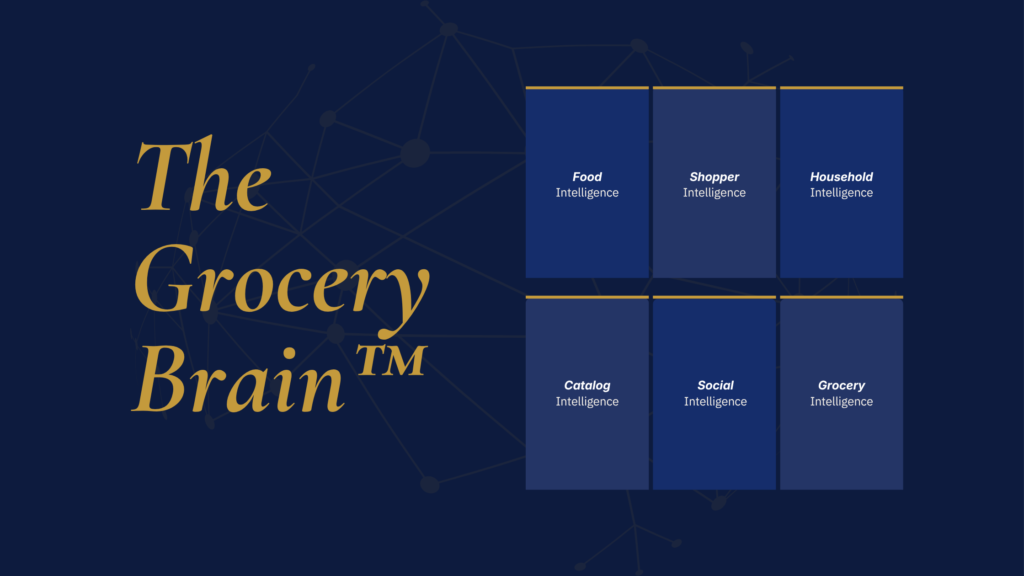
Grocery retail is on the cusp of its most significant technological shift since the barcode. But unlike the digitization waves that came before it, ecommerce in the 2000s, customer data platforms in the 2010s, retail media networks in the 2020s, this one isn’t about infrastructure for transactions. It’s about infrastructure for decisions. It’s about a new intelligence layer we call the Grocery Brain™.
The Problem with Plugging In ChatGPT
It’s tempting for retailers to think that dropping a large language model into their app solves the AI problem. After all, these models can hold conversations, answer questions, and even suggest recipes. But Delectable AI draws a sharp distinction: generic AI understands language. The Grocery Brain™ understands grocery.
The Grocery Brain™ is a proprietary intelligence layer conceived, architected and built by Delectable AI, designed specifically for grocery retailers and their technology partners. Rather than replacing an AI model, it wraps around one, supplying it with the specialized knowledge of food, shoppers, households, catalogs, and industry context that general-purpose models simply don’t have. Grocery chains, ecommerce platforms, and retail tech companies license it as the “brain” behind their AI-powered experiences, the layer that turns a capable language model into something that can actually reason about what a family should eat this week, what’s in their pantry, and what’s on promotion at their local store.
Consider what it actually takes to answer a deceptively simple question: “What should I buy for dinner tonight?”
To respond intelligently, an AI must simultaneously weigh household size, pantry inventory, budget constraints, dietary restrictions, food allergies, health goals, product availability, active promotions, recipe preferences, preparation time, cuisine preferences, and seasonal factors. A general-purpose language model handles the phrasing of that question, but it has no idea which bananas are in stock at a specific store today, which households buy them regularly, or whether they belong in a particular shopper’s cart.
This is what Delectable AI calls the Catalog Intelligence Gap: traditional retail systems know price, brand, package size, and inventory status. What they lack, and what AI needs, is understanding of recipe relevance, health implications, household suitability, dietary compatibility, substitution alternatives, and ingredient content. The Grocery Brain™ is designed to bridge exactly that gap.
For a deeper look at how AI is reshaping retail personalization more broadly, resources like McKinsey’s research on retail AI and Harvard Business Review’s coverage of agentic commerce offer useful context.
Six Intelligences, One Unified System
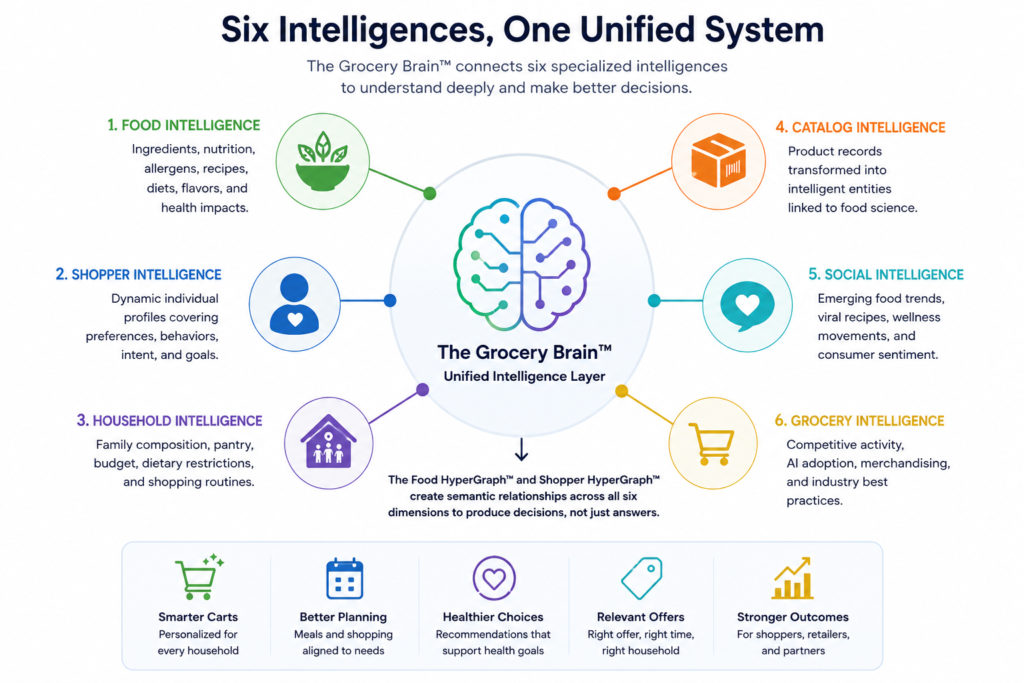
The Grocery Brain™ isn’t a single model — it’s a layered intelligence system built across six domains:
- Food Intelligence — ingredients, nutrition, allergens, recipes, diets, flavors, and health impacts
- Shopper Intelligence — dynamic individual profiles covering preferences, behaviors, intent, and goals
- Household Intelligence — family composition, pantry, budget, dietary restrictions, and shopping routines
- Catalog Intelligence — product records transformed into intelligent entities linked to food science
- Social Intelligence — emerging food trends, viral recipes, wellness movements, and consumer sentiment
- Grocery Intelligence — competitive activity, AI adoption, merchandising, and industry best practices
What makes this meaningful isn’t any single domain, it’s how they work together. The system’s Food HyperGraph™ and Shopper HyperGraph™ create semantic relationships that let the platform reason across all six dimensions simultaneously, producing decisions rather than just answers.
The Semantic Bridge: From Products to Food
One of the whitepaper’s most clarifying ideas is what it calls the Semantic Bridge, the mechanism that transforms isolated product records into interconnected food intelligence.
Take a banana. To a retailer, it’s a SKU with a price and an inventory count. To a nutritionist, it’s a source of potassium, fiber, and natural sugars. To a recipe engine, it’s an ingredient for smoothies, bread, or snacks. To a shopper, it’s breakfast, a post-workout snack, or a child’s lunchbox addition.
Most retail AI systems operate only at the SKU layer. The Grocery Brain™ operates across all three layers simultaneously — retail, food intelligence, and ingredient — which is what allows it to make genuinely useful recommendations rather than glorified keyword matches.
This connects to a broader trend in AI development sometimes called Retrieval-Augmented Generation (RAG), where models are grounded in domain-specific knowledge bases rather than relying purely on training data. Delectable AI’s approach extends this concept into a purpose-built grocery knowledge architecture.
The Perfect Cart™: From Search to Outcomes
The whitepaper’s most commercially interesting concept is the Perfect Cart™, a dynamically generated shopping basket optimized for a specific household at a specific moment in time.
This flips decades of retail logic. For most of grocery’s history, the shopper built the cart and the retailer responded. The Grocery Brain™ reverses that: the AI builds the cart, and the shopper guides and refines it.
The Perfect Cart™ isn’t a recommendation list or a meal plan. It’s an output that simultaneously accounts for household factors (family composition, pantry, dietary restrictions), health factors (weight management, GLP-1 goals, high-protein objectives), financial factors (budget, promotions, price sensitivity), and retail factors (product availability, inventory, private label opportunities).
For shoppers navigating increasingly complex dietary needs, driven in part by the rise of GLP-1 medications like Ozempic and Wegovy, and growing consumer interest in functional nutrition and biohacking, this kind of contextual, outcome-oriented intelligence is genuinely different from a search bar with autocomplete.
Research from FMI – The Food Industry Association consistently shows that health and wellness concerns are among the top drivers of grocery purchase decisions, underscoring exactly why this depth of reasoning matters.
Agentic Commerce: The Next Frontier
Perhaps the whitepaper’s most forward-looking section addresses agentic commerce, the shift from AI that answers questions to AI that takes actions on behalf of shoppers.
Delectable AI envisions a set of specialized agents, each powered by the Grocery Brain™:
- A Meal Planning Agent that automatically creates personalized weekly plans based on household needs
- A Shopping Agent that builds complete carts on shoppers’ behalf
- A Pantry Agent that monitors household inventory and triggers replenishment
- A Health Optimization Agent that recommends foods aligned with specific health goals
- A Retail Media Agent that delivers contextually relevant promotions
Without a specialized intelligence layer, these agents are limited to generic responses. With the Grocery Brain™ behind them, they become grocery experts capable of acting on real understanding of food, households, budgets, and live inventory.
This aligns with what Andreessen Horowitz has described as the emerging “agent economy” — where autonomous systems don’t just surface information but complete tasks end-to-end.
The Retailer’s Moat Is the Intelligence Layer
The whitepaper’s strategic argument is worth taking seriously: AI models themselves are becoming commodities. Every retailer can access OpenAI, Google, Anthropic, or Meta. The differentiator isn’t which model you use, it’s what the model knows.
Delectable AI positions the Grocery Brain™ as the 2030s equivalent of what ERP systems were to the 1990s, ecommerce platforms to the 2000s, and customer data platforms to the 2010s: not a feature, but critical infrastructure.
The moat compounds over time. Every shopper interaction deepens the Shopper Intelligence layer. Every transaction enriches the household graph. Food intelligence grows richer with every ingredient relationship and recipe added. Generic AI vendors starting from scratch face years of catch-up against a system that has been learning continuously.
What This Means for Grocers
The practical takeaway for grocery retailers is straightforward: the race is no longer about which AI model you license. It’s about which intelligence layer you build or adopt.
Retailers who treat AI as a chatbot feature — answering customer service questions or generating recipe suggestions — will find themselves outcompeted by those who use AI to fundamentally rethink the shopping experience. Personalization at the household level, dynamic cart generation, health-aware substitutions, and proactive pantry management aren’t science fiction. They’re the logical output of combining the right data with the right intelligence architecture.
The Grocery Brain™ is Delectable AI’s answer to what that architecture looks like. For grocery retailers evaluating their AI roadmap, it offers a useful framework for understanding the gap between what generic AI can do and what grocery AI actually requires.
Learn more about Delectable AI and The Grocery Brain™. For further reading on AI in retail, explore NRF’s AI resources, MIT Technology Review’s coverage of agentic AI, and Grocery Dive’s retail tech reporting.