
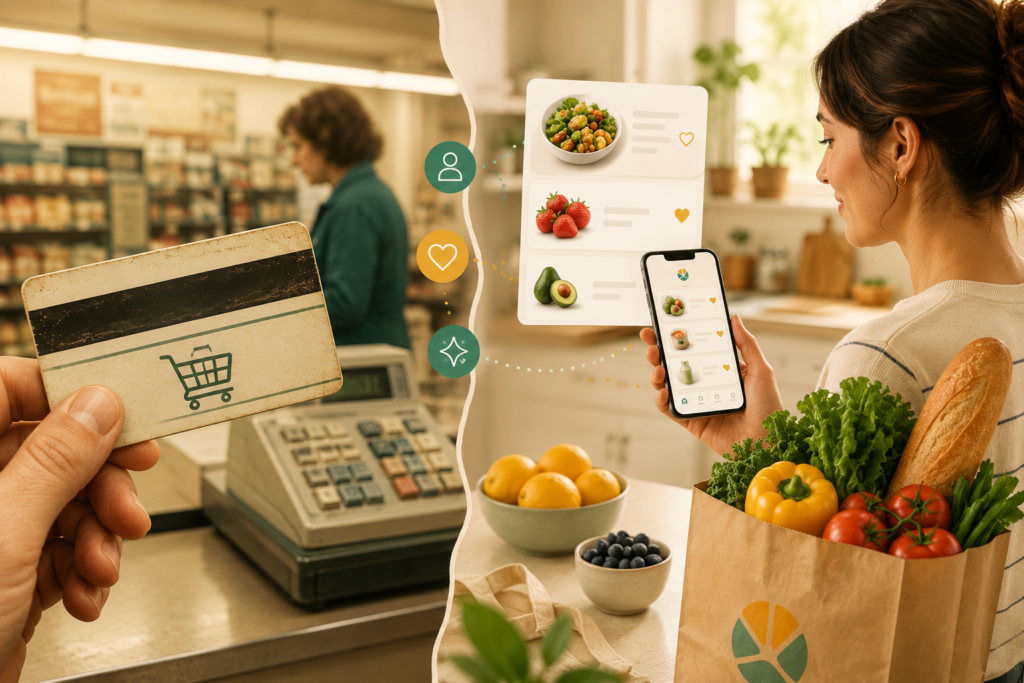
Grocery invented modern personalization in 1995. Thirty years later, most shoppers still receive coupons for products they'd never buy. The data has always been there. The problem was never the data — it was the intelligence applied to it.
The 1995 Breakthrough — and Why It Froze
In 1994, Tesco partnered with a little-known analytics firm, dunnhumby, and handed over a slice of its shopping data. Within months, Tesco’s chairman reportedly told his board that these outsiders understood their customers better after a few weeks than the retailer had after decades. In February 1995, Tesco launched the Clubcard — the first national supermarket loyalty program — and grocery quietly invented modern personalization.
The model worked: swipe the card, earn points, receive targeted offers. By 1997, Tesco was personalizing offers for individual households. Kroger followed the same playbook, partnering with dunnhumby in 2003, acquiring its U.S. assets in 2015, and building 84.51° — a data business powered by first-party purchase data from over 60 million U.S. households.
Then the model froze. The core mechanic — swipe, earn, redeem — has remained essentially unchanged. Meanwhile, shoppers now experience Netflix-level personalization in entertainment, Spotify-level personalization in music, and Amazon-level personalization in commerce. A coupon for something purchased last spring feels increasingly impersonal.
"The cards were built to record — not to reason. For thirty years, grocery's richest data asset has been aimed at advertisers, not at the shopper who generated it."
The Gap Is Measured, Not Anecdotal
The shortfall between what grocers believe they deliver and what shoppers actually experience is well-documented.

Grocery Doppio’s State of Grocery Personalization research values the resulting execution gap at roughly $12.3 billion in unrealized industry revenue.
The cause isn’t a lack of conviction. Challenges like thin margins, legacy systems, siloed data, and privacy concerns are real — but they’re addressable. The gap exists because loyalty programs were designed to collect data, not to understand it. Shoppers aren’t asking for more offers. They’re asking to be remembered.
Three Blind Spots in Your Loyalty Data
A loyalty program is like a rearview mirror: it records what was purchased, but not who purchased it, why they purchased it, or what it means. Three structural blind spots prevent loyalty programs from delivering true personalization.
1. Household Intelligence
One card serves many people. A single account manages snacks for toddlers, protein for teenagers, dietary needs for adults, and pet food — all rolled into one “customer” profile. Marketing based on household averages systematically misses individuals.
- A household newly managing diabetes still gets soda promotions.
- A family whose last child left for college still gets family-size packaging offers.
- True personalization must recognize the distinct people within a household, not just the account.
2. Shopper Intent
Transaction history reveals what shoppers bought last week — not what they need tonight. Intent is present-tense: it’s shaped by upcoming events, seasonal shifts, life changes, and real-time context. A system anchored in purchase history cannot serve a shopper planning a dinner party on Friday or starting a new diet on Monday.
3. Food Intelligence
Most grocery systems don’t understand food — they understand SKUs and UPCs. They don’t know that five items add up to a sheet-pan dinner, that a product is high-protein and gluten-free, or that a household’s recent basket is trending toward dangerously high sodium.
Without understanding food as food — its ingredients, nutrition profiles, attributes, and the meals it builds — personalization is just coupon math on barcodes.
From Segments to True 1:1
AI makes a fundamentally different kind of personalization possible — not “families like yours,” but this family, right now. The shift is from segment-level targeting to individual-level reasoning, operating in real time with full awareness of food, household, and intent.
The end state is conversational and agentic:
- What do you want for dinner tonight? I know your dietary goals and your budget.
- What’s in season and available locally? I’ll build your basket.
- Just review and approve. I’ll handle the rest.
This is what we call the Perfect Cart — a basket assembled for a single household, optimized for their food preferences, dietary needs, and budget. Not a search box. Not a coupon. A tailored, ready-to-approve cart built from genuine understanding of food and people.
McKinsey research confirms that effective personalization can boost revenue by 5–15% — but in grocery, the deeper advantage is trust. The grocer that becomes a genuine partner in a household’s health and wellbeing earns loyalty that a points program can’t replicate.
Trust Is the Dividing Line
Retail media is a significant tailwind for the grocery industry. But when personalization is optimized for advertiser outcomes first, shoppers notice — and they disengage.
According to McKinsey, 85% of consumers want to know a retailer’s privacy policies before making a purchase. The grocers who build lasting loyalty will be the ones who put the shopper first — and let advertiser value follow.
Three principles define a trust-first approach:
- Own your data. Keep shopper intelligence in-house — don’t rent it out.
- Personalize for the shopper, not around them. Serve the household’s interests first.
- Make the intelligence visible. Let shoppers see why recommendations were made and how to adjust them.
Tesco’s CEO, Ken Murphy, has pointed to this future — suggesting the use of AI to guide Clubcard shoppers toward healthier choices based on their purchase history. The technology to do this exists. The question is which retailers will deploy it to shoppers first.
The Intelligence Layer: Delectable AI’s Two-Graph Approach
Delectable AI addresses the grocery personalization gap with a purpose-built intelligence layer — two interconnected knowledge graphs that together enable true 1:1 personalization at scale using a grocer’s own first-party data.
FoodHyperGraph™
A machine-readable understanding of food at the ingredient, nutrition, attribute, and meal level. It transforms a grocery catalog from a list of barcodes into a living food knowledge base — one that understands what products are, what they contain, and what they build together.
- Nutrition profiles and health benefit attributes
- Flavor and ingredient relationships
- Meal and recipe construction logic
- Sustainability, sourcing, and dietary flag data
Shopper HyperGraph™
A dynamic model of the household as a unit — recognizing individual members, their life stages, dietary needs, preferences, and goals, as well as routines and life events that shift those needs over time.
- Individual profiles within a single account
- Life-stage and life-event modeling (new baby, dietary diagnosis, empty nest)
- Real-time intent signals layered over purchase history
- First-party only — no third-party data handoffs
Together, the two graphs power the Perfect Cart™ — delivering a real-time match between food and people, at the household level, on the grocer’s own data.
The Technology Is Here. Who Uses It First?
The foundation Tesco poured in 1995 is now universal. Every major grocer runs a loyalty program. The first-party data has been accumulating for decades.
The gap is no longer infrastructure. It’s intelligence. The grocers who apply genuine AI reasoning to the data they already own — to understand food as food, and shoppers as individuals — will own a compounding loyalty advantage that points and coupons can’t match.
Ready to see the two-graph approach in action on your own first-party data? Contact Delectable AI to learn how the FoodHyperGraph™ and Shopper HyperGraph™ deliver True 1:1 personalization — without third-party data, without handing your customers to an ad network, and without rebuilding your loyalty infrastructure.