
Grocery’s Hidden Tax: Decision Fatigue, Not Just Sticker Shock
Everyone in retail already knows AI is reshaping shopping. What’s less understood is why grocery, specifically, is ground zero — and it isn’t because grocers lack data. It’s because grocery decisions are uniquely relentless: they repeat weekly, they’re constrained by biology (allergies, diets) and budget simultaneously, and they carry real consequences when they’re wrong.
The numbers are stark. With 74.1% of consumers now actively tracking price hikes and nearly half trading down to cheaper alternatives [1], shoppers aren’t browsing anymore — they’re triaging. The tell-tale sign: more frequent trips, fewer items per basket [1], which is what rationing looks like when it’s dressed up as a shopping habit.
Online, this triage gets harder, not easier. Thirty-one percent of shoppers say they’re overwhelmed by too many results when searching for groceries digitally [2]. The instinct has been to fix this with more filters and more promotions. That’s backwards — the fix isn’t more options, it’s an engine that removes the need to choose between them at all.

II. Introducing the Perfect Cart
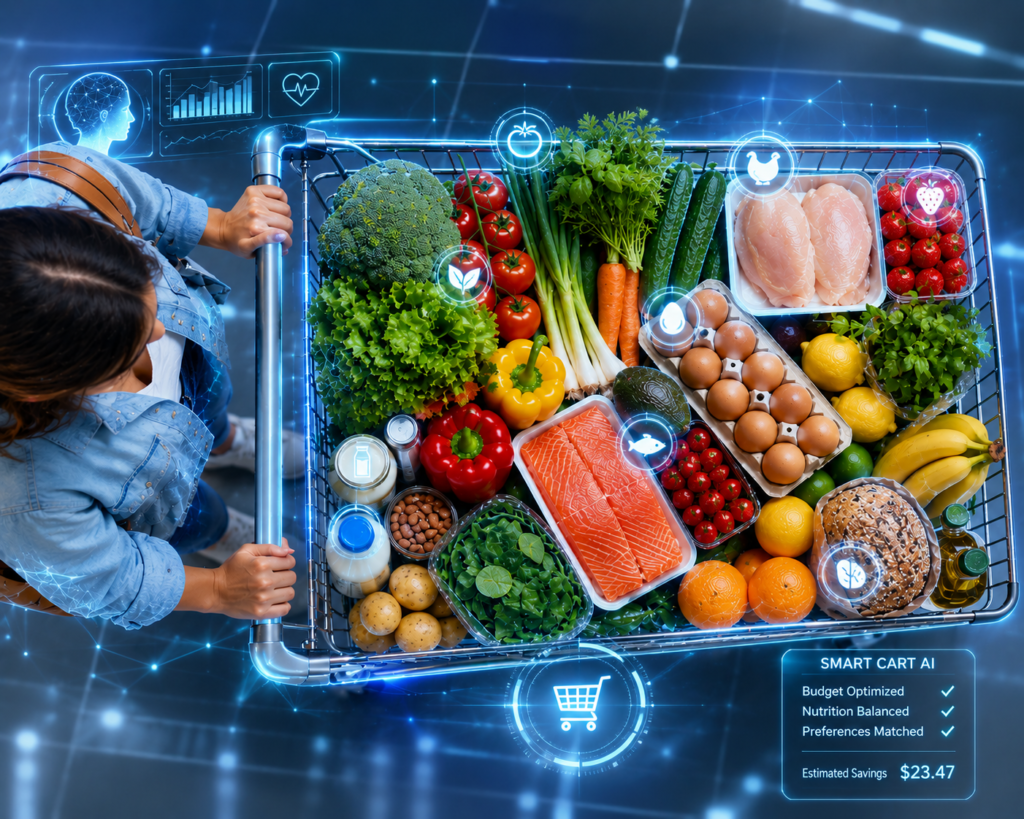
Here’s the grocery-specific insight that matters: the unit of competitive advantage is no longer the storefront, the app, or even the loyalty program. It’s the cart itself — fully assembled, household-aware, and ready to buy before the shopper has spent a single minute deciding.
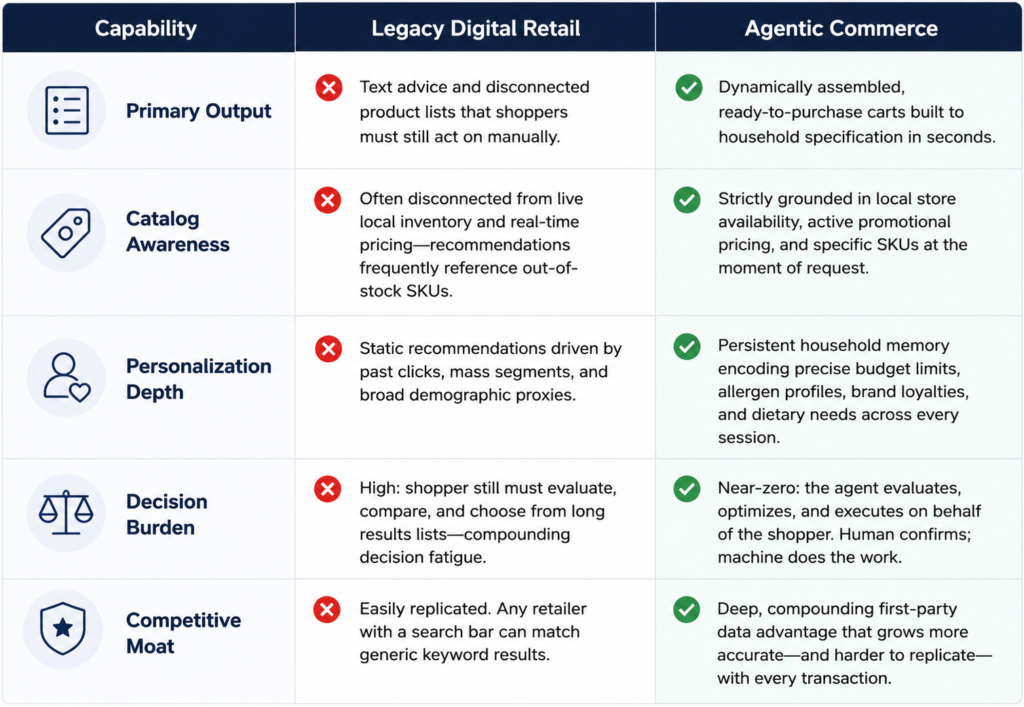
The Perfect Cart is a dynamically built, fully optimized, household-specific basket delivered in response to a single expression of need — “feed my family this week,” “I need a quick gluten-free dinner,” “stock up for the month on a budget.” It is built, not browsed. It runs on two intelligence layers working together: deep product intelligence (knowing what’s actually on the shelf today, down to allergen and nutritional attributes, not just SKU and category) and persistent household memory (knowing this family’s budget ceiling, dietary needs, brand loyalties, and weekly rhythms — learned continuously, not entered once at sign-up).
“The Perfect Cart isn’t a feature. It’s the moment your customer stops shopping and starts trusting.”
A shopper who declines premium substitutions every week is telling you their price ceiling. A household that restocks on a four-week cycle is telling you their consumption pattern. A family searching “easy weeknight dinners” every Monday is telling you they’re depleted by Monday — and a system that’s actually paying attention would have the cart ready before the search happens. This is what separates a retailer who is “using AI” from one who has become genuinely, structurally useful.
III. Why Grocery Is the Agentic Commerce Battleground
Agentic AI as a category is well covered — autonomous agents that plan and execute rather than merely advise. What matters for grocery leadership isn’t the general thesis; it’s where the economics land specifically on your P&L.
McKinsey puts the value of generative AI in retail at $240B–$390B, a 1.2–1.9 point margin opportunity [3]. In grocery, that value shows up in three very concrete places: fewer abandoned carts because the cart was never hard to build; larger baskets because the agent surfaces relevant items a tired shopper would never search for; and faster reorder cycles because the system already knows what’s running low at home.
Gartner expects AI agents to autonomously handle 15% of everyday business decisions by 2028 [4]. For a grocer, that 15% isn’t abstract — it’s the decision of what goes in the cart this week, made correctly, by an agent that already knows the household better than a generic search bar ever could.
The Agentic Divide: What Separates the Future from the Past
IV. What It Takes to Build One
The Perfect Cart sounds simple from the outside. Underneath, it depends on two infrastructure investments most grocers haven’t made yet — and the order in which you make them matters.
First: most retailer catalogs are inventory ledgers, not intelligence systems. They describe a product by SKU, category, brand, and price — not by what it actually does for a household. A protein bar needs to be understood as high-protein, gluten-free, nut-free, low-sugar, suitable for a diabetic-adjacent diet, in stock at three nearby locations, and on promotion at one of them today. Without this depth, an AI-driven substitution during a stockout is a guess dressed up as a recommendation — and in a category where allergens and budgets are real constraints, a confident guess is a liability.
Second: household memory has to be persistent and inferential, not a form filled out once at sign-up. Every accepted substitution, every declined upsell, every four-week restock cycle, every Monday-night “easy dinner” search is a signal. A system that learns from these signals can have next week’s cart ready before the shopper opens the app. A system that doesn’t is just a faster version of the same search bar.
“A cart built on a shallow catalog isn’t a Perfect Cart — it’s a confident guess.”
The sequencing matters: product intelligence has to come first. An agentic layer built on top of a shallow catalog will produce fast, confident, occasionally wrong recommendations — and in grocery, “occasionally wrong” means an allergen slip-up or a budget-busting substitution, which destroys trust faster than slow service ever could.
V. The Competitive Window Is Narrowing
The executives who will look back on this moment with regret are not those who moved and failed. They are those who waited for certainty that never came—while their competitors were building an advantage that compounds with every passing week.
Consumer adoption of AI in shopping is not gradual—it is accelerating. Eighty-one percent of shoppers report having recently used AI for shopping or product research [2], and 24% explicitly state that AI has already helped reduce their shopping-related decision fatigue [2]. These are not early adopters. These are mainstream consumers who have already formed expectations that your digital experience will be held against.
By 2029, agentic AI is projected to autonomously resolve 80% of common customer service interactions—driving substantial operational cost reduction alongside elevated satisfaction metrics [4]. For grocers, this is not a cost story alone. It is a loyalty story. Every friction-free interaction is a deposit into a relationship account that becomes extraordinarily difficult for competitors to draw down.
Regional and specialty grocers face a specific strategic reality that national banners must also reckon with: the third-party platform ecosystem is not neutral. Instacart, DoorDash, and their peers provide fulfillment infrastructure—but they extract data, margin, and customer relationship ownership in return. Every order fulfilled through a third-party platform is a transaction that enriches someone else’s understanding of your customer. Agentic, first-party AI inverts this equation. The grocer who owns the intelligence owns the relationship.
This is the competitive moat that cannot be purchased off-the-shelf or replicated in a quarter. It is built through consistent, compounding investment in household data, product intelligence, and the agentic systems that synthesize them. It deepens with every household served. It is, in the truest sense, a durable advantage.

VI. The Leadership Mandate: An 18-Month Imperative
Strategy without urgency is aspiration. The window for leadership in agentic grocery commerce is open today. It will not remain open indefinitely.
For C-suite leaders at national and regional grocers, the mandate is not to evaluate whether agentic AI matters—the evidence is conclusive that it does. The mandate is to determine the pace and architecture of your commitment, because both will define your competitive position entering the next decade.
The 18-month priority framework looks like this:
- Audit your current personalization infrastructure honestly. Most retailers discover that their “personalization” is, in practice, segmentation. Segments do not feel personal. They feel generic. Identify the gap between what your data knows and what your systems do with that knowledge.
- Invest in product intelligence infrastructure before you invest in front-end AI features. The quality of the agentic output is entirely dependent on the depth of the product knowledge base it draws from. A cart built on shallow catalog data is not a Perfect Cart—it is a confident guess.
- Establish a first-party data strategy that reduces dependence on third-party platforms for customer insight. Every direct digital interaction is an intelligence-building opportunity. Treat it accordingly.
- Define success by time saved, not just revenue generated. Basket size and conversion rate are necessary metrics. Time-to-cart, decision interactions per session, and repeat engagement without prompting are the leading indicators of genuine agentic value. Measure what the customer experiences, not only what the transaction records.
- Move from pilot to platform within 12 months. Agentic AI requires scale to deliver compounding value. A proof-of-concept that serves 2% of your digital shoppers generates neither competitive advantage nor meaningful data. Commit to deployment at a scale that creates real household memory, real behavioral signal, and real organizational learning.
The Bottom Line
Grocery has always competed on price, assortment, and convenience. A new axis has opened: cognitive ease. The retailer who collapses the distance between “I need to feed my family this week” and “my cart is ready” becomes something no loyalty program can replicate — genuinely, consistently useful.
The architecture exists. Consumer appetite is proven. The window is open for roughly 18 months before this advantage compounds toward whichever grocer — or platform — moves first.
The Perfect Cart isn’t a feature. It’s a strategic posture toward your customers’ most scarce resource: their time. The retailers who commit now won’t just grow share — they’ll own the household.
References & Data Sources
1 Supermarket News. “Grocery shoppers still shifting behaviors due to inflation, rising fuel costs.” Consumer survey data, 2025–2026. [Source: Supermarket News industry research]
2 Klaviyo. “AI-Driven Future: Predictions & Trends for the CRM Market.” Klaviyo Research Report, 2025. Consumer adoption figures include AI usage for shopping, decision fatigue reduction, and search overwhelm statistics. [Source: klaviyo.com]
3 McKinsey & Company / Evinent Analytics. “AI in Retail: Solutions to Boost Margins and Loyalty.” Figures cited: $240B–$390B economic value potential from generative AI in retail; 1.2–1.9 percentage point margin improvement; 80% personalization preference rate; 50% incremental spend with personalized brands; 48% consumer satisfaction with current retail personalization. [Source: McKinsey Global Institute; evinent.com]
4 Gartner / Polestar Analytics. “Top 3 Ways AI Agents Are Transforming the Retail Industry.” Projections include: 15% of everyday business decisions handled autonomously by AI agents by 2028; 80% of common customer service issues resolved by agentic AI by 2029. [Source: Gartner 2025 Forecast; polestaranalytics.com]